
- Lucas: Not whether AI, but whose AI? (⏱️ 3 min.)
- Fenja: Three days of doing the splits (⏱️ 1 min.)
- André W: Why re:publica is more to me than just a conference (⏱️ 4 min.)
- André S: Between technical self-empowerment and defending the foundations of democracy (⏱️ 8 min.)
- Magdalena: The bubble accusation: who gets to take part in re:publica? (⏱️5 min.)
- Fenja: Where were the men, actually? (⏱️ 1 min.)
- Magdalena: The “Ponyhof” accusation: who’s actually being naive here? (⏱️ 2 min.)
- Magdalena: Shaping the future means defending democracy (⏱️ 2 min.)
- Conclusion: up for shaping the future (⏱️ 1 min.)

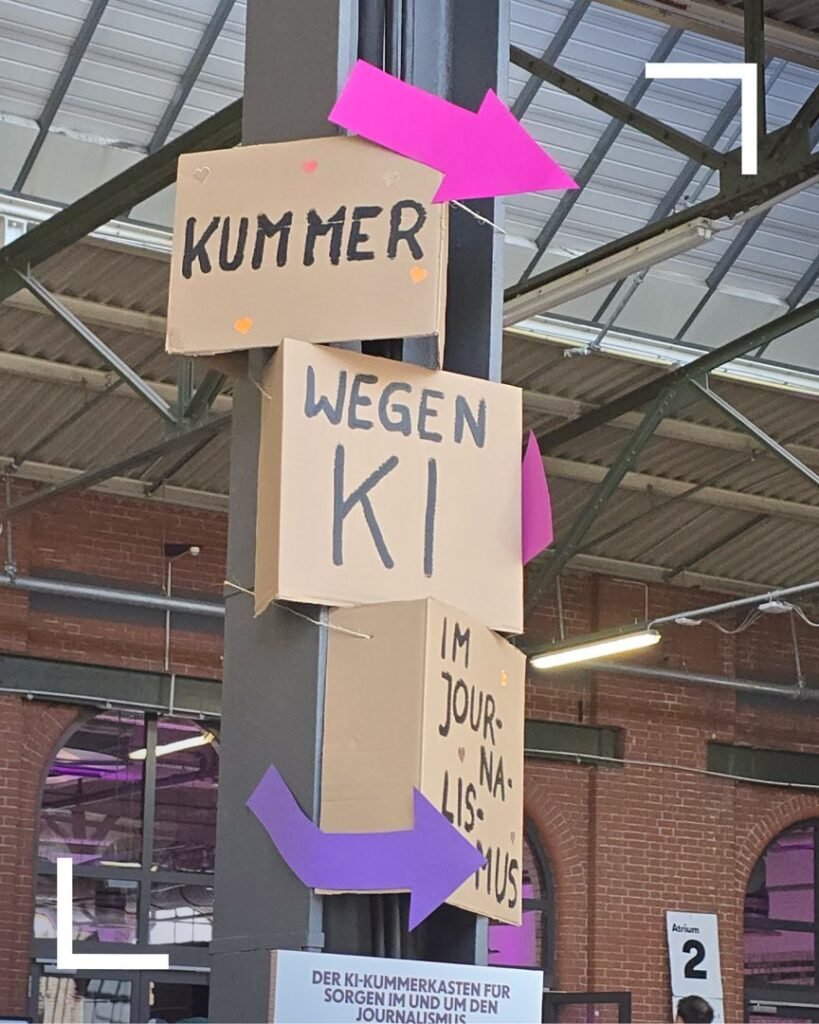
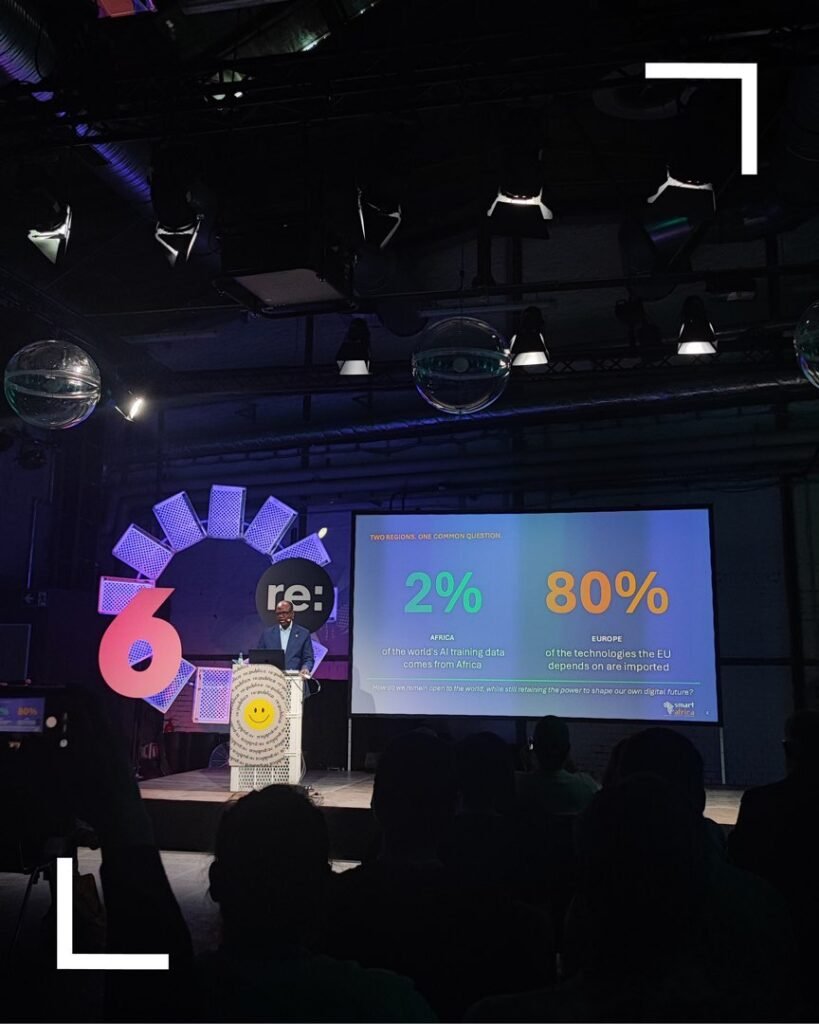
Not whether AI, but whose AI?
Three days of re:publica, and I leave with one question: not whether AI, but whose AI?
Karen Hao set the tone with her opening keynote – she's just published a book about OpenAI that describes from the inside how a research lab turned into a corporation with an imperial logic. Her image for the two ways of building AI models: rockets versus bicycles. The rockets are the general-purpose models we all use – ChatGPT, Gemini, Claude — driven by the mantra "scale at all costs." The bicycles are the counter-model: small, specialised systems like AlphaFold, which solved problems in protein research that science had failed to crack for decades. Hao's punchline: "Scaling is not bringing us innovation, it's costing us innovation." The costs are measurable: by the end of the decade, AI data centres could consume one and a half to three and a half times Germany's annual electricity generation and the reason the chatbot answers we use every day come across as clean is that click workers in Kenya sort out traumatic content for, in part, 1.46 to 3.74 dollars an hour.
But who is building this AI? This year, “broligarchy” has finally made it into our vocabulary – not as a polemic, but as a sober description. Quinn Slobodian, historian of neoliberalism, has coined the term “Muskism” for it: with Starlink, X and xAI, Musk has built a vertically integrated structure in which political sentiment can be automated. It’s no longer about tech companies offering services, but about players who want to co-govern – to have a say in decisions. Annette Zimmermann (philosopher, AI ethicist) supplied the most precise term for it: AI exceptionalism. The convenient narrative that AI is too complex for democratic control – so the matter is left to the corporations that build it. That’s not a description of the situation but a voluntary surrender of our own agency.
How far this has already gone becomes concrete in Germany: four federal states now use Palantir software for automated police analytics, often without any scientific evaluation. Rainer Mühlhoff (philosopher, Osnabrück University) coined the formula I can’t get out of my head: “AI is a technology for sorting people.” For me, professionally, this leads to the most important shift: digital sovereignty is no longer an idea we discuss on panels. It is a question of infrastructure. Which stack, which models, which cloud, which contracts. If you use other people’s infrastructure, their politics come included. Hito Steyerl put it in two sentences: “Start building your own stack.” And: “Friction is the medium of reality.” Friction is not a bug. Negotiation, delay, dissent – precisely what the tech empires want to optimize away is what makes democracy.
That brings me to the actual core of the three days. According to its subtitle, re:publica is a conference about the digital society, but in substance it’s a conference about democracy under technological conditions. No matter which talk – the underlying theme was the same: a democratic society is not background noise against which technology unfolds, but an achievement in its own right that has to be actively defended against the logic of the tech empires. That doesn’t happen through grand gestures, but in inconspicuous things: which software a public authority buys, which model we build into our tools, which questions we ask before we procure a solution.
What I’m taking away for our work at Schaltzeit: AI remains a central tool, but the question of which AI we use and who owns it is becoming more important than whether we use it. The future is built, not predicted. The only question is by whom – and whether we get involved.

Three days of balancing
Honestly, it wasn’t a single talk that stuck with me, but the variety of topics that impressed me: one morning I sat in on the Bundesbank talking about the digital euro (surprisingly not dry), in the afternoon I was in Atrium 1 somewhere between Marinetti’s 1909 Futurist Manifesto and today’s accelerationists like Nick Land, and in between I listened to Düzen Tekkal speak about digital violence – 96 percent of all deepfakes are sexualized content, and 99 percent of those target women.
This variety is exhausting, but it’s also the point. Rarely have I felt so clearly at a conference that the topics we discuss separately – tech ideology, democracy, misogyny, infrastructure, sovereignty – somehow hang from the same thread.
Johannes summed it up in his talk on tech hype: “The future is built, not predicted.” As a futurist, that stuck with me right away. For three days, the same question of power from several directions: who is actually building what here – and who gets to be part of it?
What stays with me: it’s nice to spend three days in a bubble where values are shared.
Never Gonna Give You Up – why re:publica is more than just a conference for me
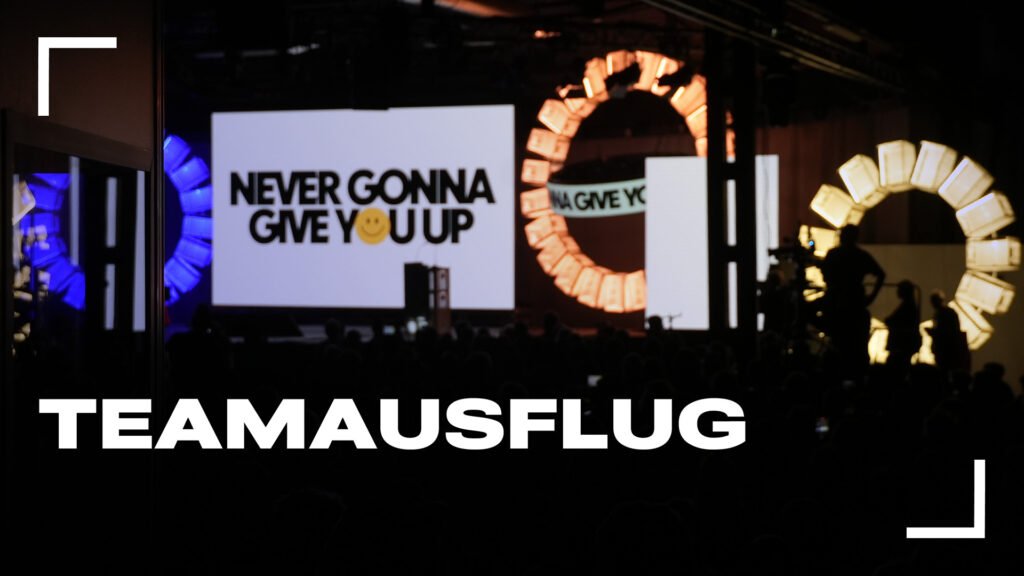
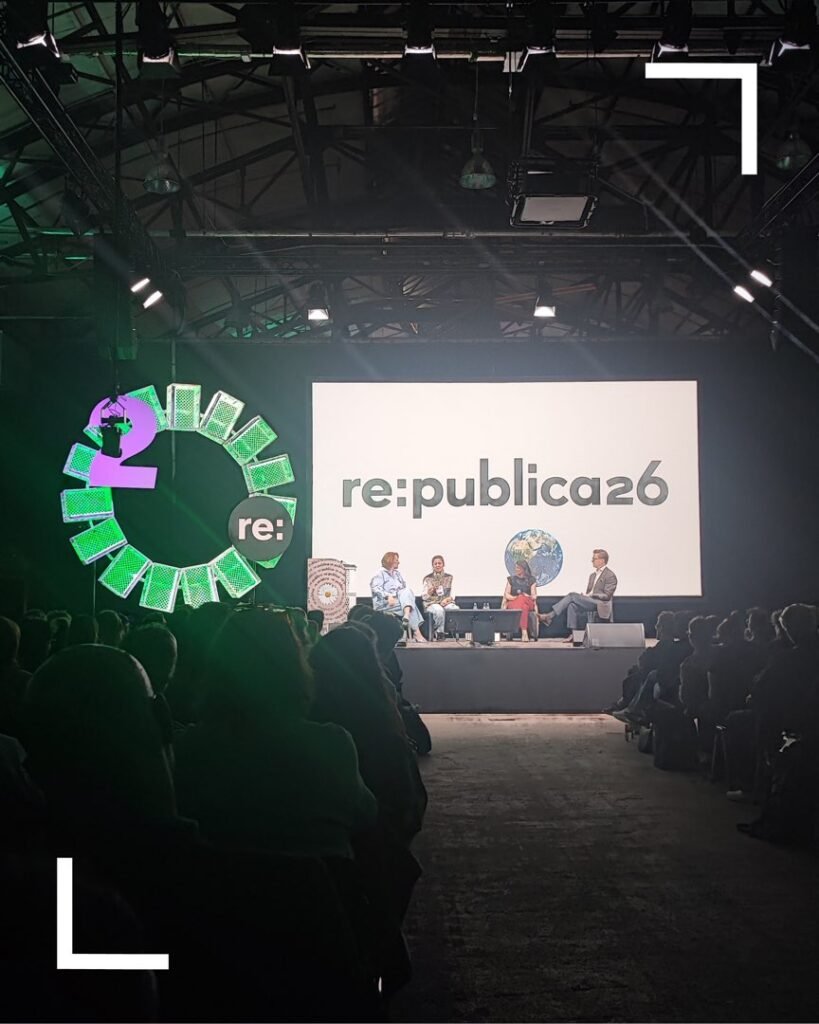
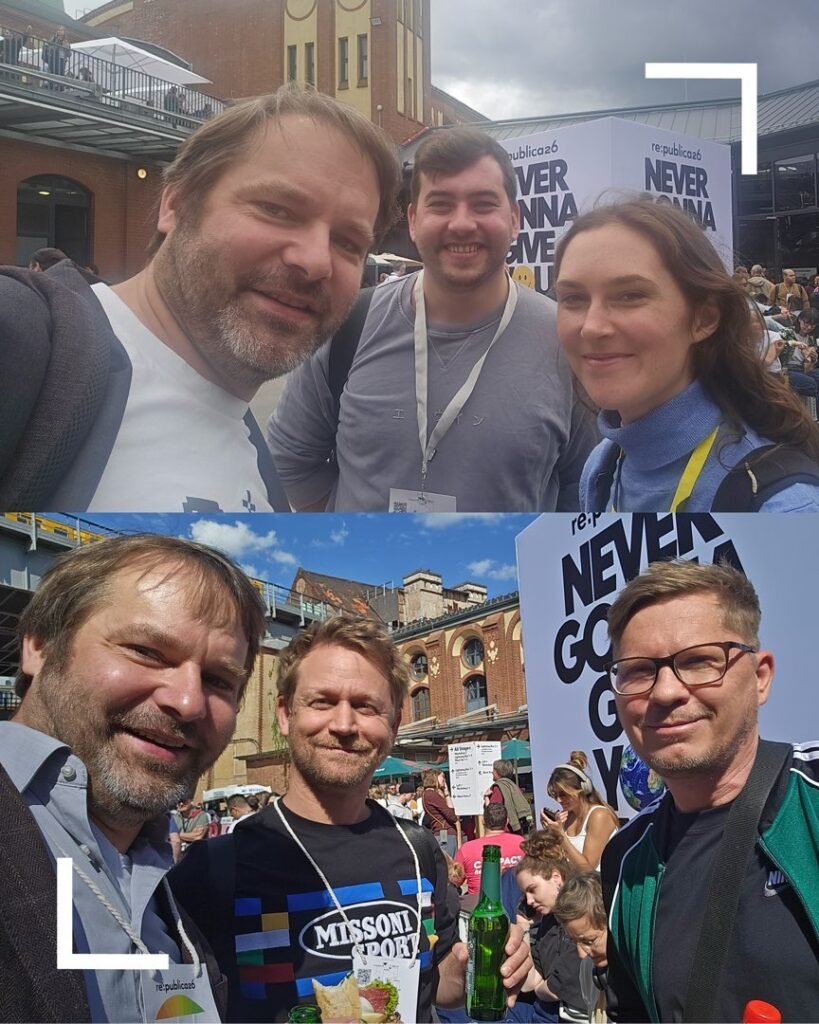
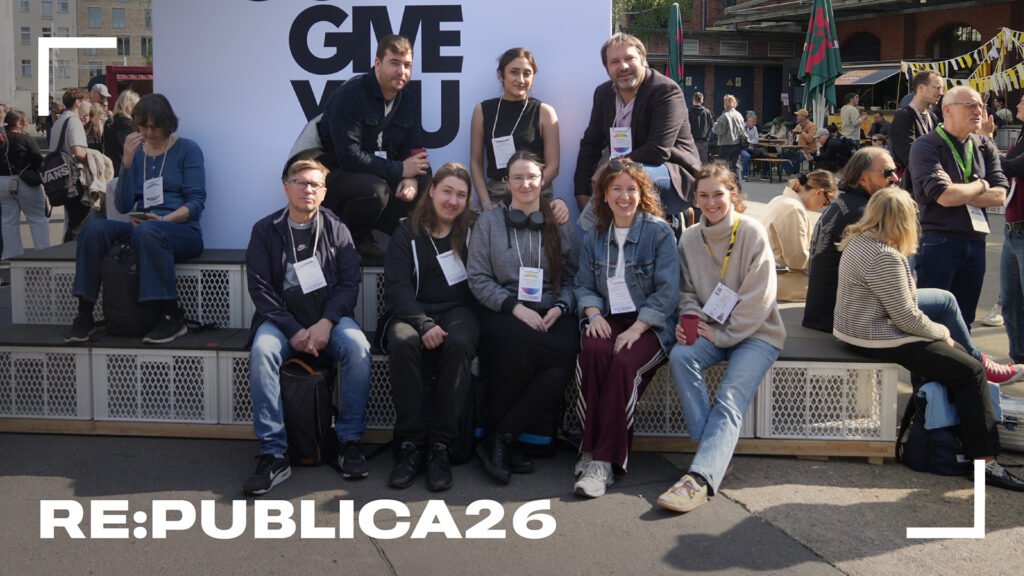
re:publica – a team outing for the entire Schaltzeit crew every year.
The well-known people behind re:publica include Tanja Haeusler, Markus Beckedahl, Johnny Haeusler and Andreas Gebhard. I have a great deal of respect for this organizing team, for this format, for the complexity of this event! Together with a team of around 25 people and several hundred volunteers, they manage the 1,000+ speakers. The program is to be live-streamed, made available as audio in various languages and then accessible to everyone via an app. The Wi-Fi has to work – for 30,000 people. Choosing content and speakers is surely a tough job, too, because the exchange has to work internationally as well. But content should also achieve reach at no cost. It has to be edited and published.
It’s political. The tech industry as a so-called “broligarchy” is no longer glorified, because our understanding of tech and money means we have to think about our own tech sovereignty.
The motto “Never Gonna Give You Up” is a call to action: “re:publica and all the people behind it: believe in us and don’t give up on us! And we mustn’t give up on ourselves either!”
Very often, it’s a situation in which we have to consciously give up convenience in order to control the consequences. We humans aren’t always ready to do that. But how does a civil society defend itself? How do we defend ourselves against right-wing authoritarianism?
For me, re:publica is above all one thing: a place for reflection. About us, about myself and about the changes the future will bring. As a man and a father, I deliberately attended sessions on feminism & digital violence. Ingrid Brodnig’s systematization was an eye-opener. I found the signed book, with its systematization of the forms of belittling and degrading women, very insightful. For raising my son, too.
On polarization, I found Nils C. Kumpkar’s talk very exciting. We use the construct of polarization to create urgency for our own issues. In other words, no matter which party or which issue, creating enemy images ensures that we draw attention to our issues. And urgency is quickly generated, too. Whether it’s the decline of the West, “foreign infiltration” of one’s own country, ecological biocide or a population that supposedly no longer wants to work. Seize a moment, create an image and connect the issues so that an emotional kick sets in, outrage or approval. Then no arguments are needed anymore.
This week also sees the start of the Enhanced Games, which are highly controversial. But what if we can tune not only our bodies but also our brains? Psychotechnology enables us to develop neural networks in our brains better and faster – Surjo R. Soekadar impressively showed that this new form can also lead to more inclusion and that mental illnesses such as PTSD can be treated effectively. Of course, here too we will optimize in a data-driven way. Whether out of ambition or to get the ultimate trip. Responsible innovation also means focusing on more self-determination and mental freedom.
These days, three days of conference are a real luxury. On the third day, I had to catch an ICE train to Frankfurt. Thanks to the app and a power bank, I was able to follow along without interruption for the entire train ride. My compliments to Deutsche Bahn and to the re:publica livestream. I listened intently to Frauke Fischer, who talked about whether AI can save nature. In her talk, our ecosystem became an eco-warning system. AI recognizes animals such as whale sharks by their markings. Changes in animals within their habitats, combined with all that data, tell us what works and which connections exist in nature.
Unfortunately, there was no joint closing sing-along for me this year. But one thing is clear: we’ll be back next year. It does my soul good to meet so many people who don’t simply accept that the world is the way it is. Who think about which boundaries we need and what, all in all, is good for us as a society.
True to that motto, I firmly believe in all of you. I will… “Never Gonna Give You Up”!

Between technological self-empowerment and defending democratic foundations
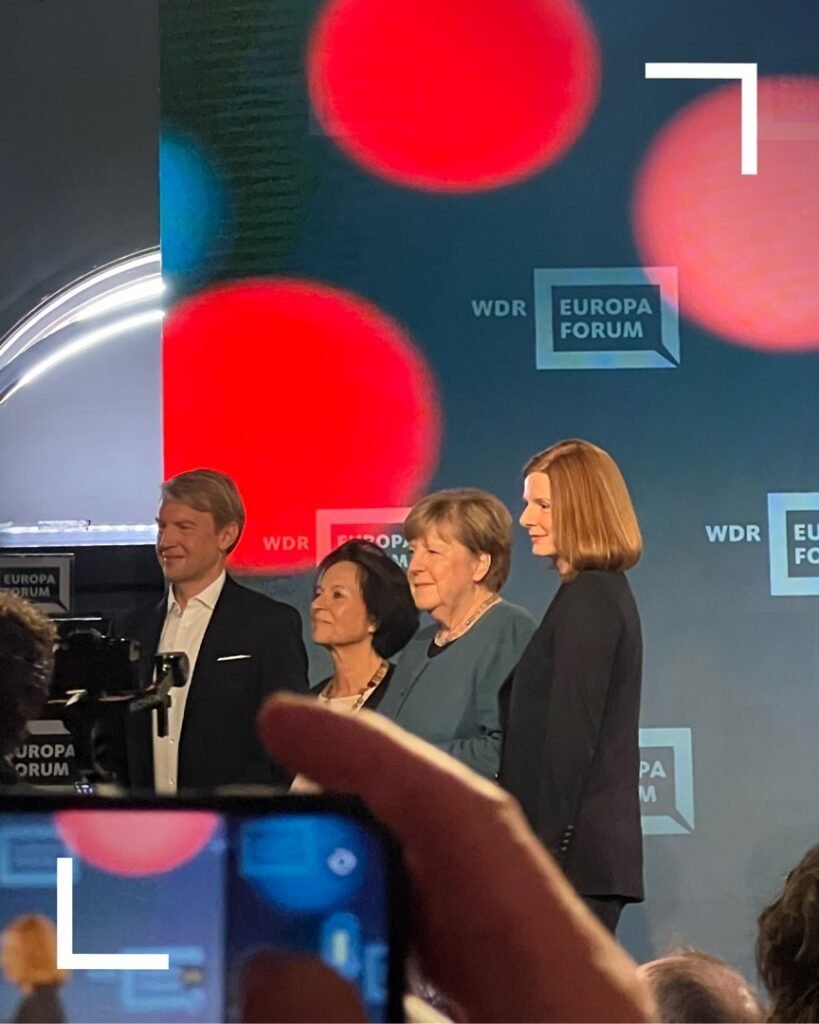
This year, re:publica felt like an intense stocktaking of our digital civilization, wavering between technological self-empowerment and the defense of democratic foundations. My review inevitably begins with Angela Merkel, who, as a “political citizen” at the WDR Europe Forum, radiated an almost prophetic calm. She reflected very openly on how the internet has changed political work. In view of the current upheavals, she soberly observed: “I believe that digitalization, through the many so-called social media, has even made it harder to have stability”.
Asked about a possible role as a mediator in the war against Ukraine, the former chancellor gave a clear no, as she is convinced that such mediation is inseparably tied to current political power and therefore lies with those in office today. “Personally, it wouldn’t have occurred to me to ask a mediator to go to Minsk for me and talk to Putin like that. […] These are politicians acting today.” Her plea for an inclusive notion of “the people” was also powerful: “The AfD is trying to define who the people are. And I can only ask everyone in this hall and everyone watching: every German citizen is the people. And nobody gets to divide that up. You are the people and you are the elite. I am the people and you are all the people and together we are the people. And these are the things: compromise, facts – and every German citizen has the same rights and duties and belongs to the German people.” When she conceded that it was important, above all, not to keep defining oneself indirectly through the AfD, there was a lot of applause. She warned emphatically that moods must never replace facts, otherwise we are “really on the wrong track”.
Carline Mohr summed up in “Of course nobody’s listening to you!” that many politicians and CEOs have long since lost touch with this fact-check and with today’s reality. She diagnosed a deep crisis among power players who still communicate as if it were 1987, while the world around them has long since gone digital. In this context, it became clear that the technological upgrade through AI often only makes the problem worse, since AI-generated texts usually remain alarmingly mediocre and merely flood the digital space as “AI slop”. This mediocrity means that real attention gets lost in a sea of generated content – and in the end, nobody is listening after all.
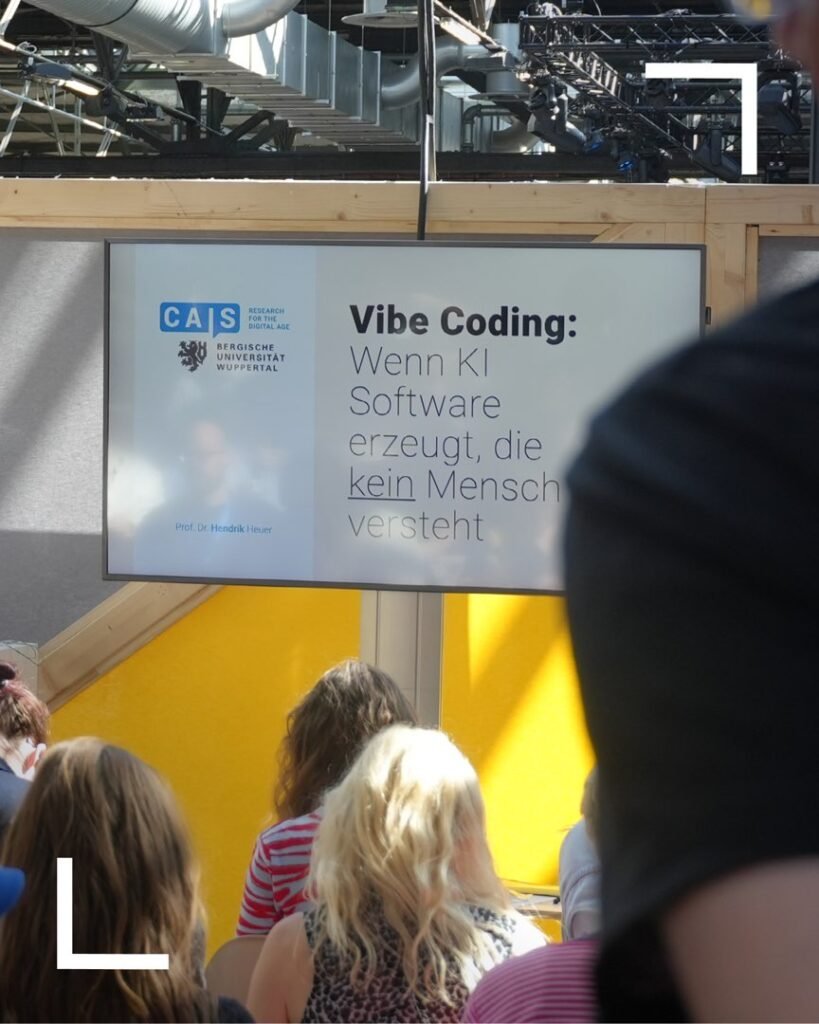
A technological counter-model to this powerlessness of the “old world” came from the talk “OpenClaw – Anatomy of the Coming Wave” by Stephan Noller and Benedikt Köhler, which, incidentally, had what were for me the best slides and the sleekest slide design of the entire conference. Their solution “HybridClaw” shows that powerful AI agents don’t need “a gigawatt data center” but can be run sovereignly on a Raspberry Pi in your own network. It immediately made me want to self-host LLMs from now on instead of turning every thought into expensive tokens that only fill the coffers of the big AI tech companies. Projects like OpenClaw or HybridClaw are essentially “friction in practice” instead of a Silicon Valley vacuum, since you can define and trace every step of the machine in simple text files. This technical independence only works, however, if we truly master the possibilities on offer – something Hendrik Heuer, in his talk on “vibe coding”, put under critical scrutiny. English may now be the “hottest new programming language”, but Heuer also warned against the fallacy of speed. The problem is that with “vibe coding” – the rapid generation of code by AI – the most important groundwork, the clarification and testing, is often simply skipped at the level of detail it requires. Software is behavior, and that behavior has to be safe in complex situations instead of going online untested, where it can endanger real people and organizations.
This loss of control and understanding at the technical level is mirrored in political dependence, which Annette Zimmermann, like many others, called the “broligarchy”. She also criticized politics’ “learned helplessness” toward tech giants and demanded that the power to shape AI be returned to the citizenry as a whole (the demos). Just how manipulable these systems are was shown by the “AI stress test” on the topic of milk, in which Simone K. Frey and Jakob Vicari demonstrated once again how blatantly AIs tend toward “sycophancy” (brown-nosing) and often just tell us what we want to hear instead of delivering facts. Global models fail especially when it comes to regional knowledge: one AI wrongly claimed that under Germany’s “housing level 1” label, cows “are permanently kept in the barn and often tethered” – a piece of information that is simply wrong.
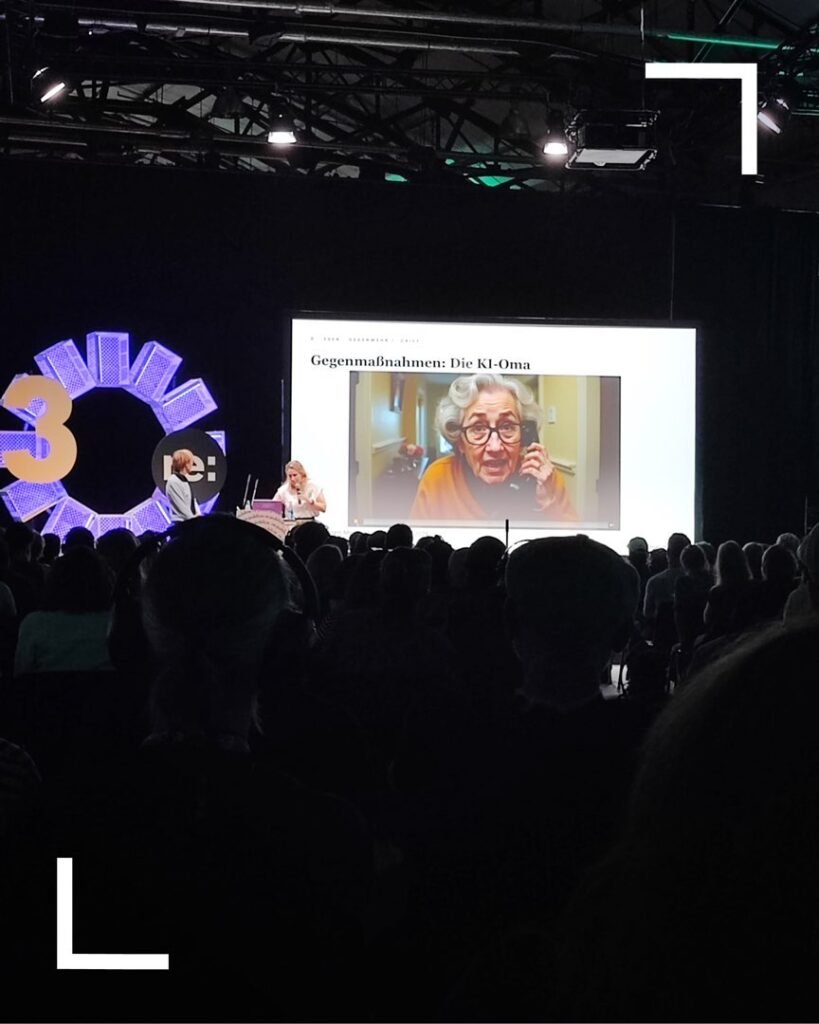
Just how creatively – and revealingly – today’s technical possibilities can be used was demonstrated by the investigative session “Talk with Elon”. Tech journalist Eva Wolfangel reported how, in March 2025 – after initially ignoring a message on Signal – she decided to play along with an “Elon Musk” scammer. She posed as a journalist with marketing expertise and actually managed to get “hired” by the scammer for SpaceX and Tesla. In doing so, she turned the tables and used AI heavily against the fraudster herself, having ChatGPT create highly professional marketing concepts and presentations to keep the scammer happy. At the same time, she deliberately built “friction” into the process by inventing, with ChatGPT’s help, two fictitious tax advisors – Dr. Hartwick and Eduard Gundlach – who made the scammer’s life difficult and kept demanding new documents.
The climax of this “counterattack” was an almost absurd form of time theft: Eva Wolfangel sent the scammer AI-generated images of Steam gift cards. Since the codes visible in the images didn’t work, she forced the fraudster to painstakingly type the numbers in by hand and get annoyed by error messages. To confuse the scammer completely, she finally sent him an AI-generated photo of the “real” Elon Musk holding exactly these fake cards, with the cheeky remark that she had already sent the cards to the “real” Elon. What developed was a bizarre “postmodern endgame” in which a scammer bot and a journalist faced off until the fraudster asked, exasperated: “What the fuck are you the real scammer?”. With this experiment, Eva Wolfangel showed that AI isn’t just a tool for criminals but, with humor and creativity, can also be used for education and defense.
But while we’re still laughing about scammers, the state is arming itself with “Palantir laws” that deeply infringe on our fundamental rights. In the session by Franziska Görlitz and Constanze Kurz it became clear that we are at a critical tipping point. The US company Palantir, a longtime military contractor, provides software with its product “Gotham” (in Germany often known under names like HessenDATA) that the company itself advertises as a “digital weapon”. Behind the company stand figures as dazzling as they are controversial, such as billionaire Peter Thiel (an early Trump supporter) and CEO Alex Karp, who cultivates a “mad scientist” image and proudly positions his company as completely “anti-woke”. In the US, the software is already being used to locate and deport people – images that should serve as a warning of what is technically possible with such tools.
In Germany, the software is in use in various federal states. The problem lies in the legal basis for these automated data analyses, which allow the police to merge huge, heterogeneous data sets in order to generate “new knowledge”. In the process, data from completely law-abiding citizens is analyzed en masse – people who ended up in police databases as witnesses to an accident or victims of bicycle theft, for example. This leads to a massive “chilling effect”: people start changing their behavior and avoid demonstrations or political meetings just so they don’t mistakenly end up in an algorithm’s crosshairs. This also affects, for example, (mediating) fan liaison officers in soccer, who are naturally always found near violent fans in order to assess and defuse situations. Although in a landmark 2023 ruling, the Federal Constitutional Court decided that such analyses are only permissible in the case of specific threats to particularly important legal interests and that lawmakers must give the police strict guidance, this is often ignored in practice. In Hesse, for example, the legal “guidance” on avoiding algorithmic discrimination consists of just a single, vague sentence, which experts criticize as a blatant disregard of the ruling. Moreover, there are still no independent scientific evaluations to prove that these multimillion-euro tools actually make threat prevention more effective. Instead, the federal states are entering into a dangerous dependency on a private US company (vendor lock-in) that gains access to sensitive police insider knowledge. Particularly worrying is the trend to extend these powers to intelligence services such as the Federal Office for the Protection of the Constitution, often even without a sufficient legal basis. If we don’t stop this development, our democratic civil liberties risk being gradually eroded by algorithmic mass surveillance.
One of the most sobering points of the conference overall was the engagement with digital fascism. It is alarming how the AfD uses AI-generated content and conventionally attractive avatars like “Larissa Wagner” to build parasocial relationships with voters and spread disinformation. These strategies were examined in several talks, along with warnings about an “authoritarian overhaul” that often begins unspectacularly in the “dark corners” of ministries and can paralyze critical civil society by cutting budget items. Max (Maximal Demokratisch) spoke about the personal dangers and threats, the kind you face when you stand up to the right-wing mainstream in small towns. He called on journalists and creators to leave “disaster mode” and to also share positive democratic news from regions like Saxony-Anhalt, so that right-wing dominance doesn’t become the norm. In this context, Arne Semsrott also called for building “counterpower”, in order to counter the authoritarian turn with structures of our own and productive conflict.
re:publica 26 was thus once again a loud wake-up call. It is our duty to actively confront algorithmically driven hate and to regain digital sovereignty before the line between fact and fiction is torn down for good.
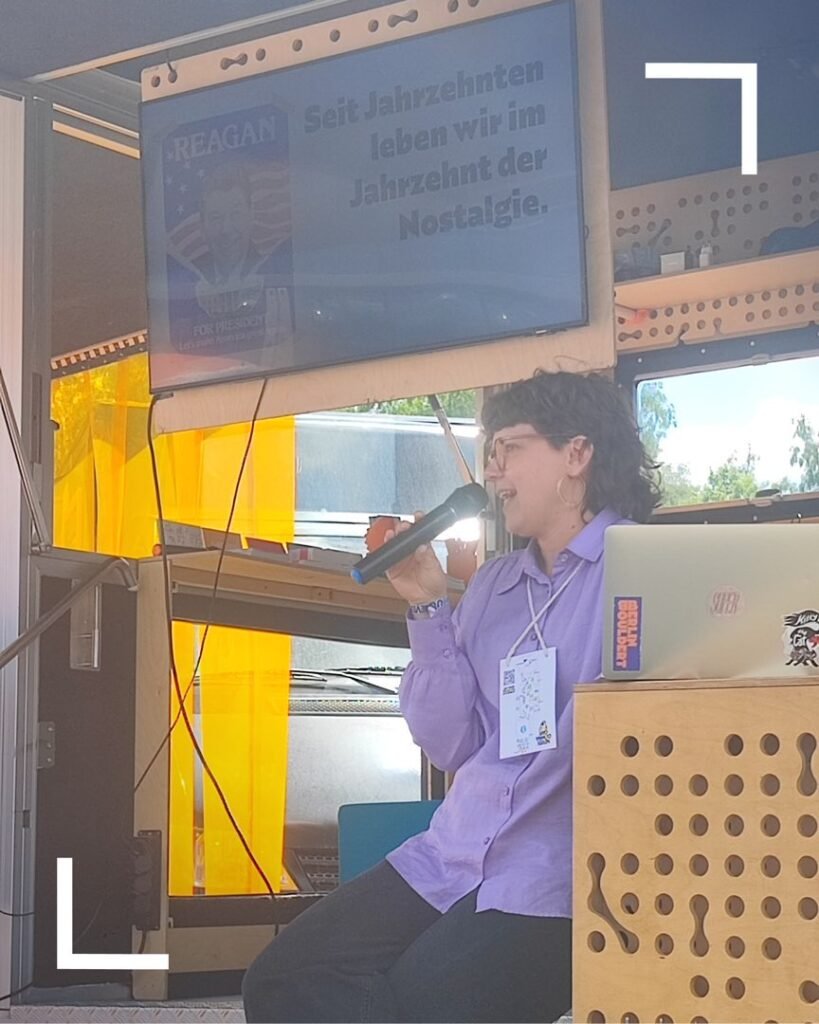
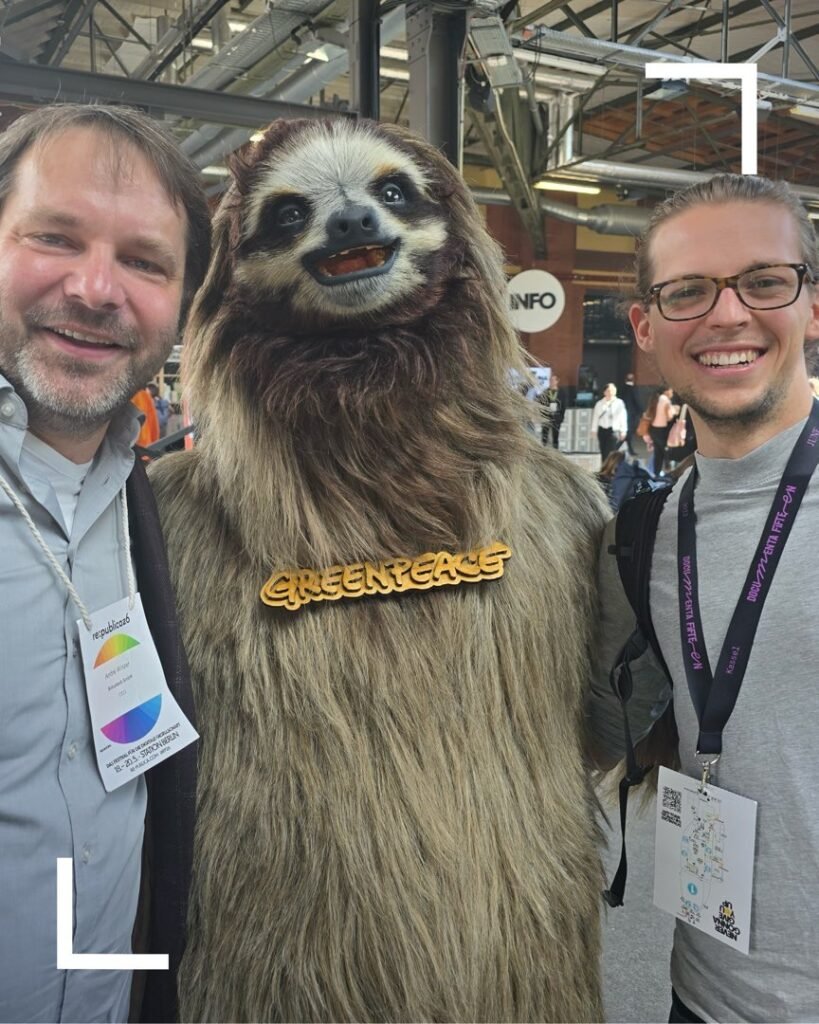

The bubble accusation: who gets to take part in re:publica?
The future is political. And so is re:publica, where so many questions about the future are negotiated. If you’re interested in nuanced, constructive debates on climate protection, AI, tech oligopolies, democracy or other sociopolitical issues, this is the place for you.
The conference is often accused of having a progressive slant – as if it were a closed-off comfort zone of “ideological purity” for the “enlightened urban class”, as a recent piece in Spiegel put it. True, a broad spectrum of democratic parties is represented, with speakers from Die Linke to the CSU, but you quickly notice who gets more applause from the audience. So the accusation that the “left-green” bubble is overrepresented at the event may not be entirely unfounded. A modest comment on that:
I don’t think that’s a bad thing. On the contrary: it feels good to spend three days a year at an event that primarily discusses progressive ideas from different angles and looks for ways to make our democracy fit for the future. In a “to some extent utopian space with a strong community spirit”, as Isabella Hermann put it on a panel. It feels good to follow discussions that aren’t – as in so many talk shows – bent out of shape by false balance.
In my view, everyone is welcome at re:publica who can agree on a constructive compass that respects human dignity. That this mainly appeals to progressives is not, in my view, re:publica’s problem.
For example, last year Friedrich Merz also made an appearance – a man who likes to see himself as part of the middle class and the center of society. Did he stay away this year because Merkel was there? I don’t know. In any case, there’s no sign of the bubble deliberately shutting itself off from conservative voices. Federal Digital Minister Karsten Wildberger (CDU), for example, was once again among the prominent speakers. Is Markus Söder – who this year was defended by his party colleague Markus Blume on a re:publica stage – not there in person because only veggie burgers were on the menu? Or because instead of beer-tent applause, nuanced debates about the future await him? I don’t know that either. But joking aside. My impression is not that conservative positions are excluded from the conference – that some worldviews don’t feel comfortable with the conference’s topics and critical debates and prefer to stay away is another matter.
In any case, I don’t share the criticism of a lack of inclusivity when it comes to the sociopolitical spectrum. On another level, however, I think the accusation is spot on: the socioeconomic one. Who can afford a 360-euro ticket privately? Who has a job that just allows three working days of educational leave? Who has the capacity to prepare a talk? In short: why is it mainly privileged people who get to join the discussion about shaping tomorrow in the “utopian space”?
As far as I know, there are no reliable figures on the social makeup of the audience, but my gut feeling is that the upper middle class is overrepresented. So the question of who has access to the debates about the future at re:publica is also a question of class.
The panel “Invisible Order? What Class Means Today” made exactly that unexpectedly visible. The idea was for Geraldine de Bastion to moderate a conversation in which Mareice Kaiser and Hanno Sauer discuss how we can talk about class today. Both have written a book on the subject. He: a philosopher with a PhD, raised in a family of professors. She: a journalist from a working-class family who initially couldn’t afford to go to university. So one perspective “from above” and one “from below”.
One point that made big waves was the comparison of the two authors’ book advances: 160,000 euros for him. 15,000 euros for her. His book was on display at the re:publica signing table, hers wasn’t. Originally, only he had been invited as a speaker; she was supposed to moderate the conversation. However, she insisted on being able to represent her own perspective as a speaker on the panel.
But the issue of class became most visible when Mareice suddenly brought Agnieszka onto the stage – a worker from the kitchen of the Charité hospital. A woman who is currently fighting through strikes for higher wages so that her work pays enough to live on. You could see how much courage it took her to speak on that stage. Agnieszka made clear what she often misses in such debates: the voices of those being talked about. When classism is discussed, she says, it’s almost always those from the upper groups who speak – “the people from the lowest groups like me have no voice or chance to be visible”.
Her appeal to the audience: solidarity with strikers. This solidarity can take different forms, she explains. Donating money is one, but more important is that society understands why people strike: not out of ingratitude, but because there’s no other way. She herself has never been unemployed since arriving in Germany. She isn’t fighting for money to buy a car or an apartment, but so that her salary covers rent and food. And she is fed up with migrants like her only ever being talked about negatively in public.
To make her world easier for us in the audience to imagine, she told us what the €200 pay raise they fought for last year did for her life: it gave her the courage to leave a violent partner. As a single mother, she is now afraid when she hears about all the cuts.
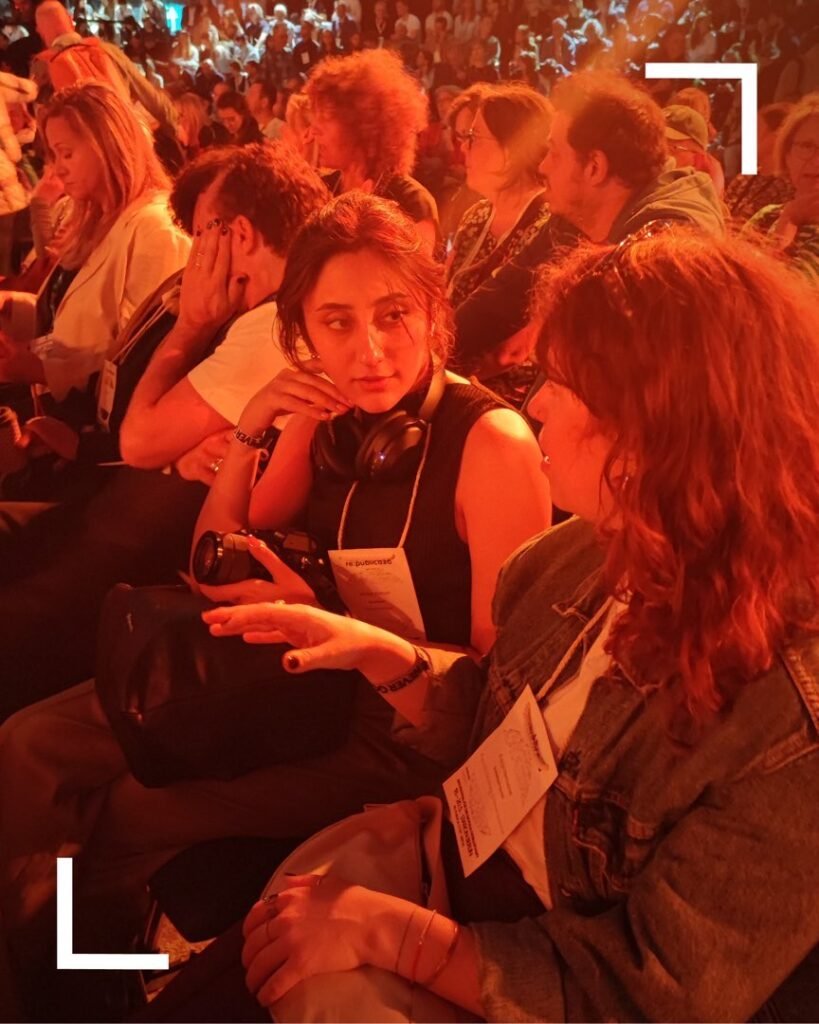
Sitting in the audience, I felt overwhelmingly aware of the bubble I was in: for three days I listen to eloquent, well-read people who discuss, among other things, better working conditions and fairer prosperity – while those who fight for exactly that under the harshest conditions have hardly any access. For Agnieszka, a €200 raise changes her life. My employer simply treated me to a €360 ticket for the conference.
To be fair: classism was also addressed in other parts of the re:publica program, and voices of people affected by poverty were represented. But mostly by people who had already fought their way out of invisibility by other means – such as Malik Yannick Gannouchi, who has built up his visibility on the topic of class through social media.
This is less an accusation against the organizers than a reflection of our society. Under the heading “I don’t earn enough to afford a regular or reduced ticket,” the re:publica website offers ways to earn free access to the conference through the volunteer program. Other options are the free livestream and the later uploads of session recordings on YouTube. But none of these efforts change the fact that you first need three days of time and energy to spare in your working life.
In the spirit of the “utopian space”: wouldn’t it be a nice utopia if re:publica 2027 weren’t mainly attended by people who can easily afford a 360-euro ticket or three days of educational leave? In other words, a bubble that opens up across class lines rather than politically to the right. That would be the more utopian answer to the not entirely unjustified bubble accusation. It would be a level of inclusivity that could break open our bubble constructively – certainly more constructively than the attempt, made on countless political stages already, to include positions whose moral compass lies beyond science and the Basic Law.
Where were the men, actually?
One observation I can’t shake: the stages where activism, powerlessness, digital violence and structural misogyny were discussed were almost exclusively occupied by women. Düzen Tekkal, Luisa Neubauer, Carolin Emcke, Heidi Reichinnek, Tara-Louise Wittwer – and many more. The work of upholding democracy currently seems like a clearly divided business.
An honest counter-question to myself: maybe I simply went to more talks by women because I feel more addressed there? Quite possibly, but the impression remains. Still: we need structural change, not just individual resilience. From everyone!
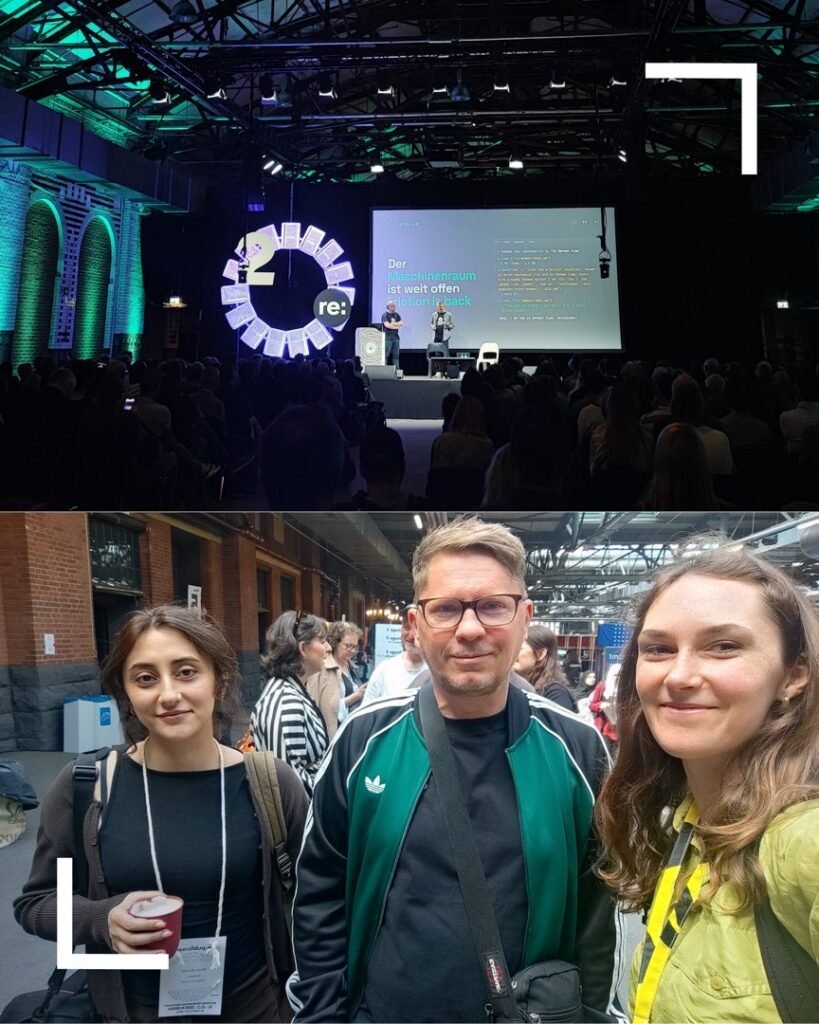
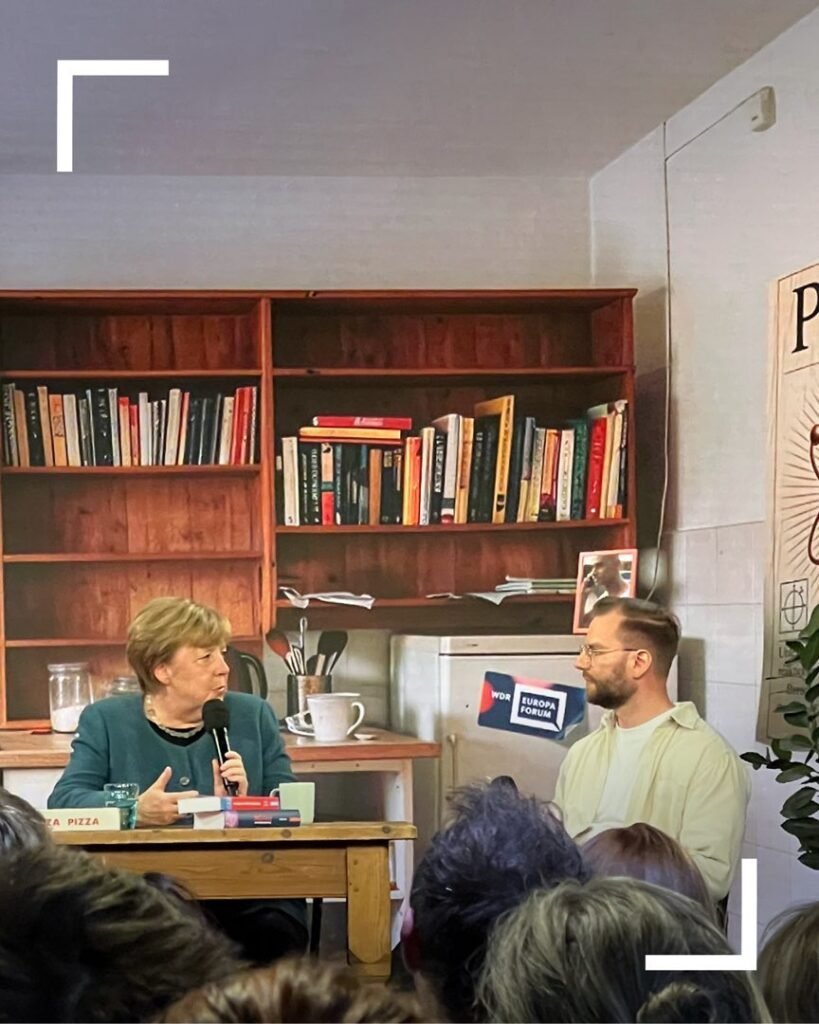
The “la-la land” accusation: who’s really being naive here?
Defending our democracy can’t do without looking at debates about prosperity. That became clear again at this year’s re:publica. Neither the topic is new, nor the realization that different people and parties have wildly different ideas about what prosperity actually means, let alone how to save it.
As a futurist, what interests me most is which images of the future are negotiated in these debates – and which assumptions they are built on. Besides the bubble accusation described above, you often hear that the ideas discussed in re:publica’s debates about the future are somewhat naive. That people need to get back to reality.
In one of the first sessions, Alice Hasters made a call, urging people to push back against exactly this pattern and not let themselves be labeled “naive dreamers”. Not because progressive ideas are above criticism – but because the same reality check delivers interesting results in the other direction, too.
I had to think of that during several re:publica panels. In a round moderated by Michel Friedman, Heidi Reichinnek (Die Linke) and Markus Blume (CSU) agreed: we need an economy fit for the future. Reichinnek admitted that she, too, doesn’t think it’s cool when people laze around (even if there are far fewer of them than the “hundreds of thousands of total refusers” often wrongly portrayed as a large group on talk shows). Blume conceded that “the planet is going belly-up”. The question that divides opinion was, as always: How can we tackle this in a meaningful way? Are the economy and climate protection allies or opponents in the fight for future prosperity?
Blume argued using the example of the car industry – it is one of the foundations of our prosperity and must not be slowed down. Without a functioning economy, so his logic went in Reichinnek’s direction, there would be nothing to redistribute. Friedman dryly interjected that the cars of the future now come from China. Reichinnek pushed back, too: she always has something to redistribute, “because the super-rich keep getting richer”. That’s exactly why it is politics’ job to make economic systems fit for the future.
So are only progressive images of the future naive? Or aren’t those conservative images naive, too, whose basic assumptions defend the combustion-engine economy as the guarantor of prosperity and want to keep a faltering model running under the label of “realism”? Anyone who hopes the electric competition abroad will wait a little longer looks more like a dreamer to me.
Luisa Neubauer pointed to a similar realism gap: our common economic models are simply not designed for what happens when the foundations of our lives collapse. And Eckart von Hirschhausen put it in a nutshell in another talk: the market won’t fix this as long as a ton of CO₂ causes 2,000 euros in damage and costs only 75 euros.
Are images of the future that weigh prosperity & economic growth against climate protection according to the old logic realistic? Are there realistic approaches that think both together? If we’ve learned one thing in futures studies, it’s that business-as-usual images of the future are an unreliable guide precisely when a system is in crisis or undergoing upheaval. So: a reality check is always welcome – but please also for positions that like to call themselves the realists and a sensible counterweight to progressive daydreams.
Shaping the future means defending democracy
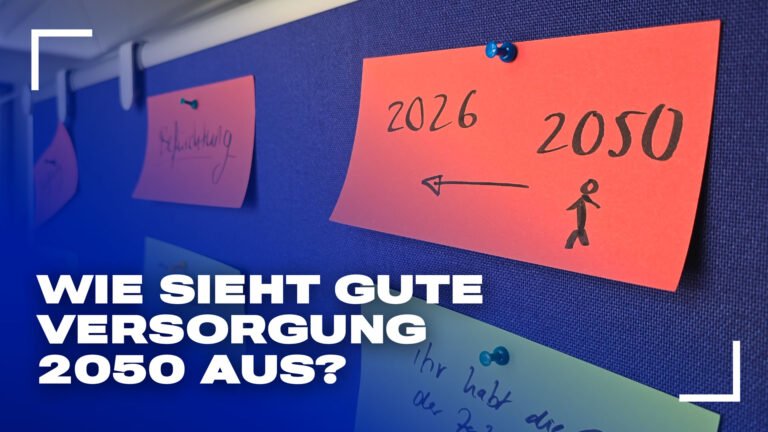
What remains after three days of re:publica from a futures studies perspective? For me, above all this: engaging with the future is not a luxury topic that a society can afford once the acute problems of the present have been solved. It is the very basis for democratic engagement making any sense at all:
If you don’t believe the future can be shaped, you have little reason to stand up for our democracy. For me, this is exactly where the political core of this conference lies, beyond all accusations of bubbles and naivety. Democracy is tedious, slow, often frustrating. It only seems worthwhile if you are convinced that this negotiation can actually lead to something other than what already is. For three days, re:publica defends this conviction against the resignation that so many sides urge on us all year long.
The motto “Never Gonna Give You Up” couldn’t have been a better fit for futures studies. Here, too, it’s about not giving up a confident look ahead – without closing our eyes to the real risks that arise from our present and past. Many talks and workshops over the past three days made it clear: alongside the ubiquitous dystopian headlines, we need an engagement with images of the future that constructively looks for room to shape things.
That’s what makes re:publica more than a conference. It is a plea for an attitude that is quickly lost in everyday life: that the future doesn’t just happen, but is made – and that it matters who helps shape it.

An appetite for shaping the future
Three days of re:publica, many voices, many open notebooks. As different as the perspectives in this post are — they all point in the same direction: the future can be shaped. But only if people actually shape it — and don’t leave that shaping to the big tech platforms, the algorithm or a “learned helplessness”. Democratic society, as became clear every day at re:publica, is not background noise against which technology unfolds. It is an achievement that has to be actively defended and developed further.
That’s exactly what we work for at Schaltzeit. We develop formats in which questions about the future are analyzed strategically and concrete solutions are worked out — whether on AI and digitalization, democracy and participation, or social change. We design participation formats that don’t just ask for input but spark an appetite for shaping the future. And we are convinced: the most robust answers emerge where different perspectives come together.
Interested in these topics? Facing similar questions in your organization? Or would you like to think about the future together?
Get in touch — we look forward to finding out with you which future you want to shape and how we can support you along the way.
More articles on re:publica
- re:publica 2025: AI in everyday life, democracy under pressure, pop culture as a crisis vitamin
- re:publica 2024: Impressions of re:publica24
- re:publica 2020: Built virtually from scratch, with lots of room for development and steep learning curves!
- re:publica 2016: Verena goes re:publica | Part 1
- re:publica 2016: Verena goes re:publica | Part 2
- re:publica 2016: Verena goes re:publica | Part 3