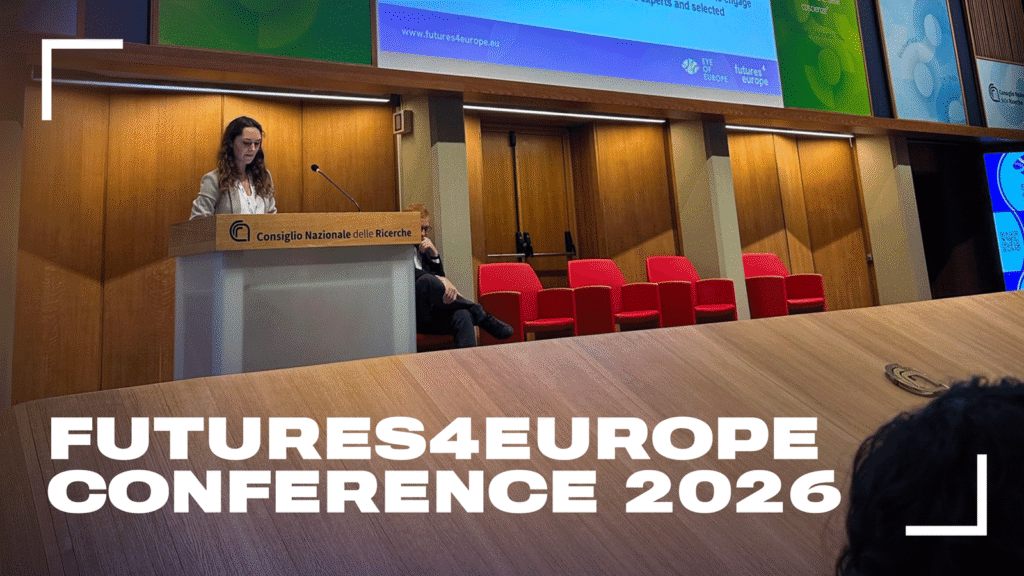

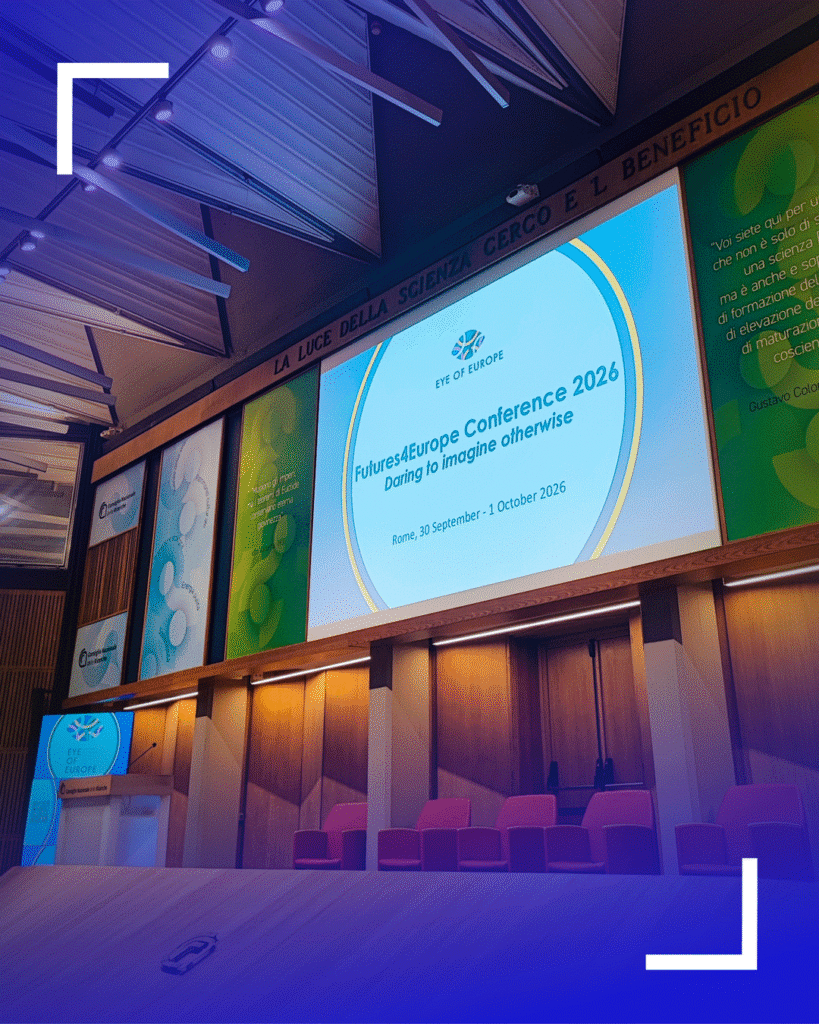
The future is not a fact – so what does this mean for science communication in futures studies, and how can it make an impact on society? Magdalena Soetebeer explored this question at the Futures4Europe Conference 2026 in Rome. In her talk “Strategic or Reflexive? The Fundamental Dilemma of Science Communication in Futures Studies”, she discussed with the European foresight community how strategic communication familiar from marketing can be used without compromising scientific standards.
Why communicating futures is anything but trivial
The communicative potential of futures studies and foresight results often goes untapped when those results lie dormant in ninety-page PDF reports waiting to be downloaded from a website. Who reads them in their spare time – and who even knows they exist?
Questions about the future are central to many public debates, yet futures studies itself often receives little public attention.
Magdalena Soetebeer
This is why there are recurring calls within futures studies to communicate effectively beyond expert circles. Back in 2006, Ramos was already calling for more strategic communication: “All the valuable insights in the world […] are worthless if they cannot be communicated more broadly and influence change” (Ramos 2006). So how do we capture the attention of fellow citizens who may never have heard of foresight or futures studies? And how do we explain to them what futures studies actually does?
Because of the distinctive nature of its object of research, futures studies faces particular challenges here: images of the future are not neutral facts but present-day constructions, shaped by the perspectives of the researchers who create them. Communicated effectively to an interested public, they may influence decisions about which direction to take – and thus become interventions in shaping the future themselves. Is this still a neutral account of research findings, or is it already activism? What might science communication look like that does not present images of the future as supposedly neutral insights – yet does not get lost in epistemological explanations that only make sense after a semester of philosophy?
Show, don’t tell: The package insert nobody reads
Every serious foresight study includes one: the note that scenarios are not predictions but explorations of possible futures under uncertainty. On top of that comes a methodology section with references to epistemological foundations. This is right and important.
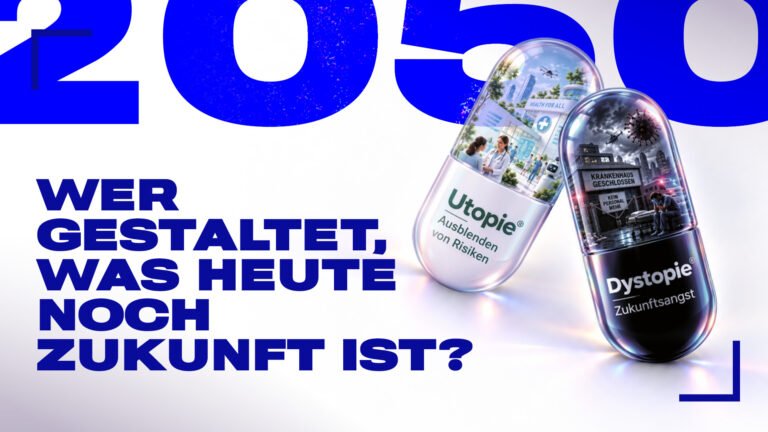
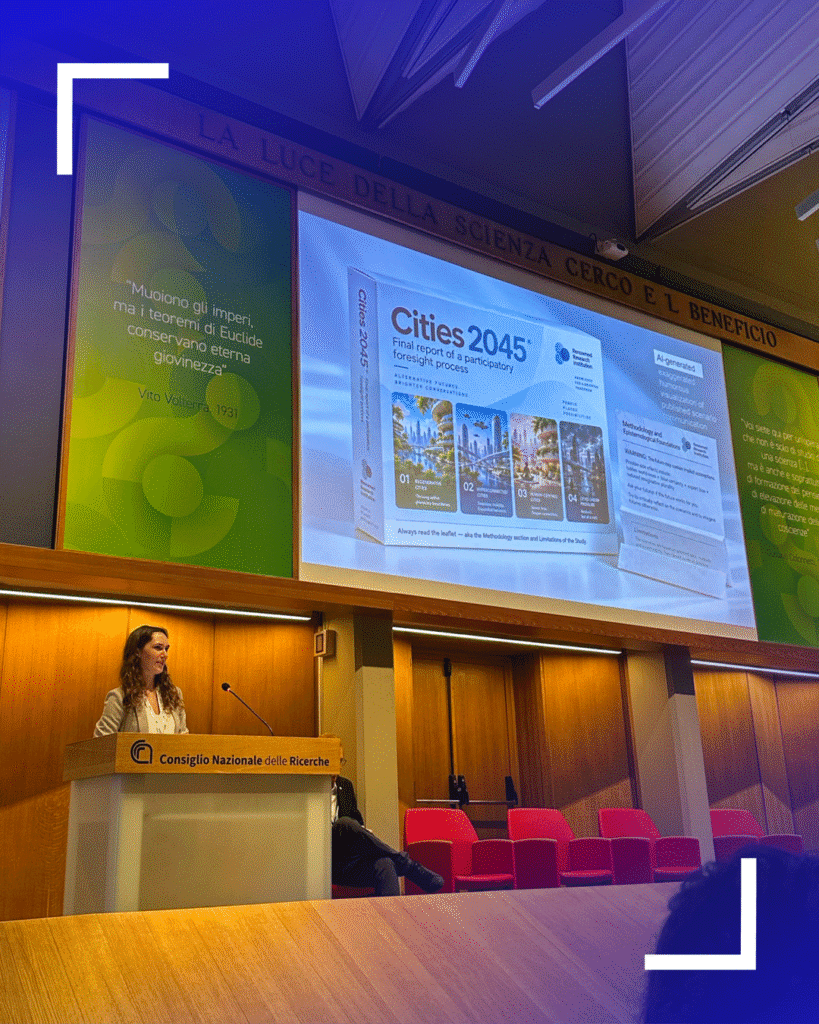
But who actually reads it? To put it bluntly, these disclaimers are like the package insert that comes with a medicine: they are there because responsibility demands it, yet hardly anyone pays attention to them. What sticks in people’s minds are the beautifully illustrated scenarios and their catchy titles.
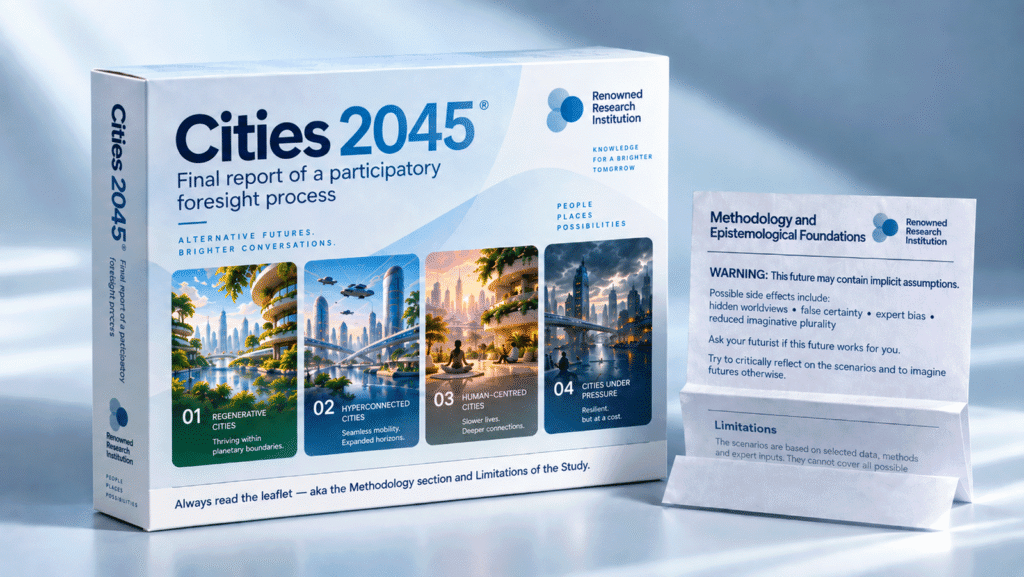
Slide from the conference presentation with an AI-generated metaphorical illustration of a typical scenario report. Like a medicine’s package insert, methodology sections and disclaimers are included because good scientific practice requires them. But who studies them before looking at the appealing scenario visualizations?
The dilemma: Impactful or responsible?
The fact that images of the future are constructions stems from the very object of research. Futures studies does not study the future – which, after all, does not yet exist – but addresses “specific questions of the present, namely the assumptions about the future that are generated, and must be justified, in the present” (Grunwald 2009). Its results are scientifically grounded assumptions about possible developments, referred to as images of the future or simply futures. They are always shaped by the researchers’ present perspectives – their frames of thought (Fischer 2023).
When these images of the future are effectively carried into the wider public sphere, they do not merely gain visibility. They also reproduce the perspectives from which they emerged. Fischer puts it clearly: “Images of the future prefigured by present frames of thought reproduce the status quo and thereby perpetuate existing power relations, systemic injustices and so on” (Fischer 2023). The greater the public reach of an image of the future, the greater its potential influence on developments of our society – and thus on the future itself. On the one hand, science communication carries a democratic aspiration: to make orientation knowledge for shaping the future accessible to an interested public. On the other hand, in doing so it tends to perpetuate the frames of thought of its authors and risks lending futures studies a technocratic character.
Yet not communicating publicly at all is no solution either. The real question is whether the way we communicate can counteract this dilemma. This requires bringing together two demands that at first seem hard to reconcile – both of which are anchored in the standards and quality criteria of futures studies.
Impactful: Strategic communication
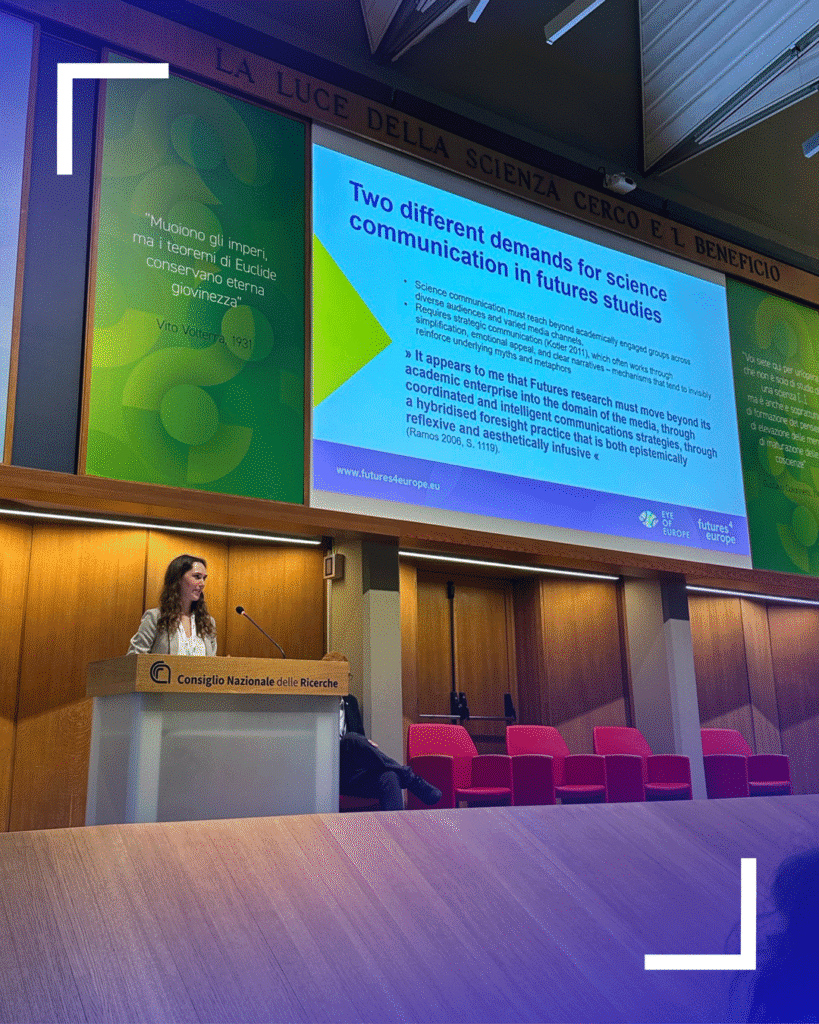
Science communication is meant to increase the public visibility of images of the future so that they can feed into societal debates. To do so, communication must reach effectively beyond academic expert circles. But “the broad public” does not exist: social groups differ in their interests, communication channels, prior knowledge, language and worldviews. Reaching them requires strategic communication using mechanisms familiar from marketing: target-group orientation, simplification, emotional appeal and clear narratives. The standards and quality criteria likewise call for “enabling ‘effective’ communication” and for preparing results “in a way that suits the addressees” “so that they can take effect” (Standards and quality criteria).
Responsible: Reflexive communication
Yet these very strategic tools can make constructed futures appear natural, probable or desirable. To be responsible, results from futures studies should not be framed as the supposedly neutral view of science, but as perspective-dependent constructions. The standards and quality criteria also require avoiding “the misleading and risky illusion of a certain prediction” and making clear “the non-factual nature of its object and the image-like, constructed character of statements about the future”. This includes the standard of “argumentative verifiability”: it should be possible to trace how an image of the future was constructed. Taken to its logical conclusion, this traceability covers not only data and methods, but also the frames of thought of those who research and communicate. After all, it is these frames that fundamentally explain why a future was imagined in this way and not otherwise. So if the call to enable “critical engagement with the content presented” is meant seriously, we should look for ways of practicing reflexive communication: a form of presentation that discloses the researchers’ frames of thought as far as possible and thereby opens them up for debate.
The intriguing question is whether both can work at the same time: preparing images of the future in a way that reaches different target groups effectively, without aiming for them – and their frames of thought – to be adopted unreflectively. How can the invitation to critical reflection itself become compelling enough not to end up as just another package insert?

Why we need both
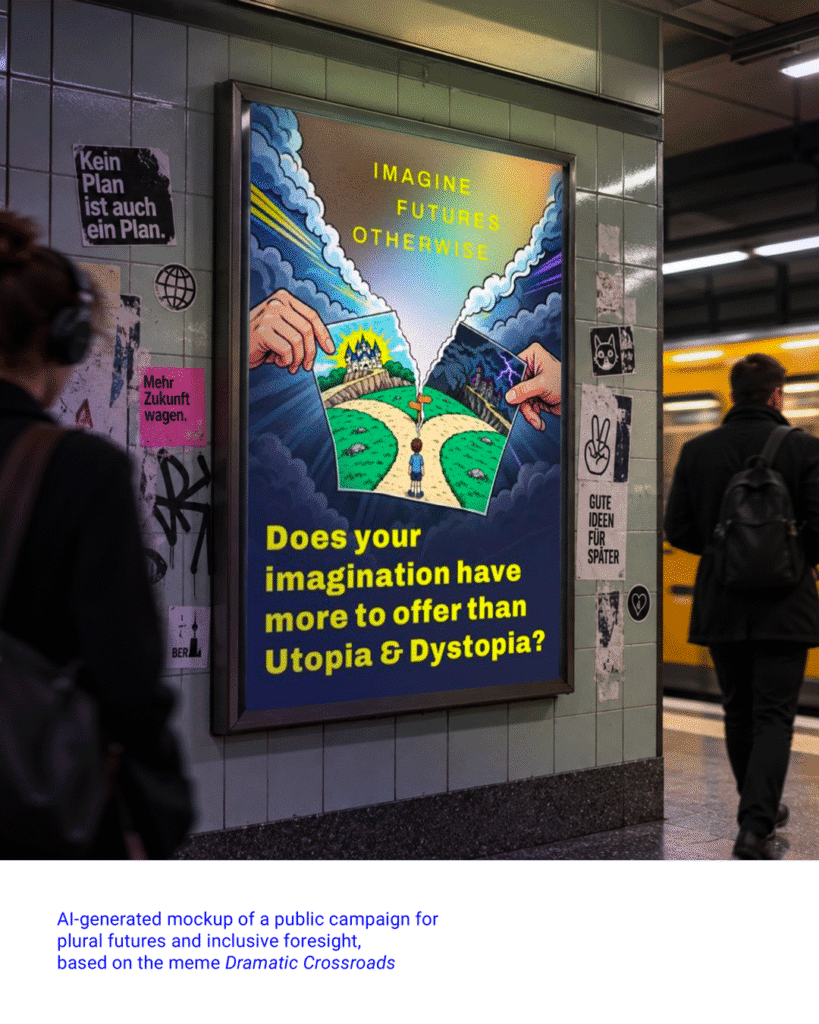
Strategic communication and critical futures studies follow very different logics. Even so, I believe we need both. Critical futures studies asks the questions that really matter: Which frames of thought are (unconsciously) inscribed in images of the future? Whose future is being imagined here? Whose perspectives have been left out? Strategic communication can ensure that these questions are also asked beyond expert circles.
The crucial shift lies in the goal. It is not about convincing people of particular futures. It is about convincing them that these futures – and their own ideas of the future – are worth questioning and discussing. That does not call for theoretical treatises that ultimately only reach academic circles. It calls for strategic communication. And this answers the question posed at the beginning: it is not about activism for a particular image of the future, but about communication that makes the future negotiable again.
A look back: Who ruined the reputation of futures studies?
The discipline’s recent history shows how serious the consequences can be when public communication is careless about the scientific foundations of futures studies (cf. Eberspächer 2018). In the 1960s, futures researchers initially adopted the media-coined term “futurology” and gave in to the temptation to answer the question of what the future will be like. In 1966, for instance, Der Spiegel ran the headline “Futurologie: Die Zukunft des Menschen wird geplant” – “Futurology: The future of humankind is being planned” (Der Spiegel, issue 53/1966). This created a false image of futures studies and expectations that could never be met. After all, futures studies does not know what the future will bring either.
Even today, some futures researchers are deeply frustrated by media-savvy figures who, in the name of futures studies, continue to give the impression that sophisticated methods allow them to know something about the future in advance – without, of course, making these mysterious methods transparent. They have been dubbed “trend gurus” and their work “tabloid trend research” (cf. Rust 2012). Whether or not one gets worked up about these figures is one question. How we communicate ourselves, and which public image of futures studies we reinforce in doing so, is quite another. It is the latter that I find particularly relevant – and so it became the subject of my talk at Futures4Europe.
Magdalena explored what such communication design might look like in her master’s thesis at Freie Universität Berlin.
Frequently asked questions
Can futures studies predict the future?
No. Even if the name of the discipline might suggest otherwise, futures studies examines present-day assumptions about possible futures and uses them to develop well-founded images of the future, such as scenarios. In other words, it is the scientific study of possible, desirable, plausible and probable future developments and of the options for shaping them. The aim is to analyze the arguments and models used to construct images of the future – and to show where there is room for shaping the future today. This is why the outcome of futures studies is sometimes referred to as “orientation knowledge”.
What is science communication in futures studies?
It makes the results of futures studies accessible to people outside the expert community. What sets it apart: it does not communicate established facts, but constructed images of the future for which the researchers’ perspective is constitutive. Communication design therefore requires particular care when it comes to how far this constructedness can and should be conveyed.
What are the standards and quality criteria of futures studies?
In the handbook “Standards und Gütekriterien der Zukunftsforschung” (Standards and Quality Criteria of Futures Studies; Gerhold et al. 2014), a group of authors defines what distinguishes “good futures studies”. Its three sections address “(1) appropriateness to the future, (2) scientific rigor and (3) effectiveness in terms of achieving goals and fulfilling tasks”. The book aims to contribute “to methodological self-assurance and to the establishment of futures studies as a scientific discipline”.
What is Futures4Europe?
The conference took place from September 30 to October 1, 2026, at the National Research Council of Italy (CNR) in Rome. Under the motto “Daring to imagine otherwise”, the European foresight community discussed futures, inclusivity, creativity and design, with plural futures and inclusive foresight as a central theme. The conference and the online platform futures4europe.eu emerged from the EU-funded project “Eye of Europe”. Last year, André Winzer attended the first Futures4Europe conference in Vienna: Foresight 4 Europe in Vienna.
References
- Eberspächer, A. (2018). Das Projekt Futurologie: Über Zukunft und Fortschritt in der Bundesrepublik 1952–1982 [The futurology project: On the future and progress in the Federal Republic of Germany, 1952–1982]. Brill | Schöningh.
- Fischer, N. (2023). Möglichkeitsräume kontingenter Gegenwarten: Die Reflexion von Denkrahmen als theoretischer und methodischer Ansatzpunkt für kritische Zukunftsforschung [Possibility spaces of contingent presents: Reflecting on frames of thought as a theoretical and methodological starting point for critical futures studies] (Doctoral dissertation).
- Gerhold, L., Holtmannspötter, D., Neuhaus, C., Schüll, E., Schulz-Montag, B., Steinmüller, K., & Zweck, A. (Eds.). (2014). Standards und Gütekriterien der Zukunftsforschung: Ein Handbuch für Wissenschaft und Praxis [Standards and quality criteria of futures studies: A handbook for research and practice] (Vol. 4). Springer VS.
- Grunwald, A. (2009). Wovon ist die Zukunftsforschung eine Wissenschaft? [What is futures studies a science of?]. In R. Popp & E. Schüll (Eds.), Zukunftsforschung und Zukunftsgestaltung: Beiträge aus Wissenschaft und Praxis (pp. 25–35). Springer.
- Ramos, J. (2006). Consciousness, culture and the communication of foresight. Futures, 38(9), 1119–1124.
- Rust, H. (2012). Schwache Signale, Weltgeist und „Gourmet-Sex“: Die unfreiwillige Komik der boulevardesken Trendforschung [Weak signals, world spirit and “gourmet sex”: The unintentional comedy of tabloid trend research]. In Zukunft und Wissenschaft: Wege und Irrwege der Zukunftsforschung (pp. 35–57). Springer.