Futures Experience
Analyzing future scenarios is good. Being able to imagine futures is even better.
Strategic foresight and futures studies become powerful when future scenarios aren’t just understood — but experienced. We design interactive formats, games, and workshops that bring futures thinking to life in groups: curious, playful, constructive.
FUTURES STUDIES
Why think about futures in the plural?
The scientific foundation of our Futures Experience approaches comes from Futures studies. The core assumption of this field is that there is no single, predetermined future. What lies ahead is open — and partly depends on decisions that haven't been made yet. The plural captures this openness: not one fixed forecast, but many possible developments that can be shaped.
Futures research therefore engages with futures on a scholarly level. Serious futures research cannot predict what the future will be – precisely because it is still open. Instead, it analyzes our present-day assumptions about the future: the images, forecasts, scenarios, expectations, trend descriptions, hopes, and fears we hold about what might come.
We believe that the ideas we hold today about what might happen tomorrow carry enormous shaping power. So it’s worth making space for futures thinking.

9 questions that change everything.
Click your way, step by step, from linear visions of the future to futures.
WHY EXPERIENCE FORMATS?
The future can be shaped – and that's something you need to experience, not just understand in theory.
Foresight reports get read and forgotten. Scenarios get presented and filed away. Impact only emerges when futures spark concrete imagination. When people start exploring them playfully.

FUTURES ORIENTATIONS
How does your organization relate to the future?
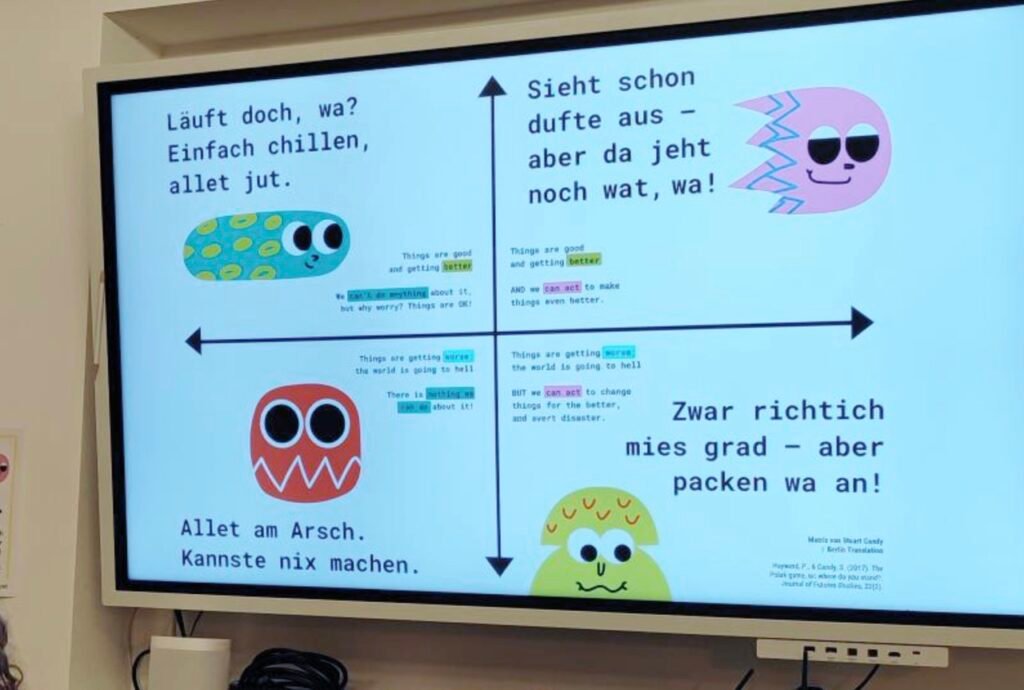
Before futures can be shaped, it's worth taking a look at your own orientation toward the future. Do you intuitively assume dystopian developments? Or are you an incurable optimist? Do you watch how others respond to change and adapt accordingly? Or do you prefer seeking out room for radical transformation? In our formats, we make these orientations visible as a reflective starting point for working with futures, not as a judgment.
ORIENTATION – PASSIVE
The future happens to us.
The future unfolds, and we react to it. Change is experienced as external, something that comes to the organization, not something it can help shape.
ORIENTATION – REACTIVE
The future is something we respond to.
Changes are noticed and addressed but only once they've already arrived. Speed of reaction substitutes for foresight.
ORIENTATION – PROACTIVE
Shaping the future.
The organization thinks and acts in futures. Signals are read early, assumptions are questioned, room for agency is used before change becomes necessity.
OUR FORMATS
Playful.
Profound.
Impactful.
SERIOUS GAME
Polak Game
INTERACTIVE TOOL
Futures Oracle
WORKSHOP
Futures Literacy Lab
VISUALIZATION
Futures poster
& communication
Complex futures research translated into sharp, visually compelling formats — for events, exhibitions, workshops, or internal communications.
LEARNING JOURNEY
Developing futures orientation
TAILOR-MADE
Your format
No context is like another. Together with you, we develop formats that fit your group, your goals, and your organization — from a conference input to a multi-day experience.
FOR WHOM
Futures thinking isn’t a question of industry.
01
Company
& Teams
“When strategy conversations always end up in the same present.”
Teams that are meant to think about the future together need more than presentations. Our formats create a shared thinking space – and make different futures visions within a team productively visible.
02
Conferences
& Events
03
Educational institutions
Futures literacy is a key competency of the 21st century. We support schools, universities, and educational institutions in making this competency tangible – playful, age-appropriate, and effective.
04
Communities
& public sphere
Why Schaltzeit
How we work.
We listen, translate complexity, and bring people into experience. Abstract futures become something tangible — something that can carry decisions. Learn more about our approach and methodology on our main site.
Reference projects
Three examples from practice: from a multi-hour cooperative workshop to an interactive festival station.
BERLIN TENANTS’ COOPERATIVE
Futures conference
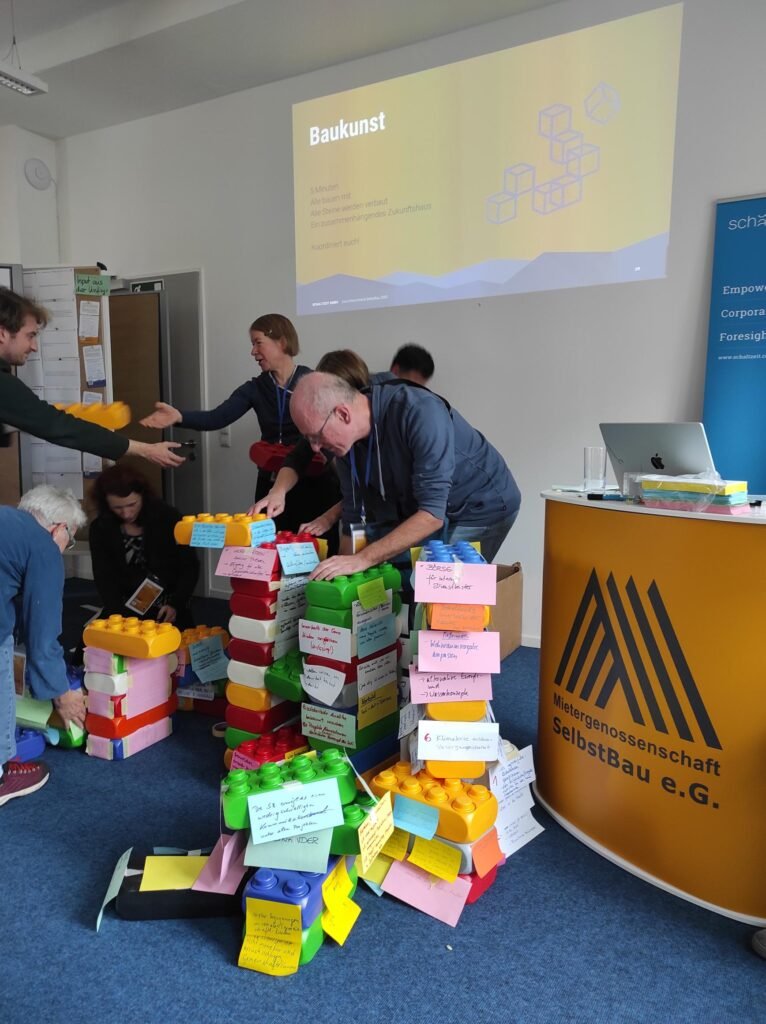
In a full-day format, participants explored present-day challenges and developed bold future scenarios for how they might be overcome. How can a sustainable future be built – quite literally? The key design challenge: an exchange format that takes conflicting positions seriously without paralyzing the process.
FREE FUTURES LITERACY OFFERING
What-if workshop
The workshop offers a low-threshold introduction to working constructively with future scenarios. It's aimed at people who want to engage with complex futures topics without years of foresight training and create their own scenarios in just a few steps. The real highlight: facilitated small-group exchange that surfaces the hidden assumptions behind participants' favorite scenarios and makes them discussable. What hidden assumptions are embedded in participants' favorite scenarios and how can they be consciously examined?
FUTURES FESTIVAL
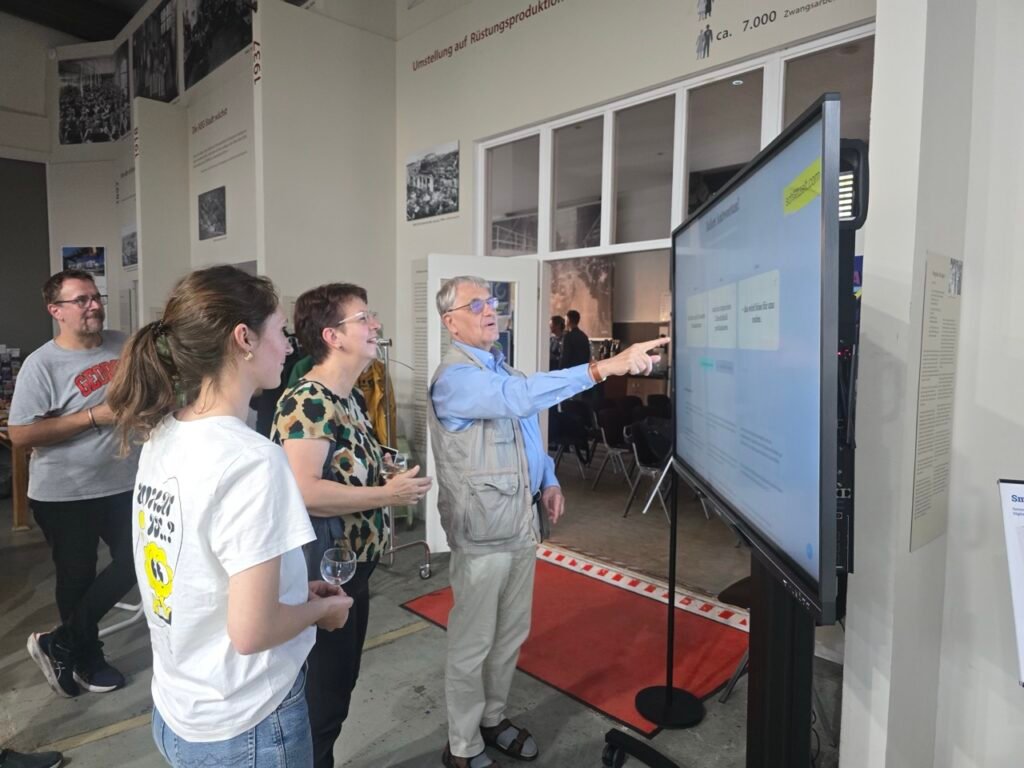
The Schöneweide Futures Oracle
The Futures Oracle is an interactive station that invites visitors, with a wink, to question their own view of the future. At events, it holds up a mirror to how we deal with the inevitable uncertainty of the future and explains with humor what futures studies is all about. It has been used at the Zukünfte Festival Biennale Futura in Schöneweide, among other places, as well as at an innovation congress for the chemical industry and at the German Congress for Health Services Research.
What assumptions are quietly steering your strategy?
QUICK REQUEST
Get in touch nowClose form
FREQUENTLY ASKED QUESTIONS
Your questions about Futures Literacy answered
What is futures studies?
Futures research is a scholarly field that studies futures, not the future itself, but the ideas, assumptions, and expectations we hold today about possible futures (Grunwald, 2009).
Since the future doesn't yet exist, it can't be empirically observed. So futures studies look at what does exist: the images, forecasts, scenarios, hopes, and fears present in the here and now. In this understanding, the future exists only as a present-day construction.
Grunwald (2009) identifies three core tasks:
- Futures critique – analyzing existing ideas about the future, including the contexts in which they emerge, their underlying assumptions, and their epistemological and normative premises.
- Futures assessment – evaluating competing images of the future, incorporating value judgments and participatory processes.
- Futures processing – developing strategies for dealing with the unavoidable non-knowledge about future developments.
The goal is to enable well-founded orientation in the present when navigating uncertainty and competing images of the future.
What is the difference between futures studies, foresight, strategic foresight, and trend research?
These terms are often used interchangeably, but they have distinct emphases. Futures studies is the academic umbrella field: it asks fundamental questions about the nature of futures and the methods for exploring them (Grunwald 2009; Steinmüller 2015).
Foresight and Strategic foresight are more application-oriented: they translate findings and methods from futures studies into organizational or political decision-making processes.
Trend research, by contrast, focuses less on alternative futures and more on a single probable future: identifying and extrapolating existing developments. It tends to be more linear than futures studies.
Inayatullah (1990) also distinguishes between predictive, cultural and critical epistemologies within futures studies.
What are exploratory and normative futures?
Futures studies distinguish between exploratory and normative approaches.
Exploratory futures ask: What could happen? They map the broadest possible range of conceivable developments without explicit judgment, but with curiosity.
Normative futures ask: What should happen? They start from a vision of the desirable and work through different scenarios from there.
It is worth noting that exploratory futures are not value-free either. Both approaches complement each other and both feature in our formats.
What is the difference between utopia, dystopia, and anti-dystopia?
Utopias sketch radically positive futures. They are sometimes written off as naïve or unrealistic rather than taken seriously. They can also become dangerous once they are no longer about desirable futures but about an absolute ideal future that is beyond criticism and alternatives.
Dystopias imagine the worst. They warn and can prompt reflection and action but can also paralyze and amplify anxiety about the future.
Anti-dystopias are a more recent concept: they take today's crises seriously but actively seek pathways through them. Dr. Isabella Hermann (2025) describes anti-dystopias as a literary and social format that opens up new perspectives for action precisely because it is neither naïve nor fatalistic. In our formats, we deliberately work with this tension.
What is the value of engaging creatively with futures?
Creative approaches break thinking out of familiar patterns and surface assumptions that often go unspoken in purely analytical work. When people don't just think through possible futures but actively shape and experience them, they gain new perspectives, find it easier to enter into dialogue and stay capable of action, even when the future remains open.
What is Futures Literacy?
Futures Literacy is a competency: the ability to engage with your own thinking about the future consciously and reflectively. The concept was significantly shaped by UNESCO and theoretically developed by Riel Miller (2018).
Those with Futures Literacy can draw on different futures as a resource for present-day thinking and action. The goal isn't prediction; it's greater agency in the face of uncertainty and complexity.
In a recent study, Chan & Erduran (2025) show that future-oriented learning strengthens not only futures literacy but also a sense of agency — the conviction that one's own actions can make a difference.
What role do emotions play in futures work?
Zukunft ist kein rein rationales Thema. Ängste und Hoffnungen – bzw. Zukunftsangst und Zukunftsmut (Waldow-Meier 2022) – prägen die Auseinandersetzung mit gegenwärtigen Krisen, Zukünften und antizipierter Unsicherheit.
Emotions aren't a distraction. They reveal which futures matter to us, which we fear, and which we want. Chan & Erduran (2025) confirm that future-oriented learning formats need to explicitly address the emotional dimension in order to be effective.
In our formats, we treat emotions as a starting point for reflection, not an obstacle.
What impact do futures have on transformation processes?
Positive, concrete, shared visions of the future have real strategic power. When groups design futures together, they shift the foundations of how decisions are made.
In the context of sustainability transitions, Loorbach, Frantzeskaki & Avelino (2017) show that new futures visions can drive structural change not as a blueprint, but as a navigational frame.
What group sizes do Futures Experience formats work for?
Our formats work for small teams of five and scale to groups of 30 or more. We adapt the structure and flow to fit the group.
How much time do Futures Experience formats require?
Formats range from compact 3-hour sessions to multi-day experiences. We tailor the scope to your goals.
How can I design Futures Experience formats around existing foresight results?
If you already have scenarios, trend analyses, or futures images, a Futures Experience picks up exactly there. Instead of leaving results in reports, we make them tangible: your futures become walkable, felt, and discussable. Insights that would otherwise stay abstract get anchored and become real for the people involved.
How can I use Futures Experience formats as a starting point for foresight activities?
A Futures Experience works well as an entry point, before analytical work begins. Experiencing possible futures together opens assumptions, raises questions, and creates a shared starting point surfacing layers of futures thinking that were previously implicit or unspoken. From there, you can move into scenario processes or strategic foresight with a much stronger foundation.
What do Futures Experience formats cost?
Pricing depends on format, duration, and group size. We're happy to put together a tailored proposal.