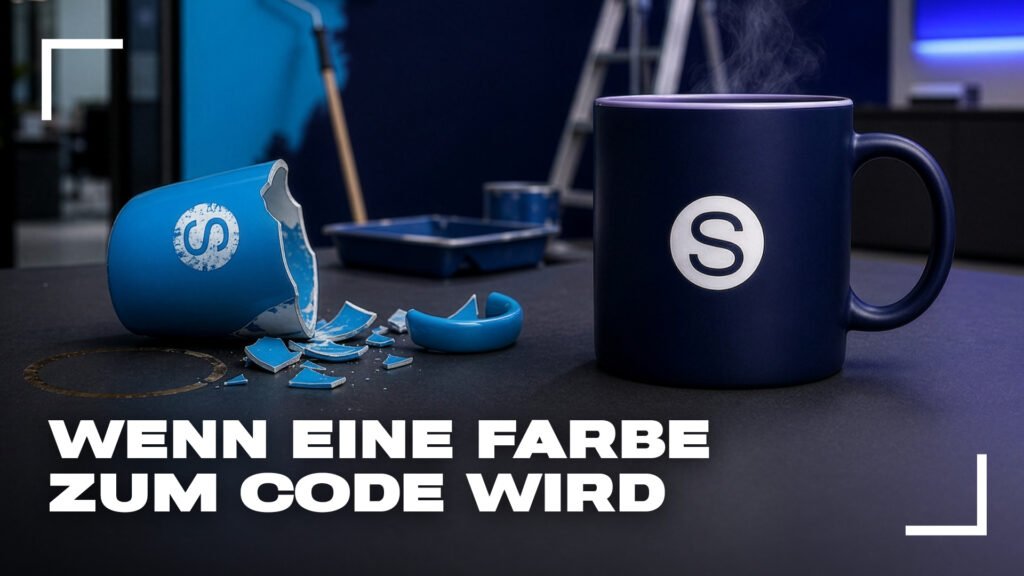

Heartbreak in blue
Berlin, late summer. I’m sitting in front of our logo and I realize: I’m attached to it. This blue was our color: trustworthy, vivid, present at every pitch and every trade show booth. Like a favorite sweater. Then the relationship started to crack. Gradually. I thought it would sort itself out. It didn’t. If you constantly preach courage about the future to your clients, you can’t dodge it yourself. Even if it’s just a color.
Colors are never just colors. From the very beginning, our Schaltzeit blue was Pantone Process Blue, HEX #009EE0 on the web. But in Germany, this blue has long since taken on a different meaning. Taken over by a party that hands out blue hearts, gathers votes with “remigration” and whose image of the future is a homeland in which many are meant to feel like strangers. The light blue in the AfD’s corporate design manuals is #00A2DF, sometimes 0099ff, and the website shows #009EE0 – the usual disunity apparently prevails here. Still, it’s always a similar shade. Not always the same, often as a gradient: but too close for a layperson to tell the difference.
Blue is no longer a color. Blue is a code.
We don’t want to be confused with that. We are a company that sees itself as part of this democracy. Open to everyone. Our mission statement is unequivocal on this: the Basic Law is our foundation, and we take a stand against any hostility to democracy.
So we are shedding this blue. No more. No less.
Understanding the frustration. Not the recipes.
We understand the frustration. When almost one in three votes in current state elections goes to a party that sees itself as an alternative to everything established, this society has lost something. Anyone who ignores that is producing the next wave of frustration along with it. But the answer is not the simple recipes that this “alternative” proclaims. Simple solutions are tempting – and almost always wrong. Lawnmower methods – blanket cuts, blanket deportations, blanket suspicion – hit first those who are least able to resist. Punching down is not politics. It’s cowardice.
Our mission statement contains a sentence I like: We don’t start fires. We make things possible. That’s why: no proximity to parties that have social hardship, exclusion or “Germans first” in their platform. The world is diverse, and Berlin all the more so. Sorting people into good and bad? Prescribing what families should look like? Please, no.
What we stand for
For strong public broadcasting. Not because it’s perfect – it isn’t – but because a democracy needs places where facts belong neither to the algorithm nor to the highest bidder. Those who want to abolish public broadcasting don’t want to save money. They want the stage all to themselves.
For participation. That’s our craft: asking questions before we sell answers. Listening before we judge. And listening to everyone – not just the loudest. It’s okay to say: we don’t have the answers yet. What’s not okay is replacing them with exclusion. Responsibility instead of future theater.
For a sense of togetherness in which support is not a weakness but a strength. Cooperation before competition. For us, that means: anyone starting out with us doesn’t have to earn trust first. A country could use more of that – especially one in which a color is becoming a camp symbol.
One color we’re happy to wear
And since we’re talking about colors, there’s one we’re happy to wear: rainbow. Berlin is multicultural and tolerant, not as a slogan but as everyday life between Kiez, Kotti and the Chancellery. People with different backgrounds, different languages and self-chosen ways of life work with us. That’s not a diversity tile. That’s Tuesday.
And this applies: I don’t expect anyone to bare their soul. Who you are is our business only as far as you want to share it. What is our business: that you are safe here. And that you feel at home. Integration isn’t a problem for us. It’s everyday life. And it works – not without friction, but always when we meet people as people.
The Germany we mean
A lot of things in our country aren’t running perfectly. By the very nature of our profession, we are concerned with the question of what in our present deserves criticism and how things could work better in the future. Anyone who knows only one future has no choice. That’s why we mean a democratic country that thinks of the future in the plural – as a space of possibility, not a threatening backdrop. By democracy, we mean shaping the future together as a society, discussing different images of the future and conceivable paths to get there. We mean a state that prepares for scenarios before it becomes necessary or even too late. A Germany that shapes developments instead of reacting. And that doesn’t just allow futures thinking but leads by example.
The blue hearts tell of a future that is a romanticized past. Ulrich Siegmund, the AfD’s lead candidate in Saxony-Anhalt, wants, for the future, “an old, safe Germany back, the way it was in the 1990s”. Was everything really better back then – or at least safer? We don’t think so. (see facts and figures below)
We don’t want a future built on a sugarcoated picture of the 1990s, but a way of shaping the future that has the courage to face a complex world and to work at a structural level on a society that respects the human dignity of every person, that thinks of freedom and peace together and does not work with hatred and incitement against certain social groups. And such futures don’t stop at our national border. We have long been living in a dense web of global interdependencies – supply chains, climate, crises. Spaceship Earth, as Buckminster Fuller called it long before the 1990s: on our planet, we are a crew, not passengers. We want human dignity for all people, not just for the part of the crew with the right passport. We wrote down how we want to argue about such things in the Debating Spaceship – and at re:publica 26 we tried it out.
Will this cost us contracts?
The question came up internally. My answer: I don’t think so. And even if it does – we don’t work for just anyone anyway. Yes, economic downturn. Yes, we feel it. If you take a position, you also have to live with the consequences, not just the applause.
What matters more is that we start talking. I want all of us at Schaltzeit to get involved – not just in our mission statement, but in our calendars. Anyone who wants to get involved gets educational leave or time off from us. Whether in a club, in the neighborhood or in local politics: no one can do it alone. Neither can we. Together, maybe.
And now?
We’re changing our color. To #090C9B – Navy Electric – a deep midnight blue, almost ultramarine. To be honest, it hasn’t warmed my heart yet. Yes, it’s still blue. We won’t let them take the color away from us entirely, just the shade. They can have the light blue, our trusty cyan.
A new color is like a readjustment. And that is exactly what’s in our name: Schaltzeit – the time in between, when something resets. We’re in one of those moments ourselves right now. We don’t want to go back.
A small sign, I know – a color value won’t save a democracy. But taking a stand starts with what you have in your own hands. Even in the smallest things. Complaining doesn’t help; doing does.
Light blue now belongs to others. What belongs to us is the question of how we want to live together. We’re happy to talk about that – with you, with our clients, and also with those who voted for the blue hearts. Just not with those who have no interest in a respectful, decent exchange.
What do you think? Write to me!
Yours, André
FACTS & FIGURES
Fact check: how safe were the 1990s – and for whom?
Since, as mentioned, images of the future interest us professionally, we took a closer look at what is highlighted and what is left out when politicians cite the 1990s as inspiration for shaping the future. What is there to this “old, safe Germany”?
In 1993, the police registered a good 6.75 million criminal offenses – with around 81 million inhabitants, the highest figure the crime statistics have ever recorded. In 2024, there were 5.83 million, with a population that has since grown to around 83.5 million. Fewer offenses, more inhabitants: statistically speaking, Germany is therefore safer today than in the 1990s. In the area of murder and manslaughter, too, the police crime statistics (PKS) recorded 4,230 cases in 1993 and 2,303 cases in 2024 (see the same PKS sources). What has increased in the statistics since then is aggravated assault, although part of this rise is also due to a greater willingness to report crimes. This is exactly where the blue hearts like to argue with knife attacks. However, the statistics have only recorded knife attacks separately since 2020; before that, they were invisibly absorbed into the respective offenses – mostly aggravated assault, but also robbery or manslaughter. Siegmund is right in the interview mentioned above when he says: the statistics only capture what is reported. But that applies to then as much as to now. It’s not an argument for the 1990s.
And beyond the numbers? Hoyerswerda 1991, Rostock-Lichtenhagen 1992, Solingen 1993. Marital rape: until 1997 not rape, only “coercion,” sometimes “bodily harm.” The BKA (Federal Criminal Police Office) has only systematically analyzed intimate partner violence since 2015. Marriage equality: this freedom did not exist in our society in the 1990s, only since 2017. Instead, in the West, Section 175 remained in the penal code until 1994. The 1990s were free and safe above all for those who already belonged and conformed to certain role models. Siegmund was born in 1990. When he talks about his view of the 1990s, it is a narrative that relies on nostalgic images – not on the (political) conditions that applied at the time or on statistically recorded data on safety.
But fear and narratives that stoke fear are faster than any statistic. The media researcher Thomas Hestermann counted for 2023: never before had there been so many reports on violent crime in Germany’s leading media. According to police statistics, 33.3 percent of suspects in violent crimes that year were non-Germans – in the media, where origin was mentioned, the figure was 2.5 times as high. German suspects, two-thirds in the statistics, accounted for only 16 to 18 percent of the coverage. This creates a perceived reality that makes people long for the 1990s: a present that seems more dangerous than it is, and a past that seems safer than it was.
Yet by now we have pretty good recipes for where we can take preventive action against violence in shaping the future, if we are striving for a free and safe future. Violence rarely has a single cause, but many: addiction, poverty, homelessness, social isolation, experiences of violence in childhood, flight and migration, young age, male gender – this is how the German Association for Psychiatry (DGPPN) summarizes it in its position paper on violence prevention. In our view, the last point also reflects outdated male role models – which are not necessarily tied to a religion or origin.
The list is uncomfortable because it allows no simple answer. Anyone who takes a lack of prospects, isolation, poverty and untreated crises seriously as causes doesn’t end up at “remigration” or “closing the borders,” but at labor market, social and health care policy. For the first 36 months, asylum seekers are only entitled to limited medical care – psychotherapy is usually not included. This complexity sounds overwhelming. But it can also be an opportunity: many factors, many levers.
Prevention is unspectacular, slow, structural. It hardly produces emotional headlines. Nevertheless – this is the kind of future-shaping we want to champion.
Because that is the difference between the two images of the future: one gives the past a fresh coat of paint so that it passes as a desirable future. The other scratches off the paint and looks at what’s underneath. We have clearly chosen the latter.