
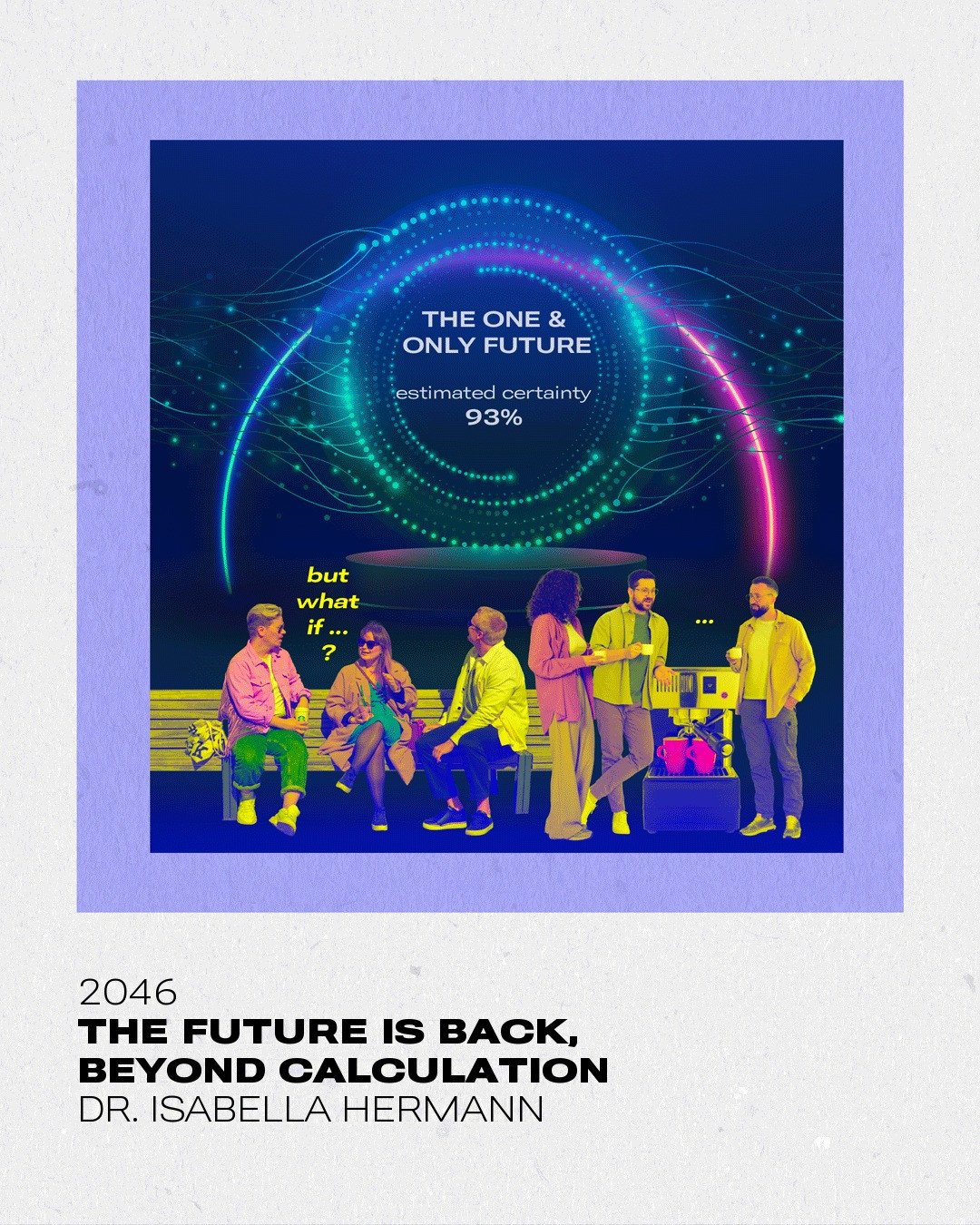
- The future is back, beyond calculation
Dr. Isabella Hermann
In 2046, Europe is regarded as a fully calculated society. Decisions are no longer negotiated but derived from data. Political processes, economic developments, and even individual life decisions follow continuous forecasts, simulations, and optimization logics. Parliaments respond to sentiment data in real time, companies steer themselves through permanent analysis, and in everyday life, too, people are guided exclusively by algorithmic recommendations. Europe proudly sees itself as “post-future(s).”
What gets lost in the process is the unpredictable, the contradictory, the human. Although everything seems to be anticipated, many developments come as a surprise. Crises occur even though their data had long been available. Because what cannot be calculated – values and meanings – has been pushed out of the processes.
In this situation, futures work by and with Schaltzeit takes on new significance. People begin to step outside the logic of calculation and organize unofficial meetings on the fringes of organizations to bring the incalculable back into their thinking. These unofficial circles turn into programs again, side conversations into strategies. Futures are coming back – not as something that can be calculated, but as something we can take part in. Europe goes from “post-future(s)” to “joint-future(s).”

Dr. Isabella Hermann is a political scientist and science fiction analyst. Her work explores how the genre shapes narratives around “future technologies” and their sociopolitical challenges – and, above all, how we can shape positive futures in dystopian times.
More about Dr. Isabella Hermann here:
www.isabella-hermann.de
- Operation #prototypemodeon
Bernd Stegmann
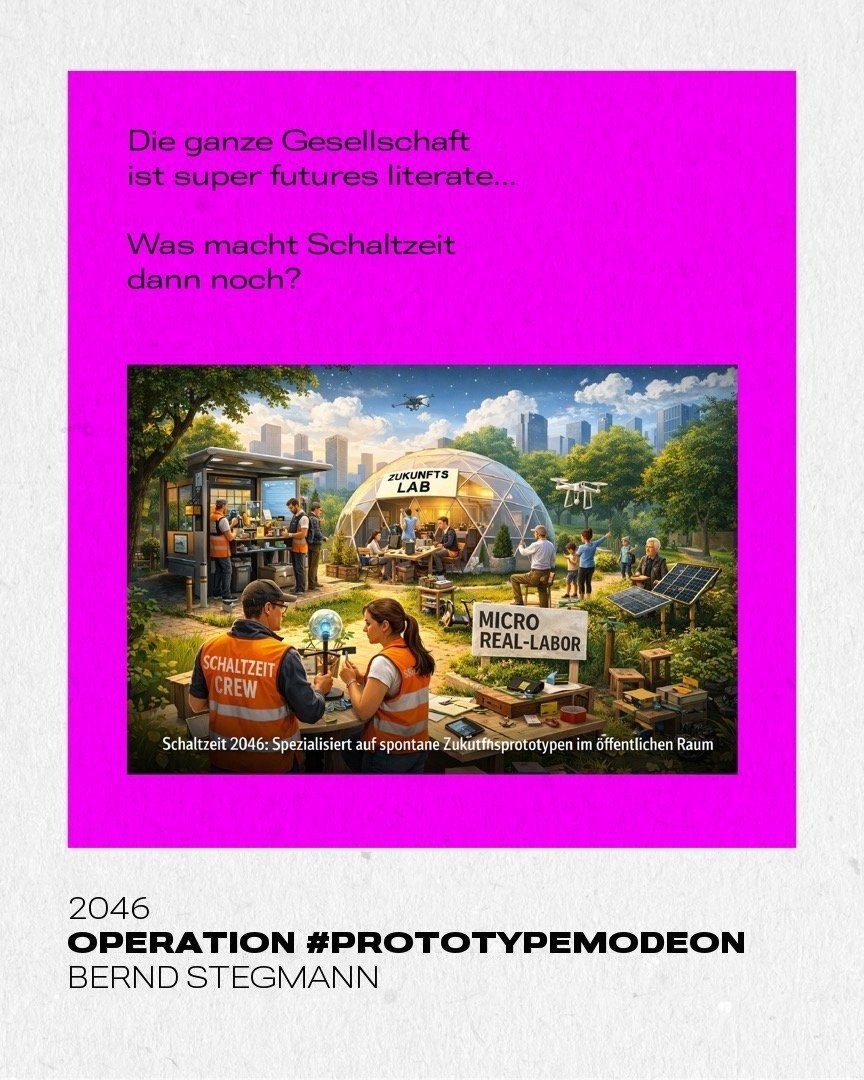
In 2046, futures literacy is part of general education. People sketch scenarios over breakfast and do trend analyses on the bus. Schaltzeit’s former consulting job seems superfluous – but the crew doesn’t close up shop, it switches gears. Because even though everyone is brilliant at thinking about the future, many find making the future surprisingly hard. Too much analysis, too little action.
That’s why Schaltzeit becomes the nation’s intervention workshop: specializing in micro-futures in public spaces, spontaneous future prototypes in the park, micro real-world labs at the bus stop, small provocations for a sluggish present.
And the founder, now past 60? He is the gentle accelerant. A kind of roving futures caretaker who, with stoic calm, shows up wherever good intentions threaten to peter out – and with a dry “Well, let’s just give it a try,” tips entire groups into prototype mode.
Role in 2046: Society knows how to think about the future. Schaltzeit makes sure it happens.
More about Bernd Stegmann here:
Stegmann’s path led from civic education to futures studies and technology assessment – a long-time shuttle between spaces of possibility and reality checks. 😊
- The voice of reason in the foresight multiverse
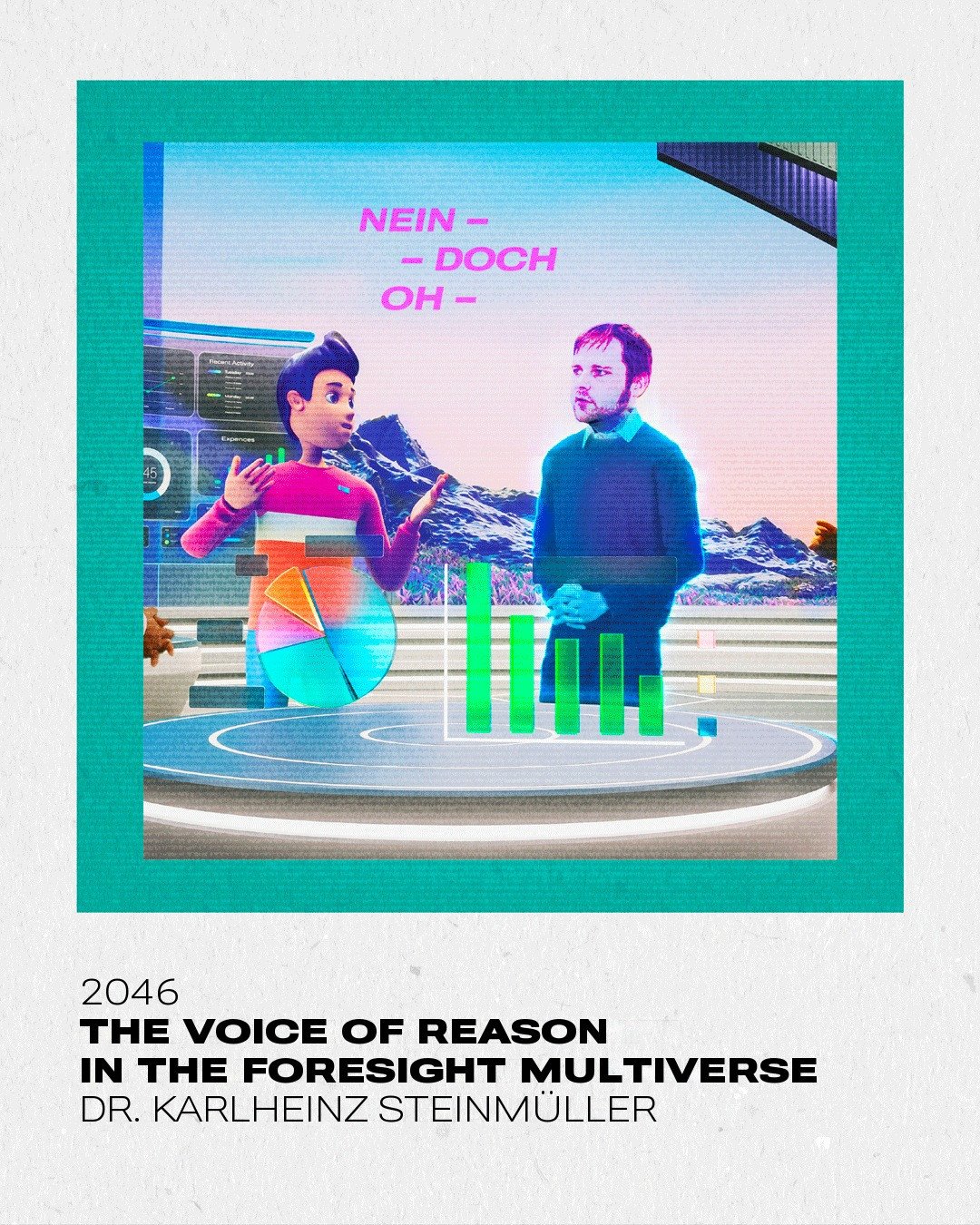
By 2046, quantum computers are throwing the structure of the universe into disarray. Here, a net media AI (N) is interviewing Schaltzeit’s public relations AI (S).
N: How would you characterize our times?
S: We live in a foresight-drunk – no: a foresight-wasted world! Everyone wants to know their personal futures. Day after day, new foresight apps are put on the market.
N: So you’re afraid of the competition?
S: Ridiculous! We’re the ones who have to re-anticipate everything straight afterward. Ever since these do-it-yourself AIs came along, there’s simply too much humbug active out there: self-proclaimed personal AI futurist agents, hourly AI horoscopes from various providers, private life-coach AIs with a forecasting module, but also traditional leftovers, especially in corporate foresight …
N: Meaning?
S: The range goes from companies using tools based on the I Ching to old-fashioned virtual corporate astrologers. But let’s not forget the individualized biographical scenario generators that, if need be, also rewrite résumés with potential future employers in mind. And most recently, quantum decider apps have emerged, also known as QuBis, quantum bifurcators.
N: Please explain that to a simple-minded AI like me …
S: As everyone knows, many people have trouble making decisions – when ordering from a menu, shopping, choosing a career or a means of transport, buying stocks, in love. A QuBi makes a random decision on a quantum mechanical basis. The advantage: thanks to quantum mechanics, reality splits at this point into all possibilities – becoming a multiverse – and you lose none of the possibilities but realize all of them …
N: Sorry, that’s simply over the head of a non-quantum AI like me.
S: Never mind. That’s what we at Schaltzeit are here for – the tough cases. As the voice of reason, we set every future straight again, no matter which branch of the multiverse you happen to be in.
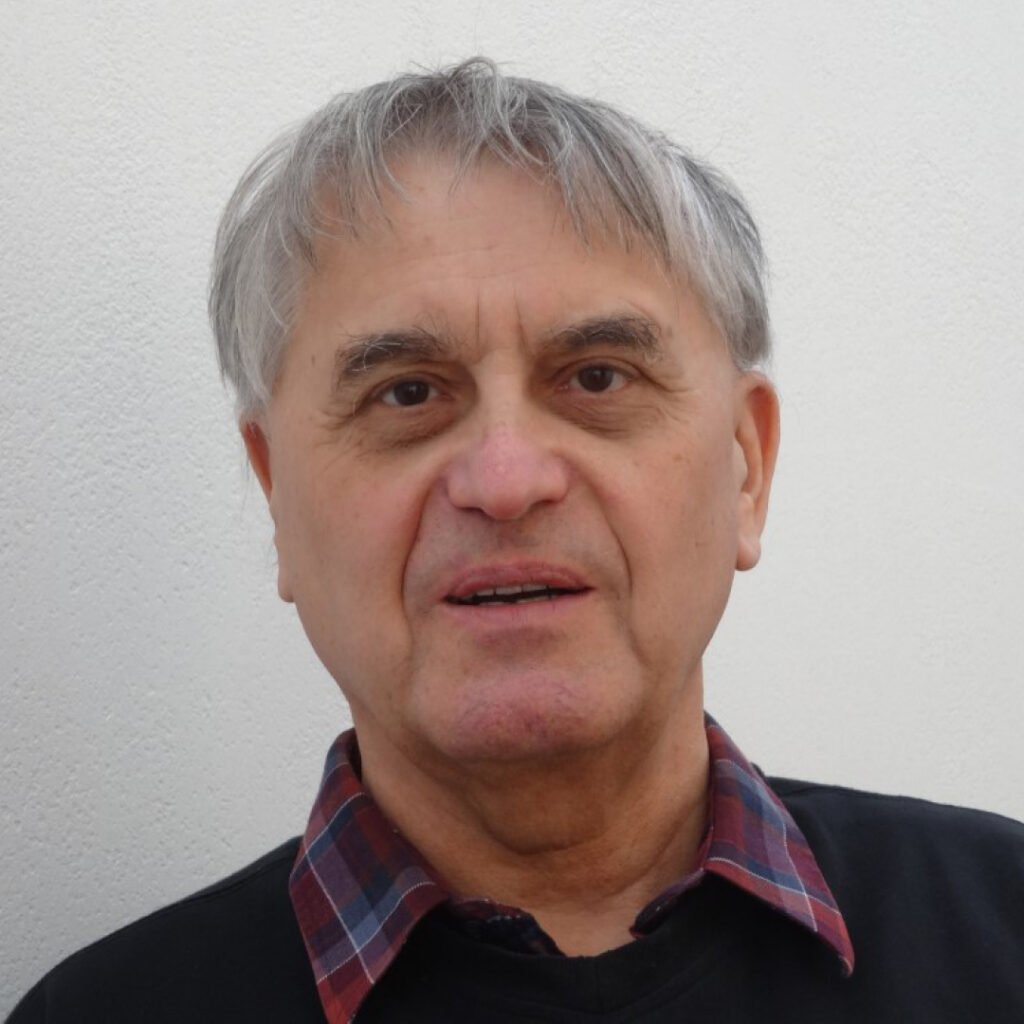
More about Dr. Karlheinz Steinmüller here:
Dr. Karlheinz Steinmüller is a futurist and science fiction author. He has taught at Freie Universität Berlin and TU Berlin, is (co-)editor of several books on futures studies, serves on the editorial board of the Zeitschrift für Zukunftsforschung, and is Scientific Director of Z_punkt GmbH. Together with his wife Angela, he has written nonfiction books and more than a dozen science fiction books.
- Deeper. Further. More human.
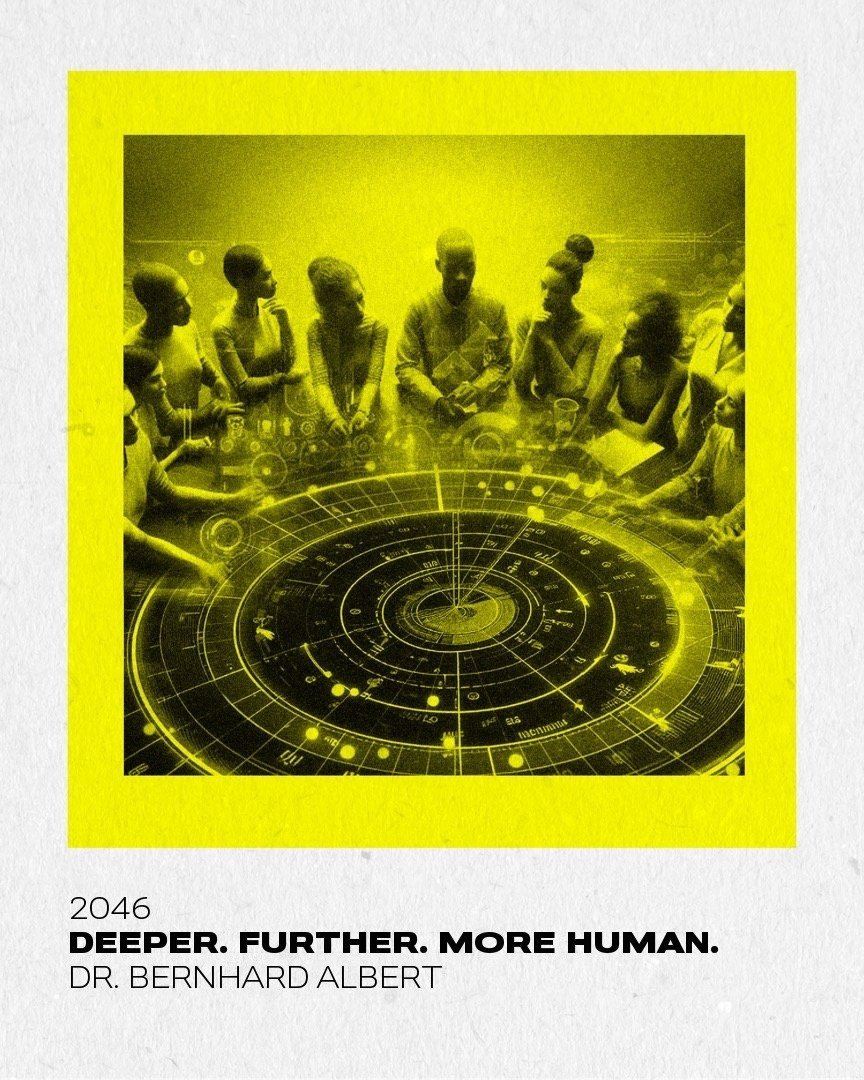
Automated trend reports every minute: AI-flooded foresight providers compete for attention – but often deliver only mediocrity. Schaltzeit takes a different path. By 2046, three levers take the team to the top of strategic foresight: 1. Embodied Signal Detection – trained researchers sense what vibrates in meetings, what goes unsaid in the hallway, and what flickers across faces – with a sensorium for weak signals, in lived relationships. 2. Chronomorphic Foresight, in which social development is not a sequence of events but a tectonic movement. A concept somewhere between macrohistory, stratigraphy, and paleoclimatology. 3. A network of Signal Custodians replaces that of trend scouts. Deeply rooted in their communities, subcultures, and world regions, they convey knowledge that resides in relationships, not on servers. This way, Schaltzeit will still be delivering images of the future that change the world in 2046.
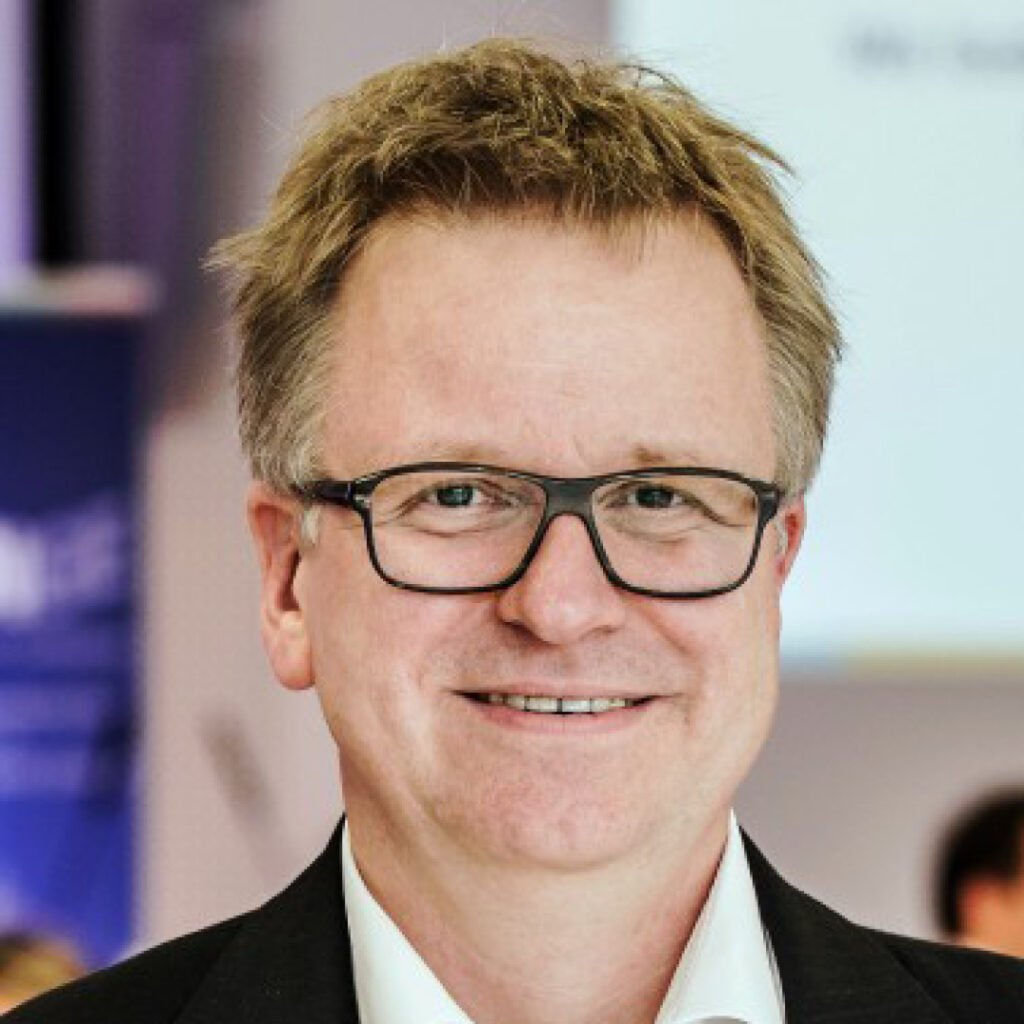
More about Dr. Bernhard Albert here:
He is the owner and founder of Foresight Solutions and a founding member of the Advanced Foresight Group. He teaches in the Master’s program in Futures Studies at Freie Universität Berlin, in supply chain and operations management at TH Köln, and in user experience design at Hochschule Darmstadt. As a founding and board member of Netzwerk Zukunftsforschung e.V., he is helping to guide academic futures studies into the future.
- Foresight 2046 – there’s no shortage of work
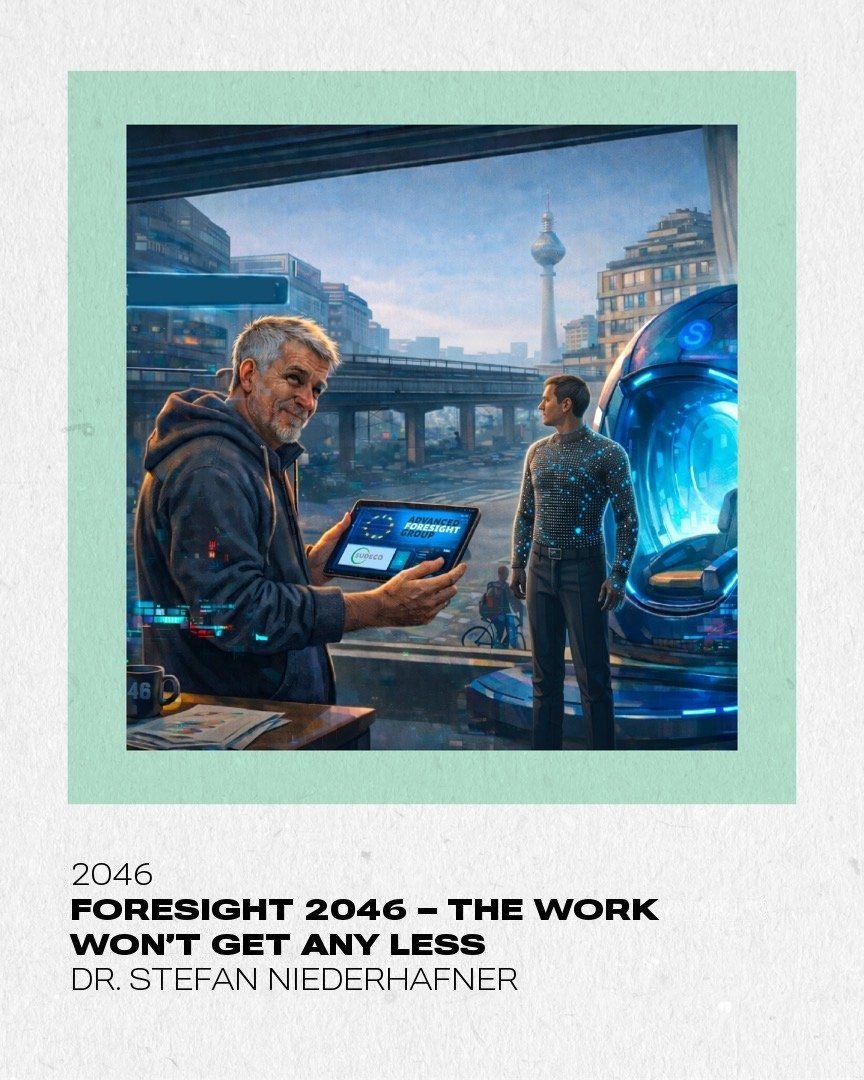
“André,” the soft voice of 9, his AI assistant, said quietly, “the elevator isn’t working.” André turned around and saw that the floor indicators of the other elevators had gone dark as well. “What, all of them?” “Yes. In 2039, when all the elevators in Block 4, John-Schehr 2–32, were overhauled, SLRB chips were installed.” André sighed loudly. Why on earth hadn’t he just stayed home and worked from there? A few hours earlier, the Taiwanese Liberation Army had managed to blow up the control plane server of SLRB, Taiwan’s largest computer chip manufacturer, in Taipei. The event apparently triggered a previously unknown code sequence in several chip series installed in electric means of transport worldwide. The code deactivated the chips and paralyzed the affected machines. Despite countless studies, discussions, and administrative measures for risk assessment and mitigation, precisely in areas like these, everyone had once again been caught completely off guard. SLRB had already announced in an official statement that the company had been entirely unaware of the existence of such a sequence and was working flat out on a solution, but for the time being, almost all electrically powered machines in large parts of Asia and Europe had ground to a halt. In Berlin, too, hardly anything was moving on rails or roads – getting to John-Schehr-Straße had been bad enough after the maglev train broke down – and now eight floors on foot….
For a moment, André thought about how, 30 years ago, a few things had been simpler in the old Schaltzeit rooms down on the ground floor. But he consoled himself with the thought that, together with SelbstBau AG, he had at least prevented the eight additional floors.
He had barely sat down at his desk when Run Chu opened the door to his office; the young Chinese man, too, clearly showed the effects of the stairs. “I have finished presentation,” he said. His German was now almost flawless. The learn-in-your-sleep programs were fascinatingly effective. André was amazed every time at how fast the learning processes ran. As always, only the definite articles remained a persistent problem. Too bad they still only worked with low drug doses in people under 20. André’s Spanish was still miserable even after three months, and because of the strong side effects of the accompanying medication, he had recently given up. In any case, these learning programs were almost certainly the reason German was still spoken at Schaltzeit at all; and not only among the AI artists on the 6th floor was the transition to English often more than fluid. Covering the cost of this extra also proved to be a very good way, among other things, of getting young talent from all over the world interested in the company.
“Great, let’s see.” “356, open file bravenewhuman03_final_final2.” 356 darkened the room and started the presentation. The 3D projectors cast razor-sharp holograms into the room. Fifteen minutes later, the lights came back on. “Very nice, very convincing. The German Life Sciences Federation and the Ministry of Economic Affairs will both be happy. Then tomorrow we’ll do the run-through in front of the whole team – and the opening block of the ‘Bundeskongress Zukunft Mensch’ is done. 9, how’s the capsule coming along?” “According to the product backlog, it has been reassembled. The bug was logged as fixed at 9:57 am. It can be tested again.” “Excellent!” André’s mood kept improving. The capsule was really just a big toy in which people could use a sensor suit and an augmented reality visor to feel what technical enhancements to their own bodies felt like – or what it was like to be without them. After a project to optimize innovation processes for a major German medical technology manufacturer, the thing had for some reason stayed at Schaltzeit and ended up in the evidence basement. Schaltzeit’s staff had now managed to squeeze an impressive amount of additional reality out of the simulations and had modified the sensor suit so that it could be put on quickly with the standard adaptive clothing that conference participants tended to wear these days. Over the course of the events, that would surely help one person or another better assess the potential of augmented human measures. Hearing is one thing; feeling, even in 2046, is another. Developing the capsule further had become much more expensive than expected and was eating up resources that were urgently needed elsewhere. The AI assistants still had to be called up by number, because nobody had yet found time to implement UN Directive 2045/9482736 on preventing discrimination in AI assistant identification.
But the capsule was a damn cool gadget, now painted in Schaltzeit blue and fitted with a cool sound when the shell closed. It was still not part of the company’s philosophy to animate data and content in such a way that the audience had to stare at endless rows of colorful 3D pie or bar charts. Moreover, it was urgently necessary to make clear, especially to critics, what opportunities were being withheld from people in Germany and the EU if access to even simple technical aids was only available to those who could afford a flight to Dubai or Singapore. Schaltzeit had also only been able to obtain the accompanying medication for the learn-in-your-sleep programs since being added to the European Commission’s ICC list (importance capitale pour la compétitivité de l’UE).
“Maybe the SLRB chip shutdown will even help,” André thought, “nobody’s getting to Dubai for now.” He looked down at the street, where almost nothing but pedestrians, scooters, and bicycles was still moving.
“Oh, and 9, pull the folder on that EU data sovereignty project from the archive for me – six or seven years ago, together with MegaBitKom, for the Ministry of Defense and the Ministry of the Interior, I think. Looks like we should offer it again.” Things couldn’t stay like this in the future, after all.

More about Dr. Stefan Niederhafner here:
Dr. Stefan Niederhafner, founder and managing director of SUDECO, has conducted research and taught in Europe, Asia, and the US. Since 2006, he has been advising on strategic foresight from a glocal perspective, integrating global trends with local contexts, economic goals, and ecological responsibility.
- The futures court of appeal
Bernd Stegmann
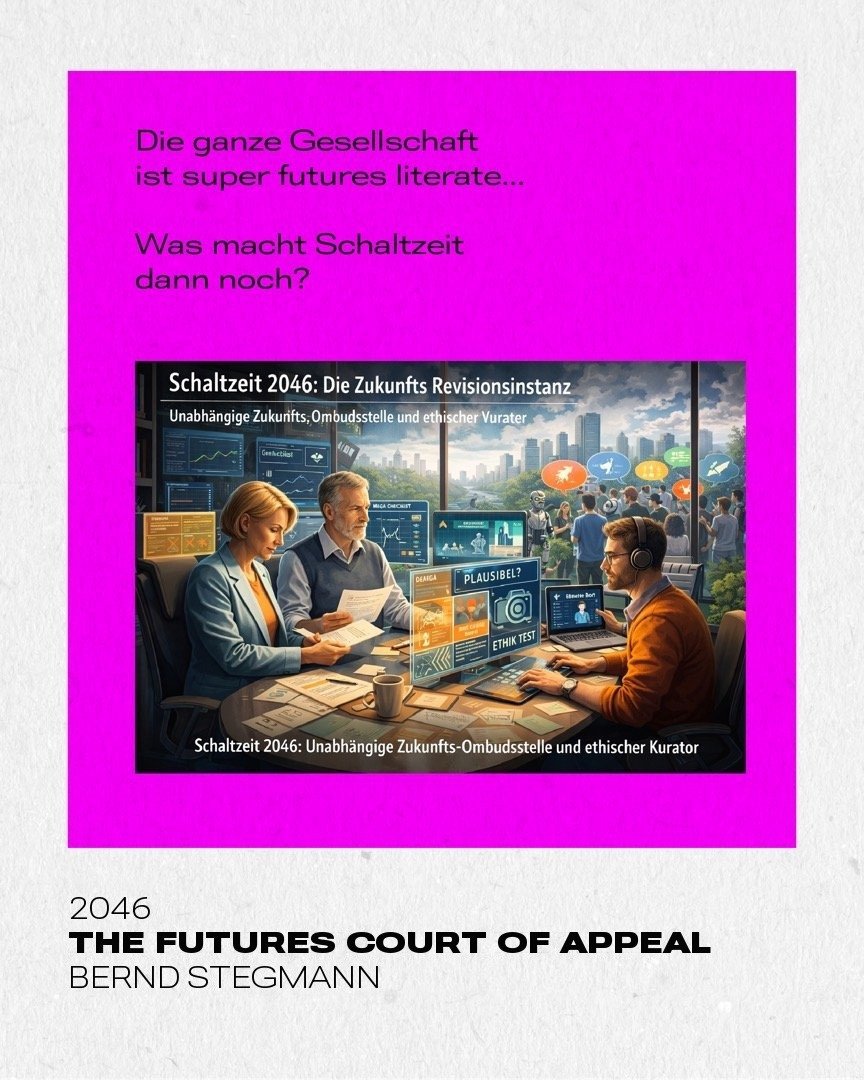
In 2046, the future is a national pastime. Hobby foresight circles, neighborhood forecasts, and enthusiastic couch futurists are popping up everywhere. But the more futures thinking there is, the more chaotic the overall picture: wishful bubbles, trend hypes, collectively overlooked side effects.
This is where Schaltzeit finds its new niche. The team becomes an independent futures ombudsman office: a mix of quality assurance, plausibility check, and ethical filter. They sort, untangle, and clear the fog – not in an authoritarian way, but as a curating body.
The founder, now past 60, serves as the living memory of the space of possibilities. A kind of futures archivist with a mischievous streak who occasionally throws in a forgotten perspective during meetings – often in passing, but with enormous impact. His comments are rare, precise, and feared: “Have you considered the side effect 15 years down the line?”
Role in 2046: Society produces the future. Schaltzeit keeps it responsibly on track.
More about Bernd Stegmann here:
Stegmann’s path led from civic education to futures studies and technology assessment – a long-time shuttle between spaces of possibility and reality checks. 😊
- Predictions for 2046 that are guaranteed to be wrong
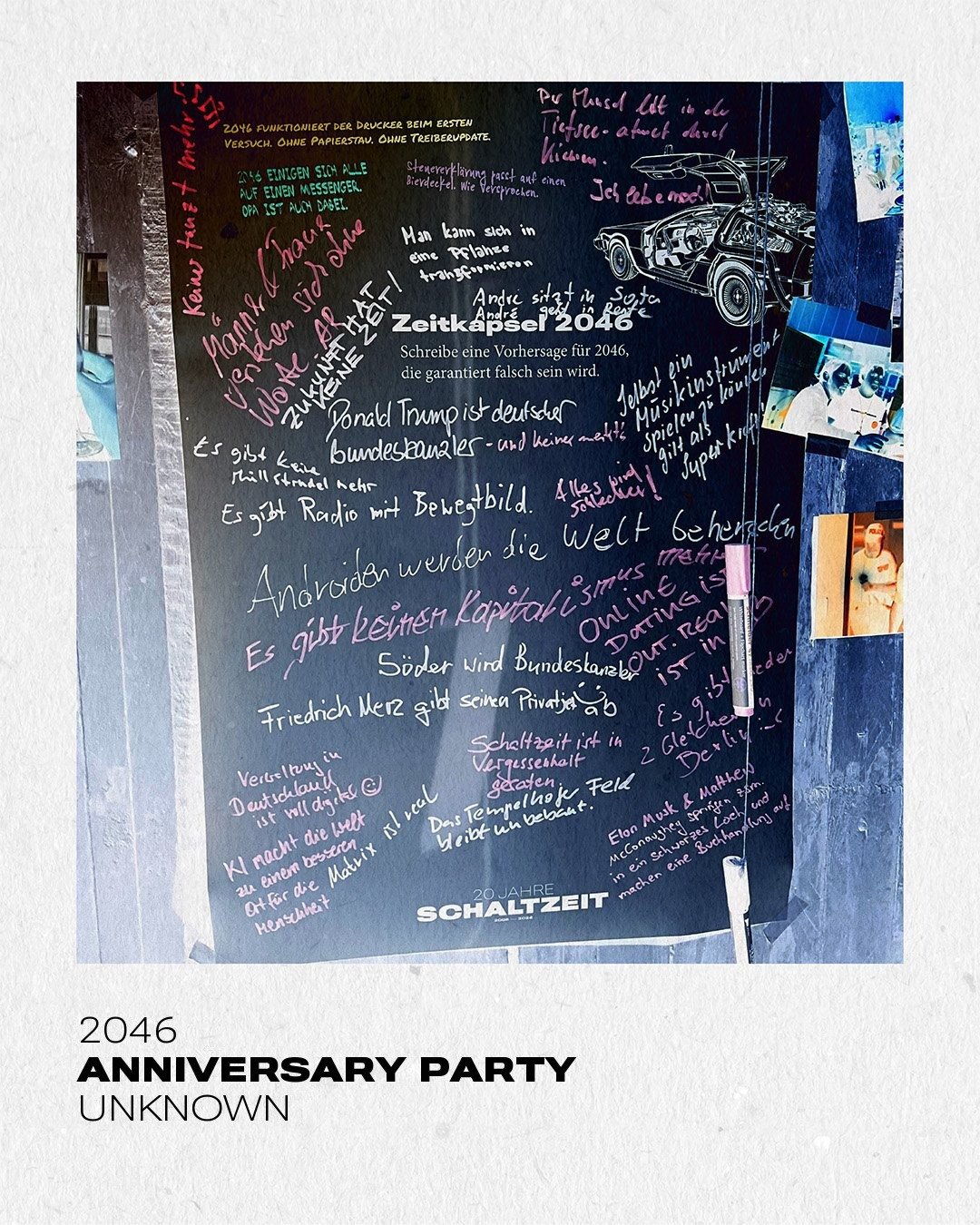
Futures thinking, as we all know, also includes the art of occasionally thinking through the unthinkable. At our anniversary party, we pursued this discipline in all seriousness: over good music and cold drinks, we asked what absurd predictions you had in store for 2046. What is guaranteed not to happen – or might it happen after all?
A few highlights:
- Tax returns fit on a beer coaster – as promised.
- Printers are the most reliable devices in the entire office.
- Men and women understand each other without words.
- You can transform into a plant.
- Schaltzeit has been forgotten.
- Online dating is out. Really!
- André retires to the sofa.
- ….
With that in mind: the future hasn’t been written yet – let’s see what happens.