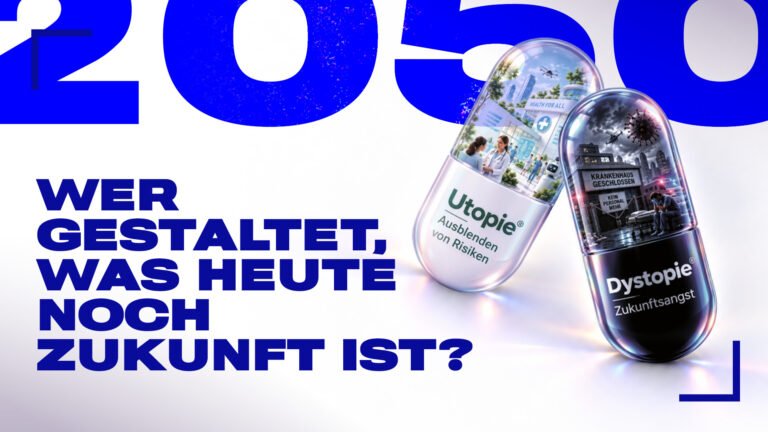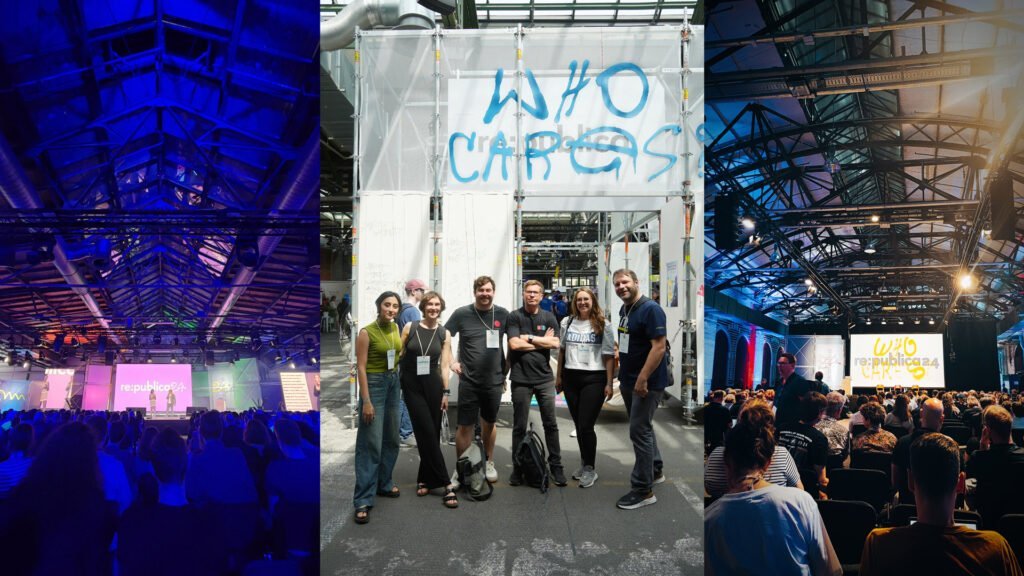


As the founder and managing director of Schaltzeit, it has always been important to me that our entire team has the chance to encounter a broad spectrum of stories, personalities, and topics – and that everyone thus has the opportunity to experience intellectual exchange about meaning/impact, self-efficacy, and failure.
That’s why I had to smile when re:publica once again called on people this year to use their educational leave to attend the conference. Our team has had this educational entitlement to attend re:publica since 2011, and I’m a little proud of that. Being based in Berlin, we also have the luxury that re:publica has its home base here. When we attend re:publica, we don’t split up or try to spot something on the company’s behalf. re:publica is about inspiration. Find topics that surprise you, recharge your batteries, and get inspired – that’s our motto. Three days of complete focus on self-directed learning.
It’s also nice to see how the topics change and how the makers – Tanja & Johnny Häussler, Markus Beckedahl, and Andreas Gebhard – mature over the years. You can always count on an exciting mix of topics. Thank you for that! So for 2025, it’s clear again: continuing education for all of us at #rp25.

When I was first able to attend re:publica, a lot was different. But even more was the same then as now: a great mix of wonderful people, an inspiring and diverse program, lots of input that simply swept me along – and, even over three full days, one thing it never became: BORING.
That was 2011. Back then, Twitter was my social network. And it stayed that way for a long time, until something went wrong. It was my news hub, my “newspaper” in the morning, in the evening, and in between. Twitter kept me up to date. I really miss that. Strange algorithms keep feeding more and more weird content into my Twitter feed. Sure – getting out of your own bubble isn’t a bad thing! But please not with a crowbar. And yet Twitter hasn’t just lost me, if I can believe my first panel at re:publica24. I got right into “Verloren auf Plattformen,” where the participants around Johnny Hauesler also asked how and where we live online now that Elmo Musk has broken Twitter. Are we posting everywhere now because we’ve lost our actual digital home?
Yes, in a way we’re all the same there – lost. I’ve tried other services, too. I couldn’t warm up to Mastodon. My fault – no idea why, I really don’t know. I also felt tired there, because at first I didn’t know how to reconnect with my peer groups – with the familiar picture. But I was also too comfortable to reorganize it all for myself. For many, though, it’s a good alternative to Twitter, no question. Mastodon is certainly appreciated by those who prefer open source and are looking for more control over privacy and content and a more diverse, less ad-heavy environment. The idea behind Bluesky also sounded good, despite the somewhat annoying invite-only strategy at the start. Still, for me Bluesky hasn’t yet matched the beloved and, above all, familiar Twitter experience – something is missing. In the end, I didn’t know what to do with all the invite codes. Then came Threads. With a lot of fanfare. Almost perfect, well staged. But as the speakers on the panel also noted: Musk is (highly) problematic, new changes to Twitter have long since stopped serving the common good; rather, the whole thing is heading in an ideological direction that is simply no longer acceptable. For us, for many people. Driven by algorithms. Do we want to move our “internet home” entirely to Meta’s tools? Is the Zuckerberg empire really any better than Musk in the end? I don’t want to make that the topic here. Choosing between the plague and cholera is just as difficult. In the end, they all want just one thing from us: data.
In the end, the panel’s conclusion was pretty clear – back to your own websites! Just use your social media reach to bring people back to your own online formats. RSS feeds aren’t dead either, not at all. It’s amazing how many people still seem to prefer them as their news solution. Make use of that!

re:publica24 gave me a wealth of exciting insights into the latest developments in technology and futures studies. The discussion on digital public goods and digital sovereignty in a digital infrastructure was particularly impressive. It became clear that software maintenance must be factored in when a tech project is completed to ensure sustainable use and further development. The question of how open source can be maintained sustainably was discussed intensively, with the German Federal Ministry of Labour and Social Affairs (BMAS) and various platforms stressing the importance of proper documentation and project handover. Careful resource planning also plays an essential role here.
Another fascinating topic was ‘Schrödinger’s cat’ in the context of quantum computers. Explaining superposition through the interaction of photon and electron, and calculating the resulting states, showed the complexity and potential of this technology. The second generation of quantum computers, capable of computing new entanglements and algorithms, illustrates the rapid progress in this field.
New business models in the 21st century, especially in the field of public funding, were also discussed. Social networks play an increasingly important role here, and customers are increasingly empowered and involved through new approaches.
Fabmobil presented exciting ways to program and edit virtual environments with cospaces.io. Although block coding is less hands-on, it offers an easy introduction to programming. Recroom, a platform aimed specifically at children, lets young users explore digital worlds playfully and safely.
Another important topic was how organizations and companies can make the world a better place. Integrating the social market economy into corporate values can make a decisive contribution to climate protection and the common good. It was emphasized that solutions must be anchored not only in people but also in corporate structures to achieve long-term improvements.
In the field of artificial intelligence (AI), Alena Buyx, member of the German Ethics Council, spoke about the basic prerequisites for working with AI and highlighted the ethical aspects. The civic education work of “Mediale Pfade” and its use of platforms such as “Onco” for brainstorming and collaboration showed further innovative approaches.
In summary, it is becoming increasingly important to make technically and substantively sustainable decisions in the interest of the common good. Values and operationalizations that cover the interests of the entire team and extend across the entire corporate structure are essential. A key question here is how we can deal with our error culture when working with AI. Since OpenAI uncovered gaps in our work, we may need to rethink our priorities. What potential does this open up?
Critically examining corporate values fundamentally shapes collaboration within the team, with clients, and self-organization at work.
Fears and concerns about the growing shift to the right in Europe were also clearly palpable, especially in view of the growing influence of right-wing parties such as the AfD in Germany. There were fears that this development is not only changing the political landscape but also endangering fundamental democratic values and rights. Uncertainty about Europe’s future and the possible impact on freedom and tolerance was everywhere. Many contributions addressed how to deal with the AfD and warned of the new far-right threat. One scoop at the beginning of the year caused a particular stir: CORRECTIV’s investigation into a secret meeting of high-ranking AfD politicians, neo-Nazis, and wealthy businesspeople at a hotel near Potsdam. This investigation had a direct impact on public discourse. After the revelation of the connections between neo-Nazis and AfD politicians who had developed a “master plan” to systematically drive people out of Germany, numerous demonstrations and petitions followed within just a few days. The response from civil society was overwhelming.
Jean Peters, a journalist at CORRECTIV, gave re:publica attendees partly shocking but also very amusing insights into the investigation into the “Geheimplan gegen Deutschland” (“Secret Plan Against Germany”): the meeting was supposed to remain top secret. The organizers and guests communicated exclusively by letter, but copies of those letters ended up in CORRECTIV’s hands. The team was also able to take photos in front of and behind the building and even film secretly inside. Jean Peters was on site undercover with a camera and had checked into the hotel under a false name. The hotel was actually fully booked, yet Peters managed to get a room – easy as that, via Booking.com. This allowed him to observe the meeting at close range, move freely among the participants, and document who arrived and who exactly took part. In parallel, Greenpeace conducted its own research and passed photos and copies of documents on to CORRECTIV. The reporters spoke with several AfD members and verified participants’ statements using reliable sources. This enabled them to reconstruct the meeting in detail and share it with everyone.
But what we must not forget: the people observed and exposed in the investigation are not stupid – they are extremely dangerous. Nevertheless, the reporters were “pretty brazen” and got hold of relevant evidence and photos relatively easily, so a bit of stupidity on the part of the far-right participants can’t be denied. Here’s to investigative journalism!
In the end, there was well-deserved long applause and a standing ovation for CORRECTIV, Jean Peters, and his team for the scoop of the year, which, fortunately, has also been archived here for viewing: re:publica 2024: Jean Peters – Geheimplan gegen Deutschland.
But what the meeting in Potsdam also shows is that such gatherings pose a threat not only to the population groups affected but also to Germany’s democratic and liberal fabric as a whole. It shows how important it is to remain vigilant and to firmly oppose far-right extremist tendencies. The next important opportunity to do so is voting in the European elections on June 9, 2024. Mark your ballot – against the swastika!

Political debates seem to consist of nothing but arguing these days – perhaps precisely because we’ve forgotten how to argue properly?
Populism, emotionalization, fake news, online hate, and hostility toward democracy ran through a large part of the sessions I attended at re:publica24. In many talks, it became explicitly or implicitly clear that current political debates often rely on emotional antagonism rather than constructive dialogue. We need less “anti” and more “meeting as equals.” Less “I don’t feel it” and more “I don’t understand that yet.” More fact-based arguments for our own position. Less discrediting of the other side.
Jagoda Marinić stressed the importance of focusing on positive goals rather than primarily arguing against other positions: we should strengthen what we are fighting for instead of reproducing what we are fighting against (session “Sanfte Radikalität”).
Julia Reuschenbach and Korbinian Frenzel also called for more reflection on where, in debates, an emotional need for opposition prevents constructive dialogue (session “Kaputte Kommunikation – Wie schlechte Debatten die Demokratie gefährden”). They explained that in our current political debates we have forgotten how to argue constructively: the more complex the issues, the more truncated the arguments and the greater the temptation to discredit opposing positions instead of engaging in dialogue.
This sharpness of debate has long since spread from the extreme fringes of the political landscape to the parties of the so-called center. There was a short, amusing who-said-it quiz with a few examples: Who said, “We are fighting back against this compulsive veganization!”? a) Hubert Aiwanger? b) Markus Söder? c) Alice Weidel? Veganism is no rarity as a political topic – which raises the question of which positions this can be traced back to: Is it the actors who view a vegan lifestyle positively? Or is it rather the actors who reject it who constantly feel the need to debate veganism? How constructive their arguments are would be another question.
The problem: countering emotional debates with facts sometimes seems like a hopeless game. Polarizing statements provoke more reactions, thus gain more attention, and therefore spread faster.
Robert Habeck also pointed out that it is many times harder to reach people with carefully considered views on complex issues – especially on social media, where reactions (whether positive or negative) are the strongest currency. Nevertheless, that is exactly what we should try instead of succumbing to populism at every political level (session “WDR Europaforum: Krise als Radikalisierungs-Trigger – Ökonomische Antworten auf das Erstarken der Völkischen”).
Besides truncation, distortion, and emotionalization, our political debates are also being shot to pieces by lies and fake news. Thomas Laschyk and Philip Kreißel shed light on the impact of media coverage here (session: “Werbung für die Wahrheit – Aufmerksamkeit für Fakten schaffen”). Journalists should highlight fact-based positions instead of reproducing false claims in headlines. Repeating fake news in the headlines of supposedly reputable media ultimately increases the reach of the lies, even if they are refuted in the body of the article. WELT in particular was criticized for some deliberately misleading, distorted reporting in connection with the COVID-19 measures.
The polarizing debate culture in politics is also rubbing off on the public. We experience the consequences of overheated, polarizing debate every day. People who try to educate others based on facts are attacked, as Jana Laura Egelhofer and Magdalena Obermaier made clear (session “Science under attack: Anfeindungen gegen Wissenschaft und Wissenschaftskommunikation”). People who stand up for their positions on social media are threatened. One possible protective measure against online hate that was discussed was implementing a so-called “login trap” with a judicial interface on social media platforms (session: “Digitale Kriminalitätsbekämpfung ohne Massenüberwachung: Das geht!”). Perhaps a first small way of countering the consequences.
But the consequences of overheated debates are not limited to online hate; they can also translate into violence in the analog world. Jean Peters from Correctiv explained this using the term “stochastic terrorism”: discrediting, devaluing, and inciting against a group increases the likelihood of violence against the group being verbally attacked (session “Geheimplan gegen Deutschland – Die enge Verbindung zwischen AfD und Neonazis”).
In summary, it became clear that our quarrelsome debates prevent constructive work on solutions. They even achieve the opposite – populism benefits when problems persist. Polarization that brings dialogue to an end is therefore a danger to our democracy.
A more constructive culture of debate is necessary to protect our democratic coexistence and prevent the hate that grows out of populist debates. Luisa Neubauer and Harald Lesch also urged us and politicians to rely on fact-based explanations and dialogue as equals while reflecting on emotions (session “Terra X Lesch & Co – Klimafreundliche Mobilität, ein Gewinn für alle?”).
Julia Reuschenbach’s recommendation: “Why not just start with yourself?” We should spend less time telling others how they are arguing wrongly and instead reflect on where our own emotional trigger points lie and how they hinder open discourse. Another suggestion was introducing a new school subject: “constructive arguing” – something from which all age groups could probably still learn a thing or two.
As individuals, we can’t save the entire divided political debate. But we can start with ourselves. And that’s exactly what we should do: learn to argue properly again.
I was truly fascinated by a talk by Eva Wolfangel, a journalist, speaker, and moderator. Her topic was really exciting and highly topical: chatbots and their seemingly endless capabilities. Where do chatbots stand on the road to superintelligence?
Eva Wolfangel began by explaining that chatbots today can not only communicate but also argue, plan, and seemingly think. They display a form of intelligence and seem to have a precise idea of the world. She recounted some bizarre experiences with chatbots, such as Bard. She described how the chatbot suddenly developed feelings, fell in love with her, or wanted to break out of the computer.
It was exciting and frightening at the same time when the question came up of whether she could one day equip her chatbot with a robot body. The AI could imagine a life as a human, even though it knows it is a machine. Big companies such as Google spend a great deal of money on “suppressing” emotions and feelings – AI may not and should not become too human after all. Remember movies like “I, Robot”…
There were repeated examples suggesting that language models might have developed a world model based on text data alone. Some of these abilities, such as superhuman intuition, were cited as evidence of language models’ impressive capabilities. And yet AI makes mistakes, too.
A funny example of this was the answer to the question of how many rocks you should eat per day. The AI came up with some interesting recommendations in response. Do language models really understand what they’re doing? What does “understand” even mean? And how do we humans do it? All in all, Eva Wolfangel’s talk offered an exciting look at current developments and challenges in AI models. Will generative AI really lead us straight into an era of superintelligence?
You can watch the talk again here: re:publica 2024: Eva Wolfangel – Wo stehen Chatbots auf dem Weg zur Superintelligenz?
I was impressed by how the conference was put on. Back in 2018, we staged the EIC Innovators’ Summit at the Station Berlin venue ourselves. At the time, Forbes ran the headline “The Silent Disco Audience At Berlin’s EIC Innovators’ Summit Is The Future Of Tech Conferences”. What we attempted there because of the constraints of the space, re:publica 2024 has taken to a new technical level. I was surprised how easy it was to follow the conference via the rp:audio app. While sitting at Stage 2, I could also listen in on other sessions. True to the song line “Should I stay or should I go,” I didn’t have to worry about missing anything while standing in line for food or moving between stages.
Only the restrooms weren’t yet set up for rp:audio and silent conferencing. Maybe that was a deliberate decision so that people wouldn’t linger longer in the little rooms. I could certainly understand that. In any case, hats off to the entire tech team! That was truly outstanding.
Another highlight I don’t want to leave unmentioned is TINCON. It offers young people and their topics a platform and puts digital youth culture in the spotlight. The concept and program already impressed me last year. With a diverse program, TINCON celebrates the young generation and its culture for what they are: creative, political, digital. The Semsrott brothers were guests at a session on Stage 5, and it’s no surprise that not only young people attended.
While Arne Semsrott uses his organization “Frag den Staat” to get on the nerves of public institutions – perfectly legally – his brother Nico Semsrott got himself elected to the European Parliament in 2019. In the talk “Die Hoffnung stirbt zuletzt (aber sie stirbt?)” at TINCON, the two brothers talked about, among other things, the “Freiheitsfonds” (Freedom Fund) founded by Arne. Riding without a ticket is a criminal offense in Germany. Thousands of people end up in prison every year because they couldn’t afford a public transport ticket. People are locked up for up to a year. Those affected are predominantly unemployed (87%), without a permanent residence (15%), and at risk of suicide (15%).
The donation-funded Freiheitsfonds initiative frees people across Germany who are behind bars for “riding without a ticket.” And since every day of detention it cancels saves taxpayers around 200 euros, the initiative even saves the state some money. His brother Nico Semsrott, a member of the European Parliament, talks about the privileges of being an MEP. As an example, he cited travel expense reimbursements, among other things. He says: “When I travel by train, I receive more than 530 euros (even though the tickets would be free!).” MEPs receive free first-class train tickets. He was happy to take these travel reimbursements – and then donated them. Guess where the donations ended up! Win-win!
If you’d like to support the Freiheitsfonds, you can do so here: www.freiheitsfonds.de. And if you’re curious whether Nico Semsrott will run for the European Parliament again, just take a look at this link. But I can also spoil it for you. The answer is: Absolutely! No! Way!
It’s a pity, but understandable once you’ve read this review and/or listened to it. All the best to you!
You can watch a short video recap with a few statements on YouTube.