
On a conference sidekick bot and crunchy background noises, a room full of trolls and the rules of virtual events – the re:publica in digital exile brought us a wealth of new experiences.
Spread across eight conference rooms – though not necessarily any easier to navigate than usual – re:publica Berlin took place entirely in virtual space for the first time on May 7, 2020. Given the circumstances, its thematic scope was comparatively small, yet the event still stood out as a remarkable learning experience – for the organizers, for the audience and especially for us at Schaltzeit, because, as always, we were there.
Trying to stage a larger event in virtual space raises questions and answers, problems and new solutions:
How should interaction happen in virtual space? Can attention really be sustained in front of a screen? And first of all, of course, it has to be clear how the content should be shared with the audience in the first place.
A total of 53 sessions, spread across the channels ASAP 1, ASAP 2, re:work and Media Convention Berlin – each of these channels with its own deep-dive room for debriefing, to really dig into the subject matter – as well as to exchange ideas with speakers and the audience. Plus the courtyard and the breakout rooms. How would you follow all of that, let alone take part?
Through a Zoom stream on the website!?
And fortunately also via YouTube and Facebook, because with more than 100,000 views in total (according to verdi.de), the website offered only sporadic access. Anyone who wanted to check the program again during the event often refreshed the page in vain.
So my advance planning would have served me well – had I not thrown it overboard in the course of the afternoon.
Priorities had to be reset. More than once I had to guess which session I had just dropped into – thanks to schedule shifts and a lack of overview graphics.
In general, we were short on visuals. Schaltzeit CEO André Winzer, for example, switched to “radio mode” as a test during the event, turned to other work and fell out of the loop. He lost his focus. After all, unlike casual radio segments, the at times truly demanding talks just couldn’t be enjoyed in the background, he told me. It’s a pity that in front of the virtual backdrops (in sterile shades of yellow, red and purple), often just a single speaker could be seen on camera. More media content would probably have held our attention better.
“If we plan something like this in the future, I will definitely make sure to avoid formats where you see nothing but a head for 45 minutes…”
Felix
Because when the audience we would otherwise share the experience with is missing, the presentation itself has to become a memorable experience. Information that is packaged not only in words but specifically in visuals helps make learning tangible. That said, not all contributions were “just talk.”
One example worth mentioning here is my personal highlight of re:publica TV: Protest art in Hong Kong (6:37 – 7:00): A topic that seems almost to get lost in today’s social media discourse. A simply structured presentation of concise descriptions and moving images that added up to the bigger picture. Not least because art makes me far more inclined to let emotion into the process of learning.
“A flashback to the chat rooms of 1996, to the early days of the internet…”
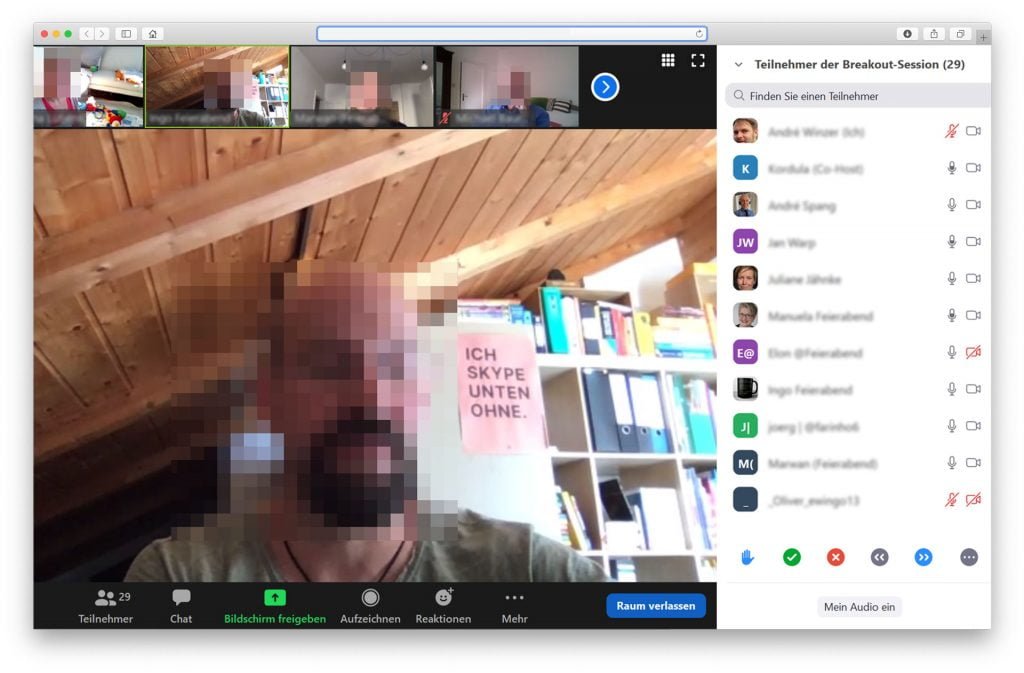
André Schulz seems almost sentimental as he talks about the breakout rooms. What almost sounds like a diss is in fact an expression of the highest enthusiasm. André Winzer and Felix Clasbrummel feel much the same: when it comes to interaction, networking and creating a space for virtual togetherness, re:publica has taken a charming path. People met in the so-called courtyard during breaks between sessions and later in the evening. From there, you could be redirected to various breakout rooms, which is what made coordinated exchange among participants possible in the first place.
Spontaneity was called for here: the moderators quickly realized that with 200–300 participants, assigning each person to the breakout rooms would have taken forever, since there was no alphabetical sorting. The team’s human intelligence came up with a quick fix: people changed their usernames so that the organizational effort could be kept to a minimum.
We particularly liked how the trolls were handled. They were to be expected: they squawked out of our speakers for exactly as long (or rather as briefly) as it took until they were locked in their own room. In the wrap-up shortly before 11:00 pm, it was noted with delight that only one “masturbating troll” had dared to appear on camera. The support crew had expected far more daredevils. The idea of the troll room was born. And it was effective: trolls only had to show themselves to be banished to their cave immediately.

Among its own kind, the troll surely found its most receptive audience...
Those who wanted to spend their time on serious conversations or a spontaneous virtual beer pong night, on the other hand, now had the undisturbed opportunity to do so – as long as they followed the rule…
We discovered the golden rule of virtual events
Only with your camera on and when you speak up are you part of the group. Presence has to be shown! And indeed, only by interacting with what was going on could you truly immerse yourself in it, rather than merely “tagging along.”
We missed the wanderings between sessions, across the courtyard and through the crowds of visitors that created such a vivid trade-fair atmosphere at past editions of re:publica, despite the collective pressure to join in. Or perhaps precisely because of it.
After all, the big “Hello, here I am!” – which rarely matters in real-life encounters – doesn’t invite everyone to interact.
Besides direct interaction in the Zoom sessions and through the Mentimeter questions, Twitter in particular served as a place for lively exchange…
“Someone’s eating chips in front of the mic…”
That, or something like it, was how tweeted comments on ASAP 1 sounded. Because that is pretty much exactly what it sounded like: someone seemed to keep munching away into the audio track – without letup…
Twitter, however, not only offered room for the corresponding amusement, but also invited more relevant content, such as the Konferenzkomplize, a bot that used a sample process to promote its capabilities for supporting conferences.
As tradition dictates, the close of re:publica in digital exile was marked by the joint Bohemian Rhapsody session. Unfortunately, this year it wasn’t a karaoke, but it still created a certain sense of community, a re:publica feeling – even remotely.
I could go on and on. We got to experience so much that was new: there was chaos, and of course there is room for improvement for the next big virtual events. What is certain, though, is that the re:publica organizers have taken a first step that many more will follow and from which we can learn a lot.

Our personal learnings:
- It takes spontaneity and, above all, formats for exchange. The courtyard was very hidden. Games like virtual beer pong add variety. We need more of them!
- Singing together – definitely not just as a video, but as a real event!
- A navigation tool, perhaps in the form of a map, would help with orientation between the streams.
- The tool landscape needs to be integrated sensibly. This may call for an editorial team. Whether Mentimeter, Zoom, Twitter, YouTube or the many boards of individual users – there has to be a shared place.
For these learning experiences, as well as for organizing great contributions and an entertaining evening program, we thank the pioneers of the re:publica team.
Feedback on re:publica TV will help optimize future formats: https://20.re-publica.com/de/news/euer-feedback-gefragt-rpremote-umfrage.