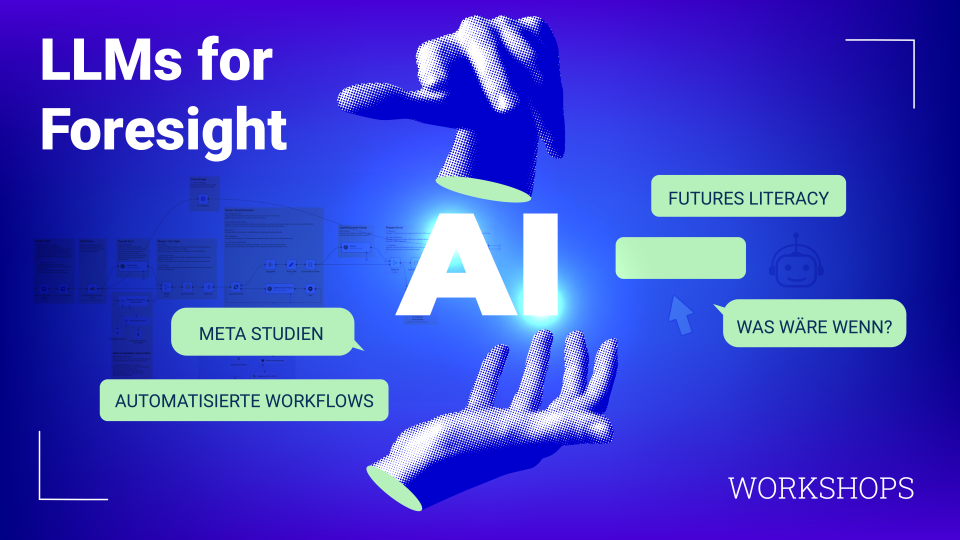

AI & foresight: discussed enough – or not enough yet? It has long been clear: not all AI is the same. As with any approach, the question is: what is my goal in the first place? What do I want to achieve with the help of AI? Between simple, low-barrier GPT applications and complex, structured workflow systems lies a broad spectrum – and that is exactly where our work at Schaltzeit takes place. Depending on the use case, we use different AI approaches to foster Futures Literacy or scale foresight processes.
Supporting complex foresight processes with AI workflows: our workshop “Foresight agents and the instant radar”
If you want to dig deeper, this workshop covers the more complex end of the spectrum: data-driven, traceable foresight workflows – from defining sources and automated analysis to documenting and interpreting trends and signals.
With our AI Instant Radar, we show how foresight processes can be accelerated and scaled without losing sight of human reflection. We present a live AI workflow with a thematic radar from real-world practice. Together with you, we discuss what it can do, where its limits lie and how strategic clarity can be gained from it.
This workshop is aimed at foresight professionals and decision-makers who want to test the potential of AI in foresight processes.
👉 Learn more in the case study “Strategic Clarity with the Ad-hoc Foresight Radar”
🗓️ Workshop: October 21, 2025 “Foresight agents and the instant radar”
🧭 Focus: Workflow, traceability, scalability
💡 Tool: AI Instant Radar (advanced level)
Simply try out what it feels like to think in futures: in our workshop “Future scenarios step by step” – Futures Literacy through low-threshold access thanks to AI
Not everyone wants to set up a full foresight process right away – and yet complex questions about the future affect us all. As a Futures Literacy offering, we have translated the systematic scenario method into a low-threshold format in our freely accessible Scenario GPT (for anyone with a ChatGPT account). The tool guides you step by step through a methodologically sound scenario construction – no prior foresight knowledge required.
This workshop is aimed at non-specialists and curious minds who want to try out what thinking in futures feels like. Together, we explore how AI can help work through questions about the future in a structured way, critically reflect on the results and thereby sharpen your own awareness of the future.
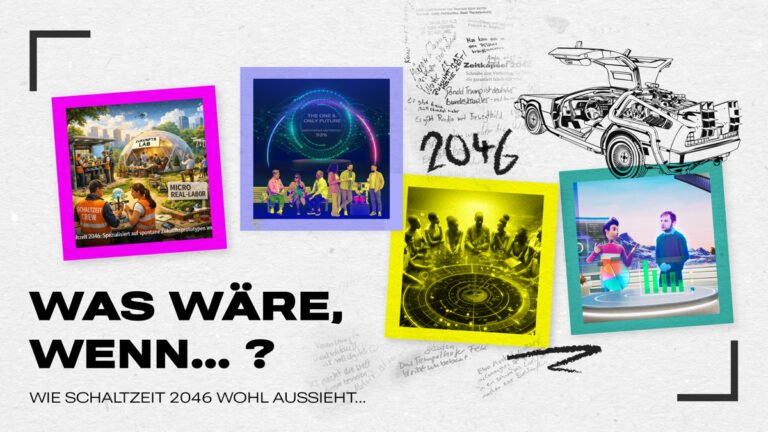
👉 Also read our blog post “The Future in the Plural – What If?”
🗓️ Workshop: 04.11.2025 “Future scenarios step by step”
🧭 Focus: Futures Literacy, low-threshold access, playful experimentation
💡 Tool: Scenario GPT (beginner-friendly)
AI in foresight – tool, mirror and challenge all at once
At Schaltzeit, we see artificial intelligence as a valuable tool, but also as a touchstone for futures studies itself. AI can help structure large amounts of data, reveal patterns and design new scenarios. But its quality depends crucially on the context, the underlying data and critical human oversight. Learn more: AI in scenario planning: Opportunities and challenges.
In foresight, AI opens up a broad spectrum: from low-barrier tools that make futures thinking accessible to everyone to complex, data-driven analysis workflows that support strategic decisions. What matters is not whether AI is used, but how – transparently, traceably and thoughtfully.
At the same time, generative AI poses new challenges to the knowledge base of futures studies. As synthetic images, texts and videos become increasingly hard to distinguish from reality, the search shifts from information to verification. Futures studies must therefore think not only with AI but also about AI: how are our forms of evidence and our trust in knowledge changing? Learn more: Between pixels and truth – implications for foresight and futures studies
For us, one thing is clear: future-ready foresight work happens where people use tools – whether an analog flip chart, an interactive radar or an LLM workflow – to think, discuss and create critically, creatively and with an awareness of context.
We look forward to your ideas and questions – come to our workshops or just drop by for a coffee. See you soon!