
Why context data is crucial for AI-supported scenario planning
Quality over quantity: Instead of blindly feeding unfiltered data into AI models, companies need to carefully prepare and structure their data sets. That is the only way to get reliable results.
Targeted data selection: Organizations should deliberately use context-relevant data that reflects their specific challenges, trends, and strategic objectives. The better the data is tailored to the context, the higher the quality of the AI-generated scenarios.
Mega-prompting and iterative refinement: how to create added value
To achieve high-quality results with AI in scenario planning, simple prompts are not enough. What you need are well-thought-out, carefully structured prompts that clearly capture the context:
Mega-prompts: These are modular prompts that break complex tasks down into clear subfunctions. They can be used, for example, to search specifically for trends, compare existing scenarios, or clearly assign topics.
Iterative feedback loops: Human experts critically review and adjust initial AI results and feed them back into the AI. This feedback process significantly increases the relevance and strategic value of the scenarios.
Transparency and trust through tailored AI assistants and causal AI
Tailored AI tools: When AI tools are precisely aligned with the scenario planning process, the results are easier to understand and trace.
Causal AI as a future trend: Causal AI is particularly exciting because it not only finds correlations but specifically examines cause-and-effect relationships. This makes it possible to explore questions such as “What happens if we do X?” directly, which yields valuable strategic insights.
Humans and AI: the perfect interplay in scenario planning
Strategic decisions remain human: Defining the scenario field, selecting key factors, and interpreting results remain the job of human experts.
Hand in hand: AI provides the data-based foundations, while human experts derive the strategic implications. This is how humans and AI complement each other perfectly.
Realistic expectations and continuous evaluation
Why we write about AI in scenario planning
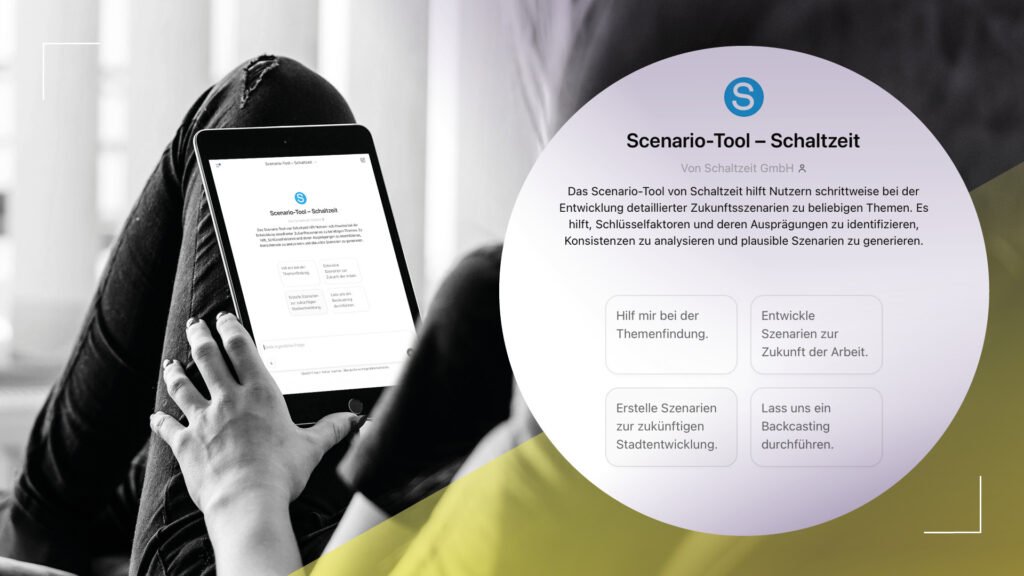
As experts at the intersection of strategic foresight and AI, we work intensively on the possibilities and limits of artificial intelligence in scenario planning and other futures studies methods. Our goal is to develop methods and tools that effectively support people in strategic decision-making. Our experience with AI-supported solutions – such as our own custom-built Scenario Tool – has shown us how important it is to understand both the technical possibilities and their limits. Only then can we develop high-quality, realistic, and strategically relevant future scenarios that enable companies to act.