
Futures Games II – Interview with Nora Marleen, Moonshot
In Moonshot, teams race each other to shoot their ideas to the moon. Nora Marleen has been running the innovation game as a Game Master for three years. A countdown from ten to zero about a forgotten game box, a space penguin and why she would rather not use the word “game”.
Interview: André Winzer, developer of the Foresight Zoo and CEO of Schaltzeit · 12 November 2026
It’s just a game ¯\_(ツ)_/¯

Nora Marleen, illustrator, Playful Business consultant and Moonshot Game Master. Photo: Benjamin Zibner
Key takeaways
- Moonshot is an innovation game for six to twelve people: teams develop ideas and business models and compete in a race to the moon.
- It was developed by Till Hasbach together with Martin Wiens and grew out of a 2017 course at Berlin University of the Arts (UdK).
- When talking to companies, the team prefers to call it an innovation methodology rather than a game.
- The name refers to the Apollo programme and to the ambition of making something ten times better rather than ten percent better.
- In Nora Marleen’s experience, everyone is fully in the game by the second round at the latest.
On 12 November 2026, Schaltzeit hosted Futures Games II in Berlin. 26 participants, three games and one evening under the motto “Stop predicting, start playing”: no matter how much data you collect, the future remains opaque – play with it!
The tables offered three very different approaches. Sylvia Veenhoff of the German Environment Agency (UBA) presented a foresight toolkit that helps municipalities rethink their town centres. Makēda Gershenson of Quest Labs brought her “Black Menagerie”, a bestiary in which animals stand for slow, long-term change. And Nora Marleen of Playful Business sent the group off with “Moonshot – The Innovation Game” in search of bold ideas beyond well-worn patterns of thinking.
We were particularly curious about Moonshot. Schaltzeit once gave away a small Moonshooter game of its own as a Christmas present, so we were all the keener to find out what it feels like when a game master sends an entire group to the moon.
Each of the three games gets its own interview, each in a different format. This one is a countdown: eleven stages from ten to zero. We met Nora Marleen just before the evening got under way.
10 – From illustration to Game Master
Who are you, and how did you get from illustration to being a Game Master?
My background is in illustration: I did a bachelor’s in illustration and have been working as a freelance illustrator for more than ten years. But in the long run I didn’t want to be only on the delivery side, so I went on to study Communication in Social and Economic Contexts at Berlin University of the Arts, first the bachelor’s and, just recently, the master’s as well. Today I know design from both sides: as an illustrator and as a client.
I also came to Moonshot through the UdK: I took a course there with Till Hasbach, the founder of Playful Business, and then started at Moonshot as a working student. These days I’m a consultant at Playful Business.
9 – What is Moonshot?
Explain Moonshot so that your grandma would understand it.
I’ve actually done that. I said: Moonshot is there to open your mind and come up with really unusual ideas. For once, you break free of conventional thinking and have a lot of fun doing it.
And for everyone who isn’t your grandma?
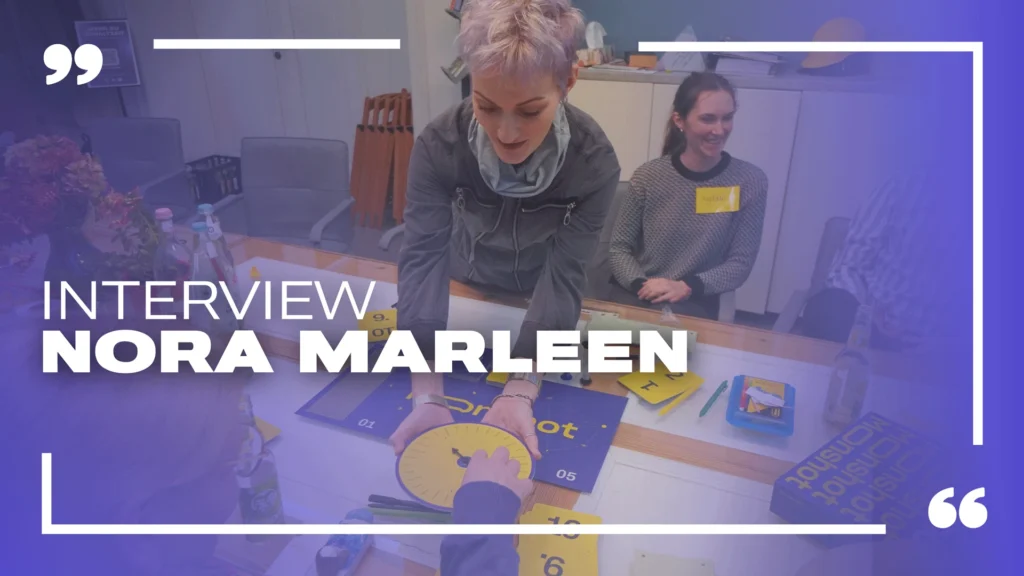
It was developed by Till Hasbach and Martin Wiens. The first prototypes came out of a course at the UdK in 2017, and since then the methodology has been refined over the years and sharpened with corporate clients. The basic idea: innovation can’t be planned, but it can be played. I’ve been involved for three years. Typically we start with an ideation phase. Then up to twelve people compete in teams and shoot their ideas and business models to the moon. Of course, every team wants to land first. Along the way, the ideas have to pass challenges and get developed further round by round. But you can also bring existing ideas and business models into the game and put them through a stress test, or develop new ideas around a specific question.
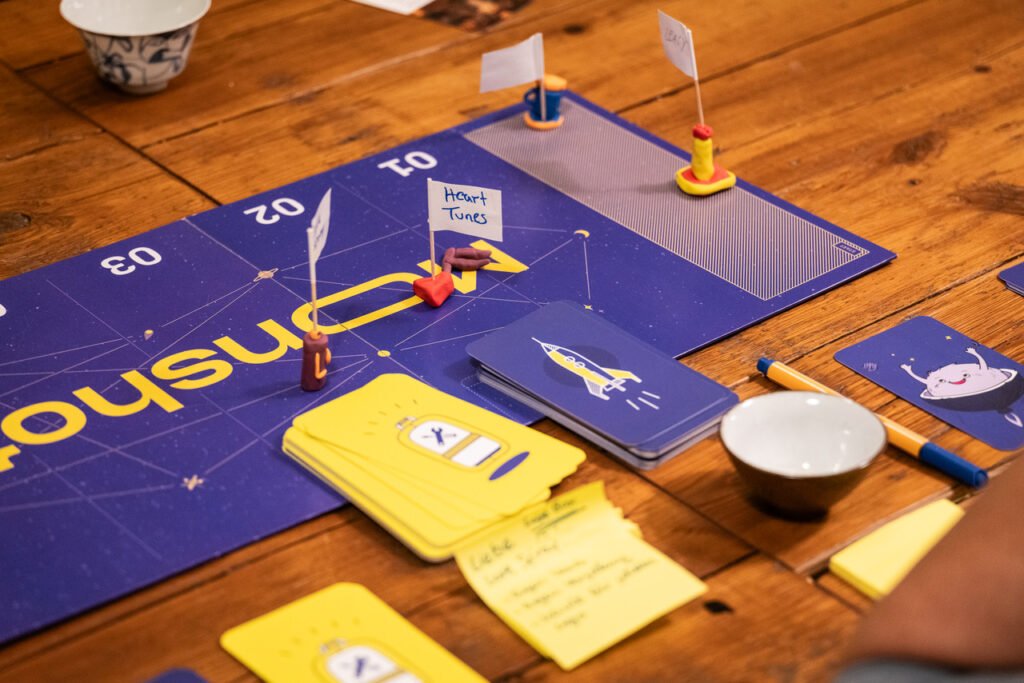
Moonshot on the table: game board, cards and modelling-clay figures with little flags. Photo: Benjamin Zibner
8 – Game or innovation technique?
Why is Moonshot a game and not a workshop method?
At its core, Moonshot is an innovation methodology cast in the form of a game. The thing is, many adults are no longer used to playing, and some even avoid it. People want to be taken seriously, and playing doesn’t seem to fit that image. I’ve often come across this scepticism towards anything playful. That’s why we usually avoid the word “game” and prefer to talk about an innovation methodology.
But it isn’t a single workshop technique either. It’s a complete workshop format: Moonshot combines creativity techniques with game mechanics that keep pulling you out of your usual ways of thinking.
When is Moonshot the right choice, and when isn’t it?
Moonshot is ideal if you want to tap into and expand your team’s potential and develop and test ideas in a playful way. It’s less suitable if you expect innovation to be a linear process that leads to a predefined goal in fixed steps.
“Many adults are no longer used to playing, and some even avoid it. People want to be taken seriously, and playing doesn’t seem to fit that image.”
Nora Marleen
7 – What you don’t see: design, giants and penguins
You’re an illustrator. Which design decision isn’t obvious at first glance?
That sounds like you’re asking about Easter eggs. There aren’t any, though, because the whole concept has to be designed so that people get it straight away. What you don’t see is the work that goes into making everything clear at a glance. And you don’t see everything that got cut along the way because it didn’t work well. Good game design is largely about leaving things out.
The design of Moonshot isn’t mine. But I did illustrate the new Game Master cards. We developed them so that teams can run a session even without a trained Game Master.
An angry giant with a club appears on your cards. Does an innovation process need opponents?
I wouldn’t call them opponents, more like challenges. The angry giant does exist, but he’s only so cross because there are no innovations his size. So: think big! Then there’s a space penguin, for example, who attacks and has to be defeated. The only way to overcome obstacles like these is to develop your idea further. Very much in the spirit of: the obstacle is the way.
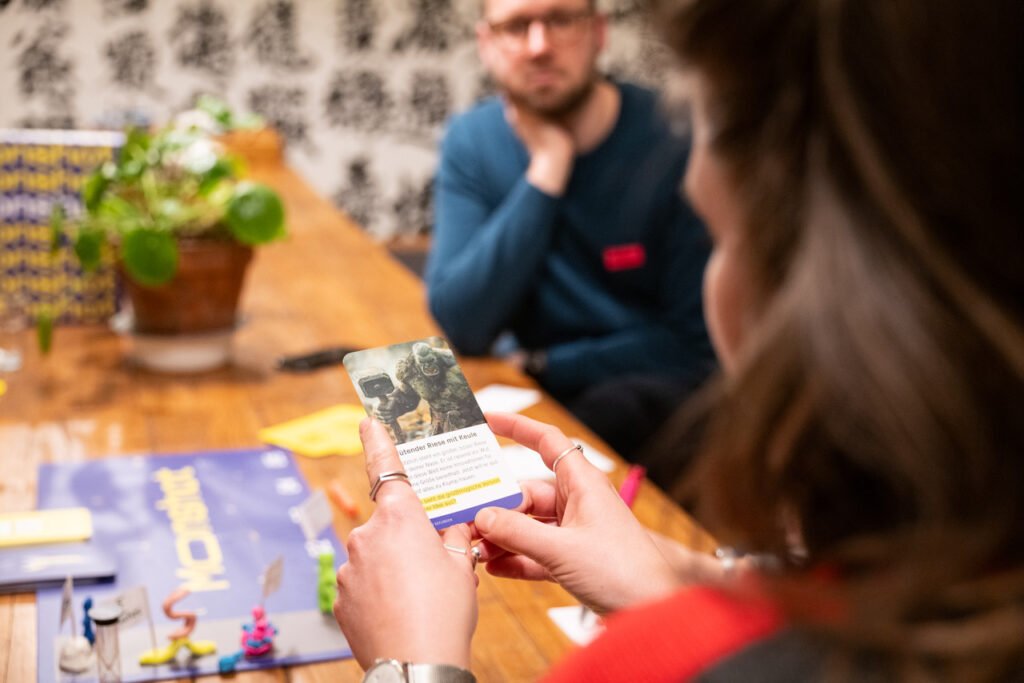
One of the Moonshot cards: the angry giant with a club. Photo: Benjamin Zibner
6 – Breaking thought patterns
Which thought patterns do you want to break?
First we create a bit of creative chaos and break up whatever has hardened. The familiar buzzword for this is “thinking outside the box”. In concrete terms, that means using productive irritations to leave conventional thinking behind. Time pressure is an important tool here. You only get 30 to 60 seconds for a challenge, which leaves hardly any time for your inner censor. And along the way, we also dispel a doubt that many people bring with them: how on earth is a board game supposed to help us think innovatively? By the reflection at the end, it has vanished into thin air every single time.
Do people find it hard to let go of conventional thinking?
Once you’re in, it’s surprisingly easy. That’s what I’m there for as the Game Master. As soon as people allow themselves to immerse themselves in the game – in the “magic circle”, as play researchers call it – different rules apply. The real world fades into the background for a while, and you give yourself permission to think differently. That’s crucial, because the biggest killer of creativity is fear. But in play, in make-believe, we can throw caution to the wind. Moonshot is played in rounds, and by the second round at the latest everyone is fully on board.
- What is the magic circle?
The “magic circle” is a term from game studies. In “Homo Ludens” (1938), the Dutch historian Johan Huizinga describes how play takes place in a space set apart, with rules of its own. He mentions the magic circle only as one example among several, alongside the arena, the card table, the temple and the stage. It was Katie Salen and Eric Zimmerman who turned it into a technical term of game design, in “Rules of Play” (2003).
For workshops, this means: whoever steps into the circle may temporarily think and act by different rules than in everyday working life. The facilitator’s job is to make it easy to step in and to guide people back out at the end. The circle is never completely sealed, though: in 2012, Zimmerman himself made clear that neither Huizinga nor he ever claimed a strict separation between play and life.
5 – The Moonshot effect
How can you tell in the room that something is clicking for a group?
You can really feel it in the mood. With teams from organisations, the atmosphere is often rather tense at the start. After a session, everyone is noticeably more relaxed. You can see it above all in how easily they suddenly talk and laugh with each other. In Moonshot, the shyest ideas person becomes a pitch pro, and the nicest colleague turns into a tenacious sparring partner.
When I run Moonshot with teenagers for the Stiftung der Deutschen Wirtschaft (Foundation of German Business), the boys and the girls still sit at separate tables at breakfast. After the session, they’re all sitting at one table, chatting and relating to each other in a completely different way. That’s a Moonshot effect too.
And your favourite moment as a Game Master?
When a team solving a challenge completely surprises itself for the first time.
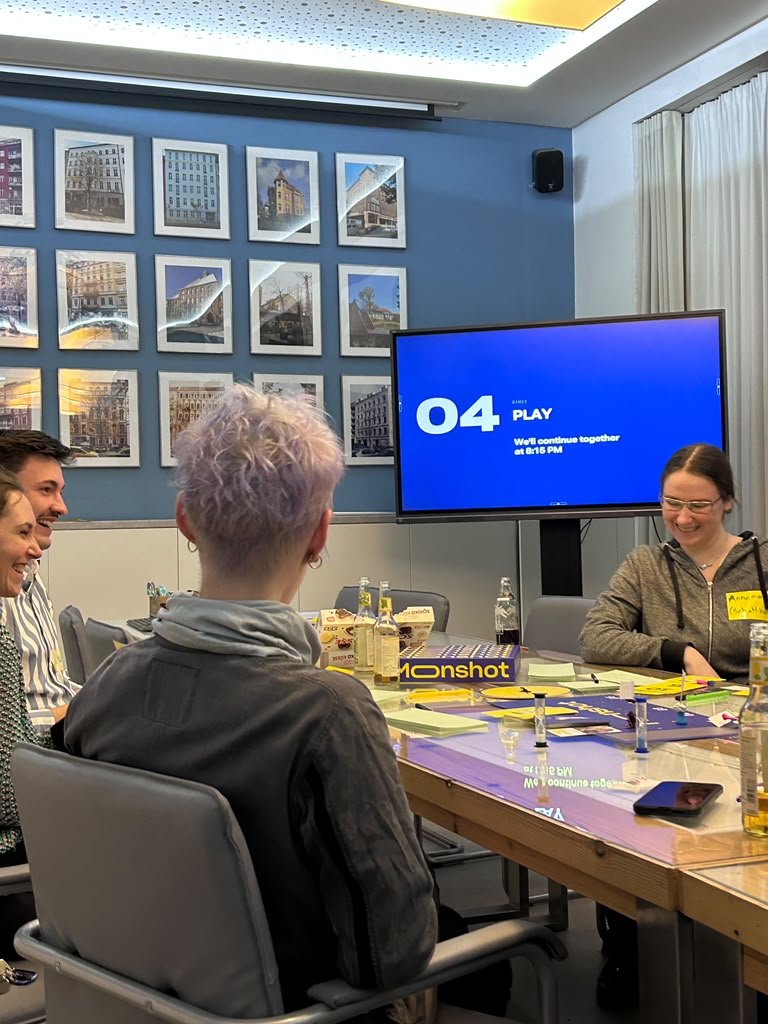
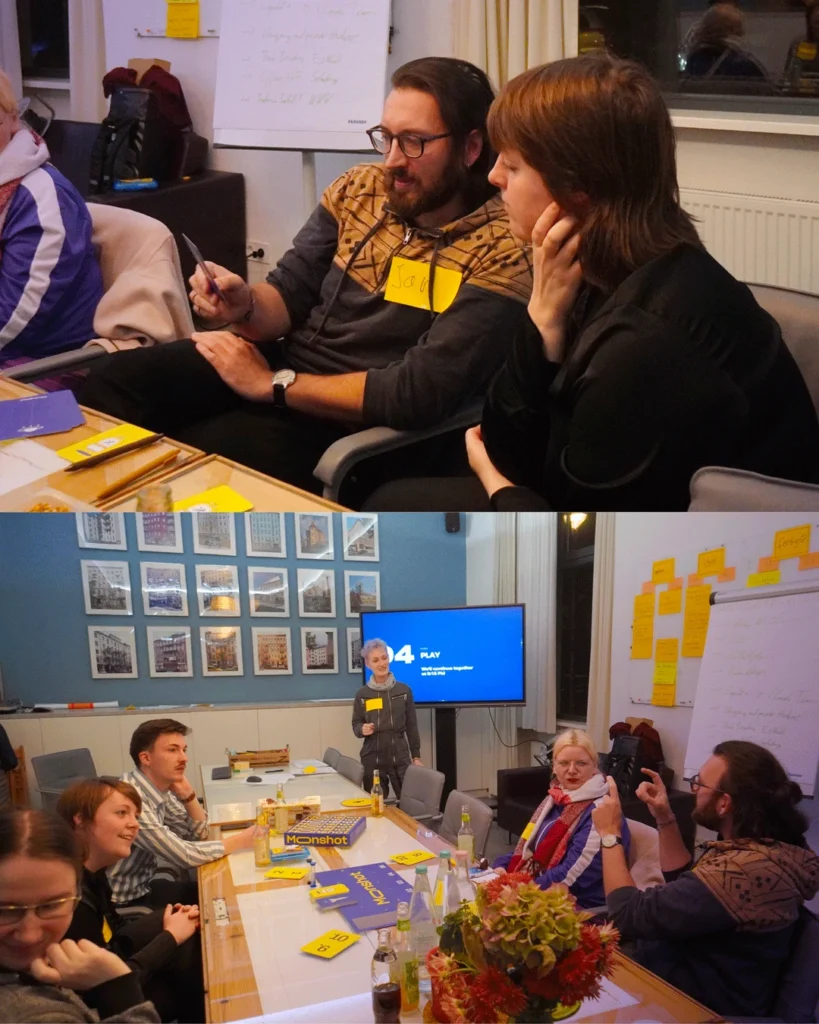
Moonshot at Futures Games II on 12 November 2026 at Schaltzeit in Berlin. Photo: Schaltzeit
And what if a team doesn’t lift off?
Catching that is my job as the Game Master. Sometimes a group is a bit sceptical at first, but in the end you always win them over. That’s partly down to the mechanics: in a game, you want to show that you’re creative, and the challenges practically invite it, because even the tasks themselves are fun. Then there’s the urge to win, even though, between you and me, that isn’t the real point of a session at all. What matters is the process. That’s why it’s hard to resist.
How do you make your presence felt and hold people’s attention as a Game Master?
With professional charm, I think. I don’t want to force anything on people. As a Game Master I tend to stay in the background, and the teams don’t even notice that I’m steering the game in certain directions. If someone really steps out of line, I address it. Part of the game is that players rate every pitch. If someone deliberately gives another player a poor rating so that they don’t win, that says more about the person rating than about the idea. Fortunately, we’ve never had any serious problems with that.
4 – The biggest fuck-up
Your biggest fuck-up as a Game Master?
At a workshop with teenagers, three groups were supposed to play Moonshot in parallel, each led by its own Game Master. And it had simply slipped my mind that packing the games was my job.
So you improvised?
Yes. And it was the improvising that showed me just how much there is to the concept. It worked, and nobody noticed a thing. You just mustn’t let on that anything is different from usual. :)
3 – The best idea on the moon
Which idea really blew you away?
What impresses me most are the ideas that are born entirely in Moonshot and then actually get taken forward. There are some very ambitious young people who go straight on to start a company with them.
2 – Kennedy, not Musk
When they hear “moonshot”, many people think of venture capital and of Elon Musk, who wants to leave the planet. Where do you stand on that?
We actually used to have a card that referred to Elon Musk: “What would Elon do?”. We threw it out and replaced it with “What would Pippi (Longstocking) do?”.
Our point of reference is the Apollo programme. When no human had yet set foot on the moon, John F. Kennedy said in his famous 1962 speech at Rice University, in essence: we’re not doing this because it’s easy, but because it’s hard. Seven years later, people were standing on the moon. That’s the spirit of Moonshot: not colonising Mars, but quite simply making something ten times better and ten times bigger instead of ten percent.
- What is moonshot thinking?
The speech. On 12 September 1962, US President John F. Kennedy said at Rice University in Houston: “We choose to go to the moon in this decade and do the other things, not because they are easy, but because they are hard …” On 20 July 1969, Apollo 11 put the first humans on the moon. Kennedy did not live to see it.
The mindset. As an innovation principle, the term is associated with X, the research lab formerly known as Google X. A moonshot sets a goal that cannot be reached by improving what already exists: ten times better instead of ten percent. The point is constraint, not ambition, because a tenfold goal forces a new approach. Müller-Friemauth and Kühn describe the test as three circles: an urgent problem, a radical solution and a reality check to make sure the fundamentals of physics and science aren’t blown apart (2017).
The objections. The mindset doesn’t provide a path from today to the goal. Müller-Friemauth and Kühn call moonshots, in economic terms, “fictional expectations, nothing more”. In European research policy, the metaphor frames mission-oriented funding; Rosa and colleagues warn that it risks missing what citizens actually need (2021).
The game. “Moonshot – The Innovation Game” practises this mindset on a small scale. It doesn’t explore future scenarios; instead, it trains the kind of creative work that such goals demand.
1 – Serious gaming and wordplay
You avoid the word “game”. Does the term “serious gaming” help you bring Moonshot into organisations?
Yes, it helps. Serious games are now established tools in organisations; lots of people know LEGO Serious Play, for example. The term makes it clear: there’s play involved, but with a serious purpose. And that describes Moonshot very well.
Finish the sentence: Play helps because …
… it’s a fundamentally human ability. When we play, we free ourselves from expectations and come up with ideas that would otherwise have stayed hidden.
What do you most like to play when it isn’t Moonshot?
Word games. I love language, and together with my favourite communication scholar (<3) in particular, I make up new words that the world doesn’t have but needs. I’m especially fond of inventing new plural forms. There are no rules for that, which is exactly why I enjoy it most.
0 – Ignition
Why does the world need more moonshots?
Because we’re facing massive problems of our own making, and they can only be solved – if at all – with very big ideas. “Ten percent better” won’t get us very far.
- Moonshot at a glance
- Name: Moonshot – The Innovation Game, moonshot.game
- Developed by: Till Hasbach together with Martin Wiens, created in 2017 at Berlin University of the Arts
- Provider: Playful Business
- Game type: Board game with cards, modelling clay and little flags, played in rounds; teams compete to shoot their ideas to the moon.
- Players: 6 to 12
- Duration: about 1.5 hours for a full round; around 4 hours or more including an input talk, ideation and reflection.
- Facilitation: a Game Master, or self-guided using the Game Master cards
- Contents (Moonshot Classic): 30 Challenge cards, 40 Item cards, 9 Game Master cards, game board with spinner, modelling clay for prototypes, tutorial videos
- Price: Moonshot Classic €499 plus VAT and shipping, to the shop
- Bookable as: Workshop (half a day to one day), Academy with Game Master training (two to four days), Lab for developing your own versions of Moonshot (seven to fifteen days)
- Extension: ROCKETSTART, a mobile and desktop app for continuing to work on the ideas after the game, rocketstart.ai
Frequently asked questions
What is Moonshot – The Innovation Game?
Moonshot is an innovation game in which teams develop their own ideas, transform them using creativity techniques and compete against each other. The aim is to break out of well-worn thought patterns and practise creative work.
Who developed Moonshot?
The game grew out of a 2017 course at Berlin University of the Arts, where Till Hasbach developed Moonshot together with Martin Wiens. It has been refined over the years and is offered by Playful Business.
How many people is Moonshot suitable for?
Moonshot works with a minimum of six and a maximum of twelve people. A full session takes about an hour and a half.
Does Moonshot need a facilitator?
No, teams can also run it themselves with the help of the Game Master cards.
How much does Moonshot cost?
According to the provider, the Moonshot Classic game box costs €499 plus VAT and shipping. Workshops, the Academy and the Lab are booked separately; the website doesn’t list prices for these.
What does moonshot thinking mean?
Moonshot thinking sets a goal that can’t be reached through mere improvement: ten times better instead of ten percent better. The term goes back to the Apollo programme and John F. Kennedy’s 1962 moon speech.
About Nora Marleen
Nora Marleen (LinkedIn) brings together design, play and strategy. She studied illustration and has been working as a freelance illustrator for more than ten years. At Berlin University of the Arts, she completed both a bachelor’s and a master’s in Communication in Social and Economic Contexts. As a consultant and illustrator at Playful Business, she designs innovation processes for companies, and as a Moonshot Game Master she gets teams to break out of well-worn thought patterns and develop bold, creative ideas.
Sources and links
On the game
- Moonshot – The Innovation Game: https://moonshot.game/
- Moonshot, method: https://moonshot.game/methode
- Moonshot Classic in the shop: https://moonshot.game/shop/moonshot-classic
- ROCKETSTART: https://www.rocketstart.ai/
On moonshot thinking as a mindset
- Kennedy, John F. (1962): Address at Rice University on the Nation’s Space Effort. Houston, 12 September 1962.
- Müller-Friemauth, Friederike; Kühn, Rainer (2017): Ökonomische Zukunftsforschung. Wiesbaden: Springer Gabler. https://doi.org/10.1007/978-3-658-14391-6
- Rosa, Aaron B.; Kimpeler, Simone; Schirrmeister, Elna; Warnke, Philine (2021): Participatory foresight and reflexive innovation: setting policy goals and developing strategies in a bottom-up, mission-oriented, sustainable way. European Journal of Futures Research. https://doi.org/10.1186/s40309-021-00171-6
On the magic circle
- Huizinga, Johan (1938): Homo Ludens. Proeve eener bepaling van het spel-element der cultuur. Haarlem: Tjeenk Willink. German edition: Homo Ludens. Vom Ursprung der Kultur im Spiel. Reinbek: Rowohlt.
- Salen, Katie; Zimmerman, Eric (2003): Rules of Play. Game Design Fundamentals. Cambridge, Mass.: MIT Press.
- Zimmerman, Eric (2012): Jerked Around by the Magic Circle. Clearing the Air Ten Years Later. Gamasutra.