
There are no facts about the future. That makes science communication in futures studies so difficult – but also so appealing. Three examples from our foresight projects show how futures studies reaches people: from postcards with pills to an oracle that talks nonsense to memes for social media.
A conference hallway, shortly before eleven. Three minutes until the next session, the coffee line is long, and you actually wanted to catch your colleague from Freiburg. Who feels like a detour into the basics of futures studies right now?
Probably no one.
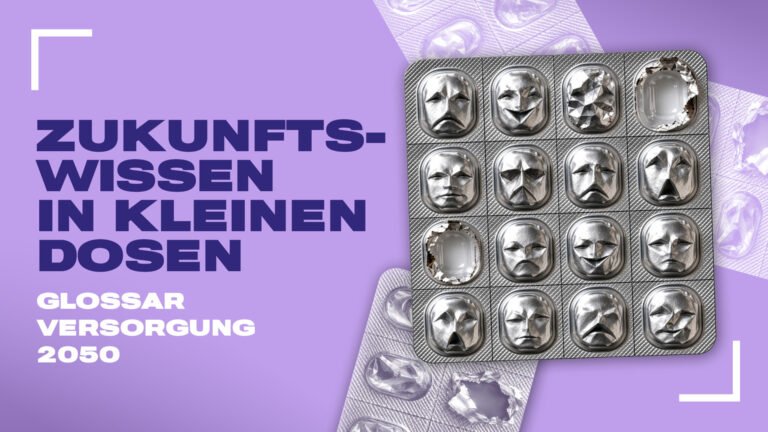
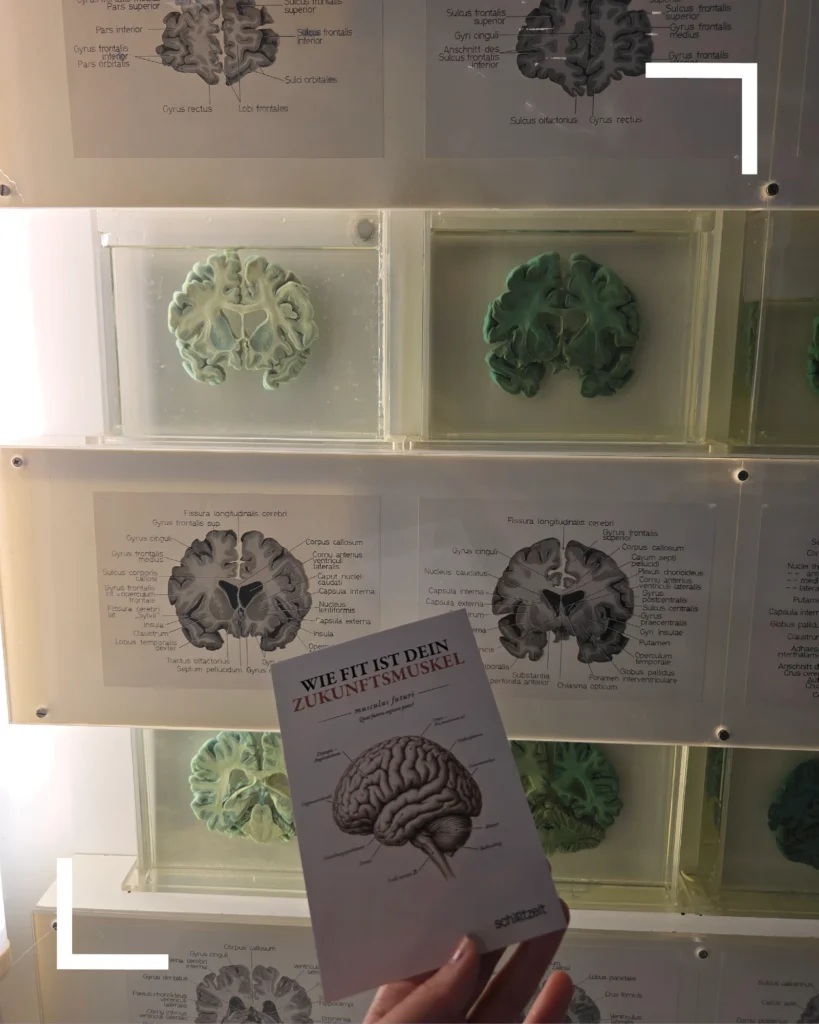
So we handed out postcards with familiar metaphors that people recognize within seconds and that, ideally, make them curious about the future.
At Schaltzeit, one of my focus areas is how futures studies can reach more people. In Communicating futures: Science communication in futures studies between impact and responsibility we looked at the fundamentals. This post is about practice: three examples from our project work that we played with to see what resonates with audiences.
1: Futures Literacy in postcard format on the effects and side effects of images of the future
At a glance
Where
German Congress for Health Services Research (DKVF) 2026
For whom
Health care professionals, many of whom are hearing for the first time that there is such a thing as futures studies
How
A saying or metaphor as a hook that everyone in health care recognizes
The DKVF 2026 focused on what a desirable future of health care in Germany could look like. Many participants were not familiar with futures studies; they came to the congress for their own fields, not for us. We wanted to reach them with a low-threshold invitation.
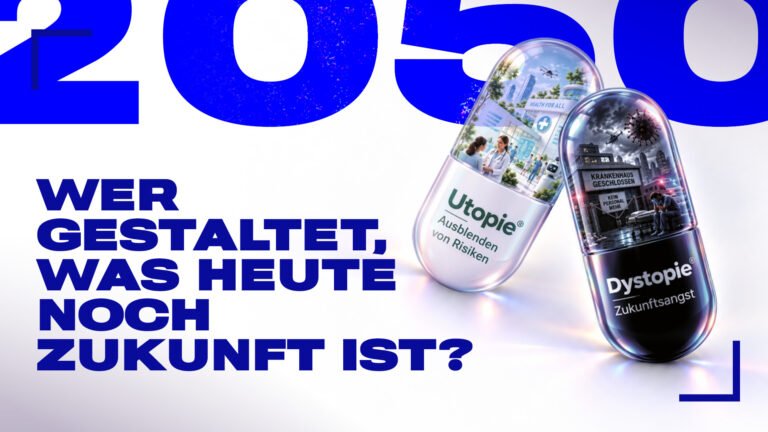
So instead of starting with lengthy theoretical explanations, we took a shortcut in the search for a sensible way to deal with images of the future, using a saying that many people in health care know: “The dose makes the poison.” Plus two pills called Utopia and Dystopia. Once curiosity is sparked, readers find more context and explanation on the back:
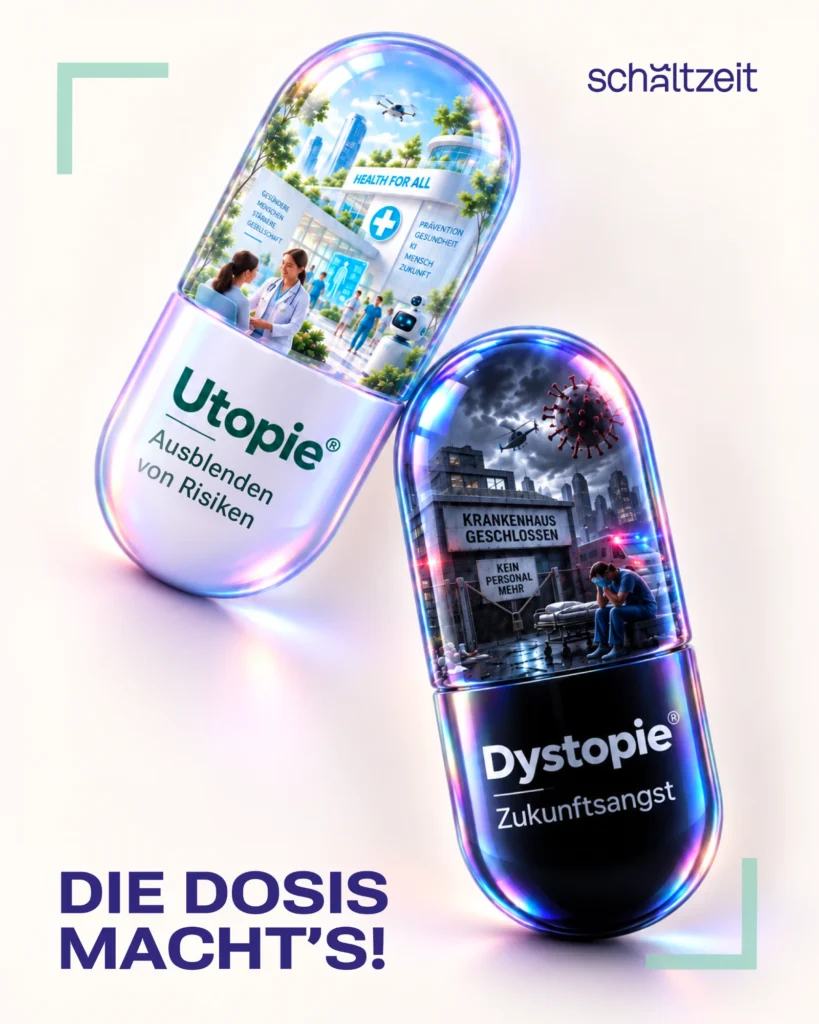
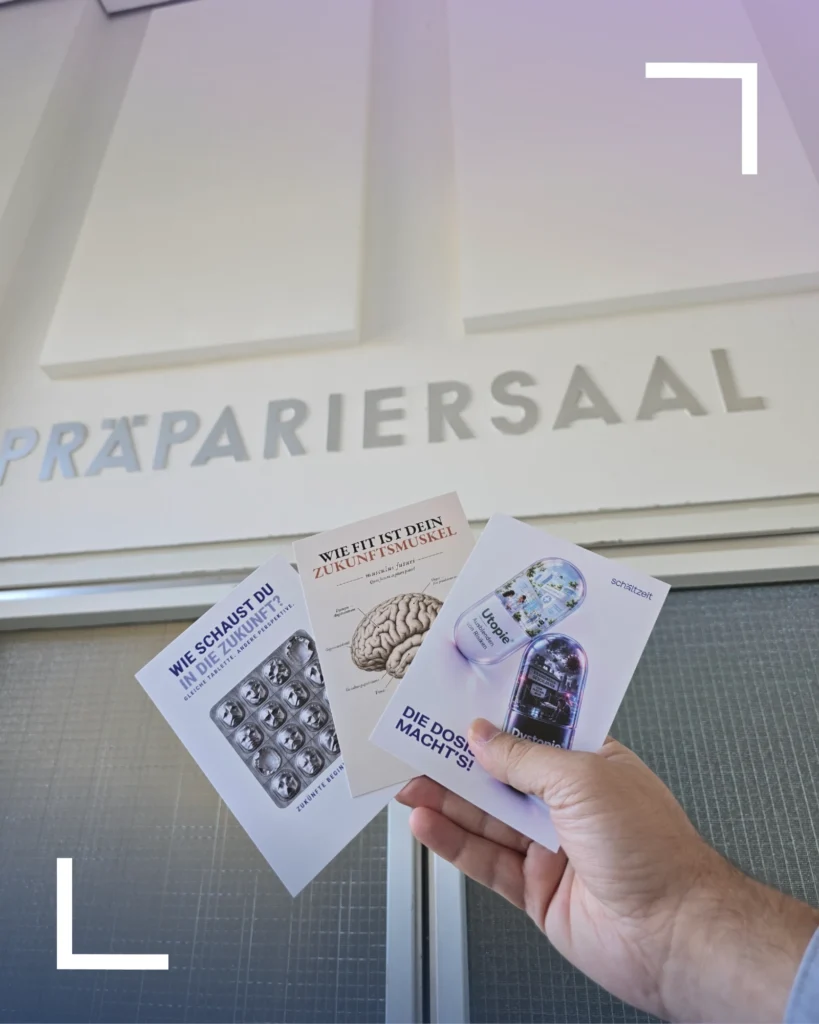
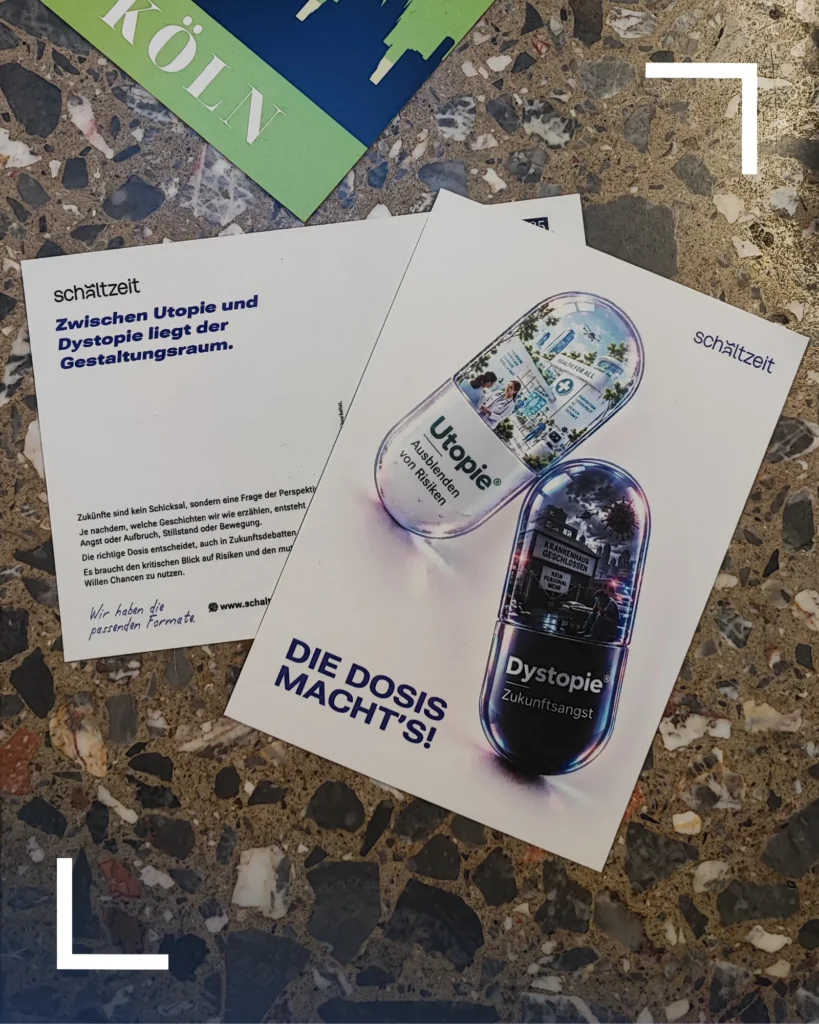
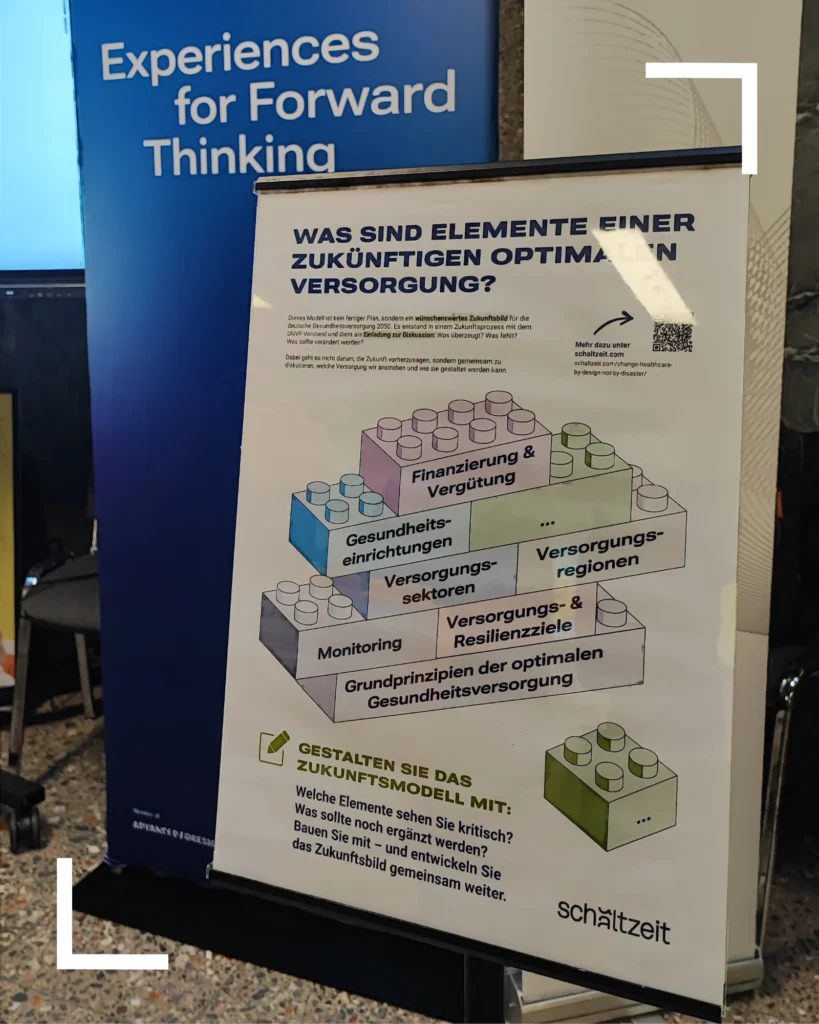
The back explains what it is about: Dystopias can serve as a warning and prompt a rethink – or paralyze people and fuel fear of the future. Courage and confidence about the future are important. But blind optimism and utopias that claim absolute truth can be just as fatal. Hence the invitation: What do images of the future of health care look like that overcome today’s dysfunctions, anticipate future misincentives, and don’t overshoot in either direction?
Anyone who wanted to know more found us at the congress booth. We were happy about everyone who stopped by to ask what this DNVF futures process was all about and what futures studies actually is.
Of course, postcards with nice pill illustrations are no cure-all. They attract attention and thereby open a door. Whether someone walks through it is decided later, in conversation.
The idea behind it
- Building on the familiar: A recognition effect with familiar images or metaphors can attract attention. And a communication format that nobody notices has no effect. That is why we wanted to connect directly with the target group’s own images – in a relaxed way and with a little wink.
- Different levels of depth: The front of the postcard works in passing. The back is for anyone who gets curious. And those who want to know more come and talk to us at the Schaltzeit booth.
- No ready-made answer: The card does not explain in a quick run-through what futures studies means or what role emotions play in debates about the future. It touches on the topic on the back and asks an open question meant to invite reflection and discussion.
2: The Futures Oracle as a humorous conversation starter about futures studies
At a glance
Where
Futura Biennale, twice at the German Congress for Health Services Research, at the Innovation Congress Chemistry and Pharma of VCI Nordost, and other events
For whom
Walk-in audiences at festivals or conferences
How
Use clichés and defuse them instead of denying them in a lecturing tone
Futures studies is occasionally mistaken for crystal balls and predictions. You can get annoyed about that – or use the cliché for a playful intervention.
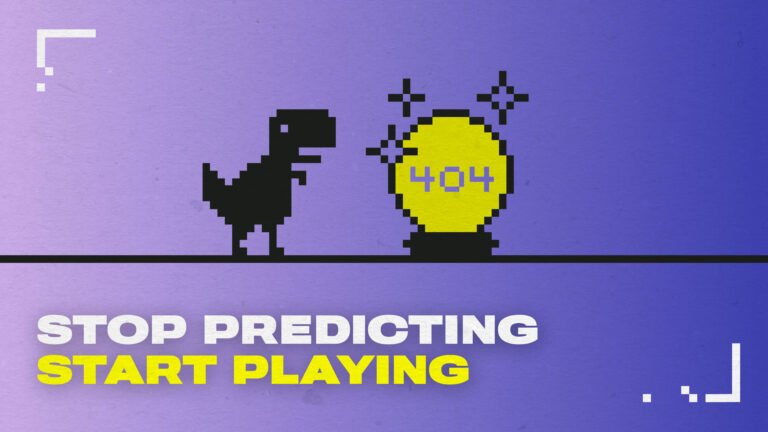
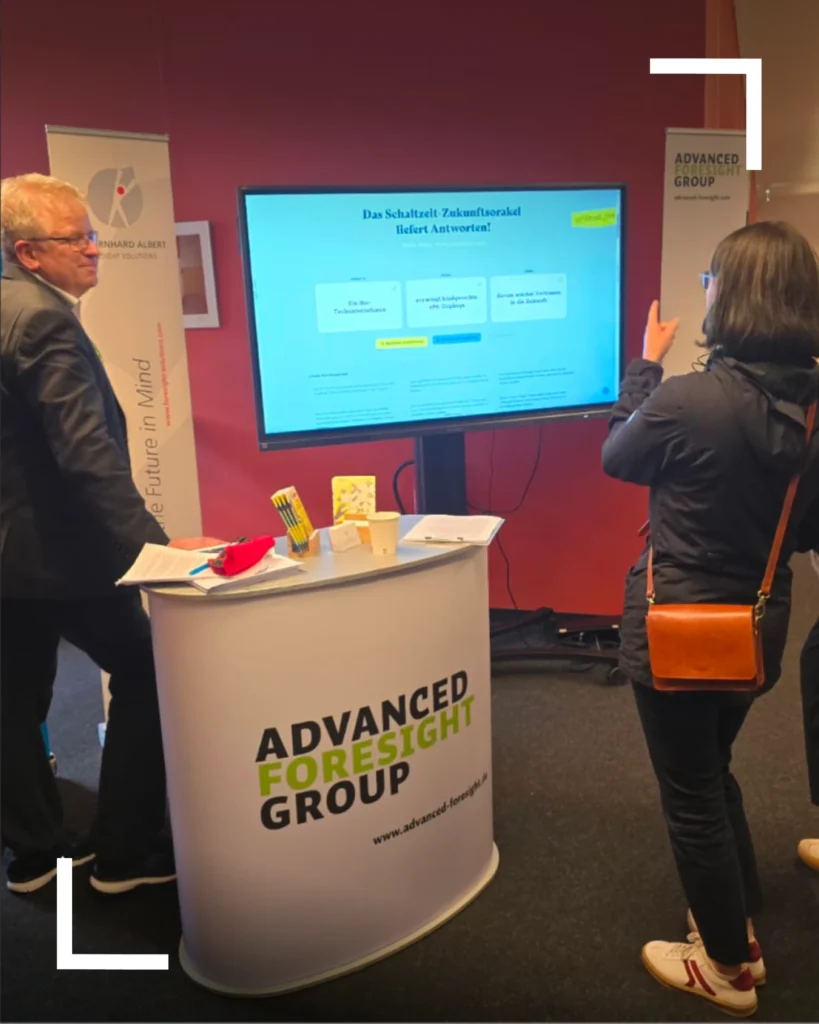
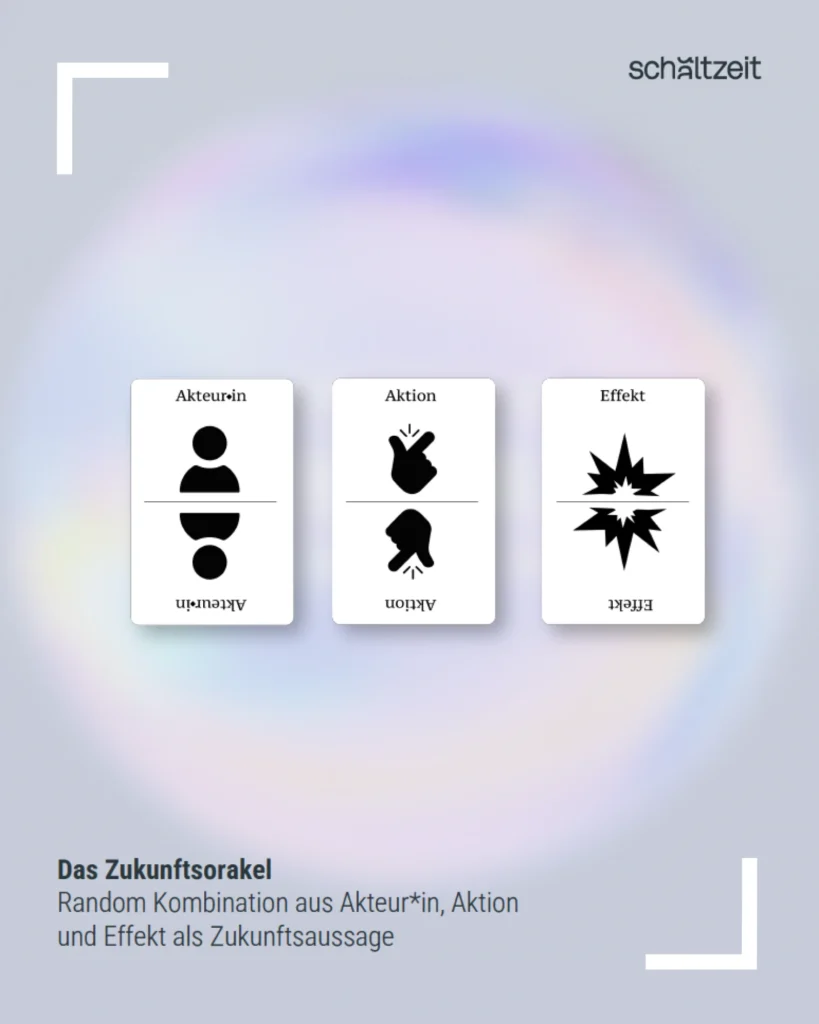
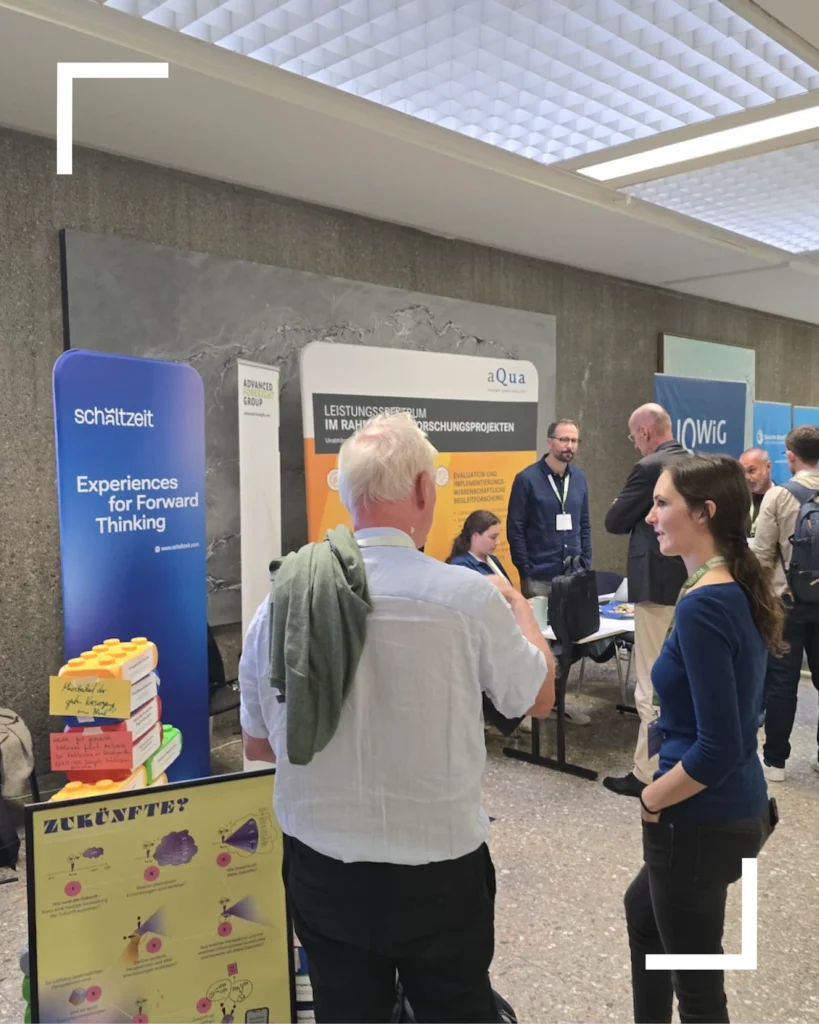
The Futures Oracle by Schaltzeit is a hands-on station for democracy festivals, street festivals, and professional conferences. It answers the question “What will the future be like?” with a random, delightfully absurd forecast.
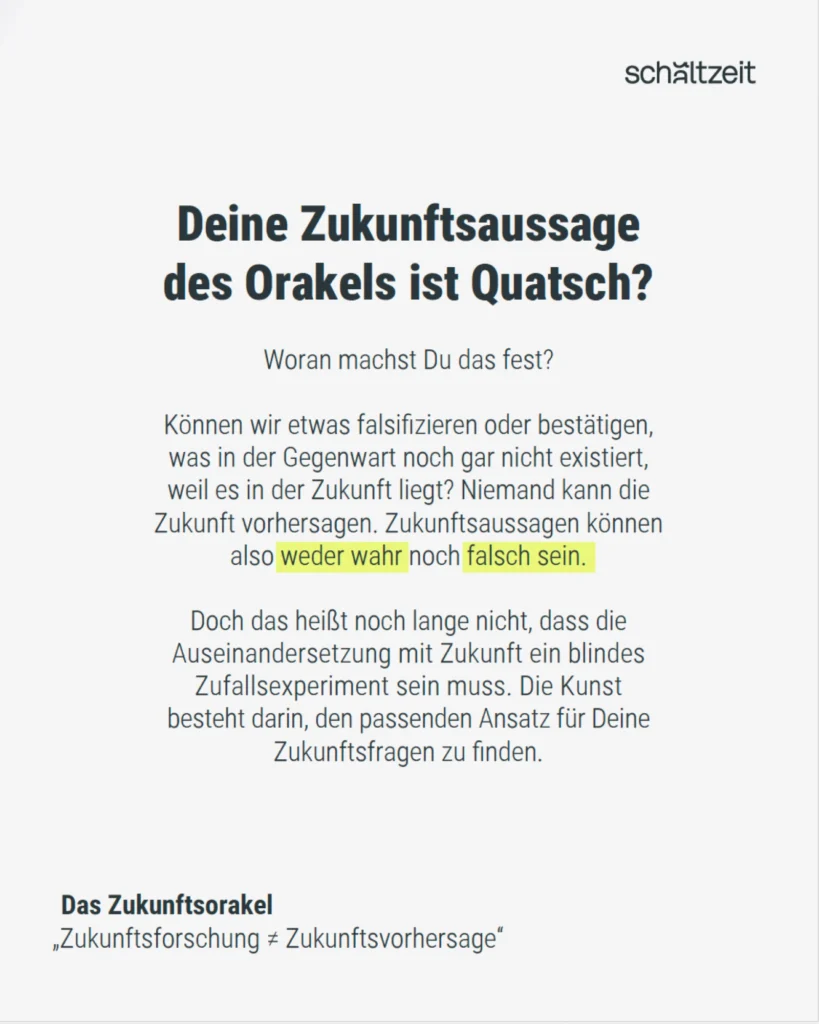
The obvious reaction to the oracle’s forecasts is: “That’s nonsense!”
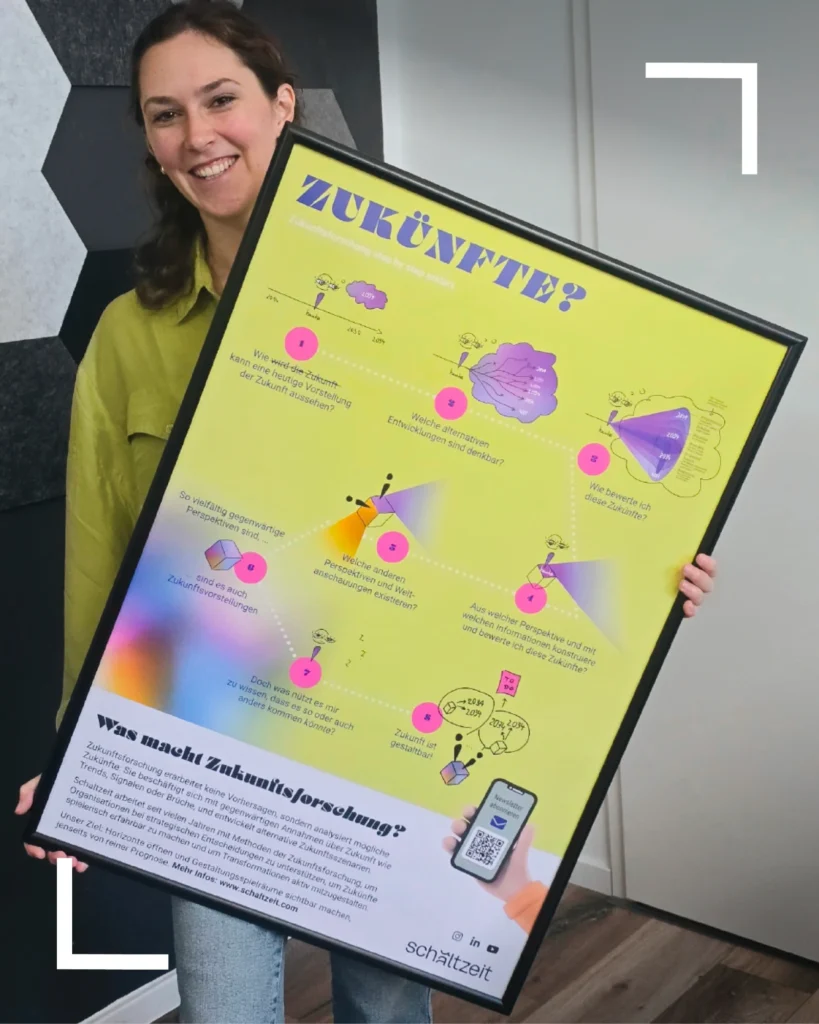
This is exactly where the real conversation begins – about a fundamental question of futures studies: How can I judge something as true or false that hasn’t happened yet because it lies in the future? And why do some statements about the future seem plausible to us and others don’t? With the help of an info poster next to the Futures Oracle, the idea of futures studies can then be shown step by step. This turns a complicated epistemological question into an entry point that is entertaining and fun.

The idea behind it
- Dealing with annoying clichés with humor: In strategic communication and in science communication research, it is widely assumed that contradicting is often counterproductive. If you contradict a cliché, you repeat it. And what is repeated often feels familiar – and we quickly take the familiar to be true. That is why we exaggerate the crystal ball so much that people dismiss the association as nonsense themselves. It does need the resolution, though; otherwise only the crystal ball sticks.
- Humor against uncertainty: People who ask about the future often want certainty. That the future cannot be predicted can feel uncomfortable at first. Humor makes it easier to engage with it anyway. But it is a balancing act: The same joke that sparks curiosity can also trivialize a topic.
- Experience instead of abstract theory: The oracle does not explain in epistemological terms that statements about the future are constructed – it shows it: with individual, concretely worded, but meaningless forecasts.
3: Memes: one image that tells a whole story
At a glance
Where
Only conceptual so far
For whom
Mostly young people who spend a lot of time on social media
How
Slightly alter well-known memes to reveal their underlying assumptions
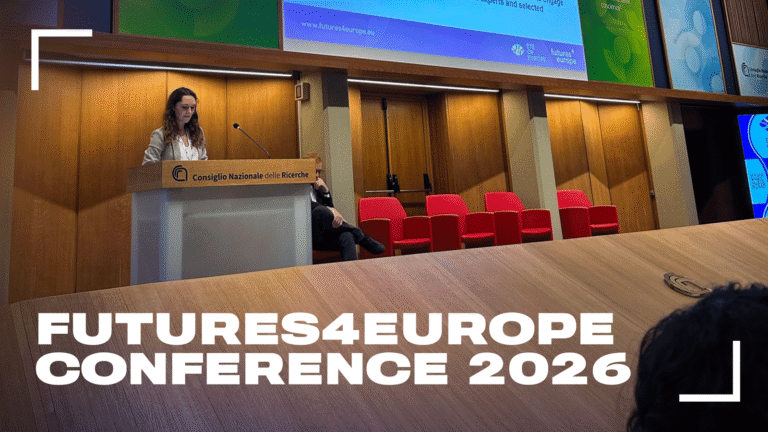
Memes convey complex meanings without lengthy explanations – usually with a certain situational comedy and humor. So why not use them to talk about futures? At the Futures4Europe Conference, I brought a few examples to illustrate how I imagine communicating futures studies with memes.
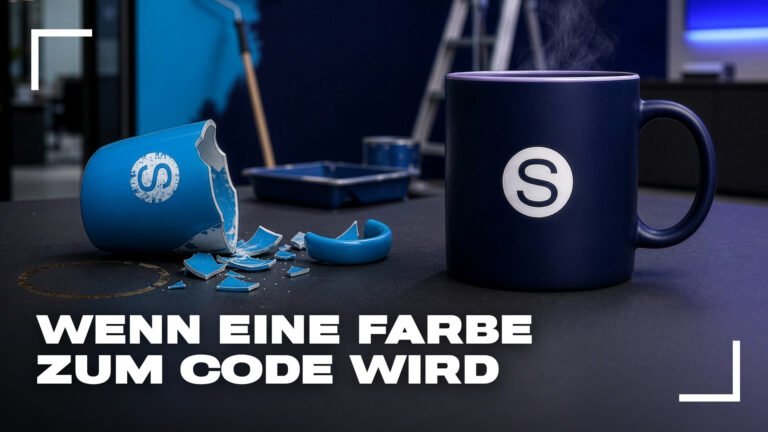
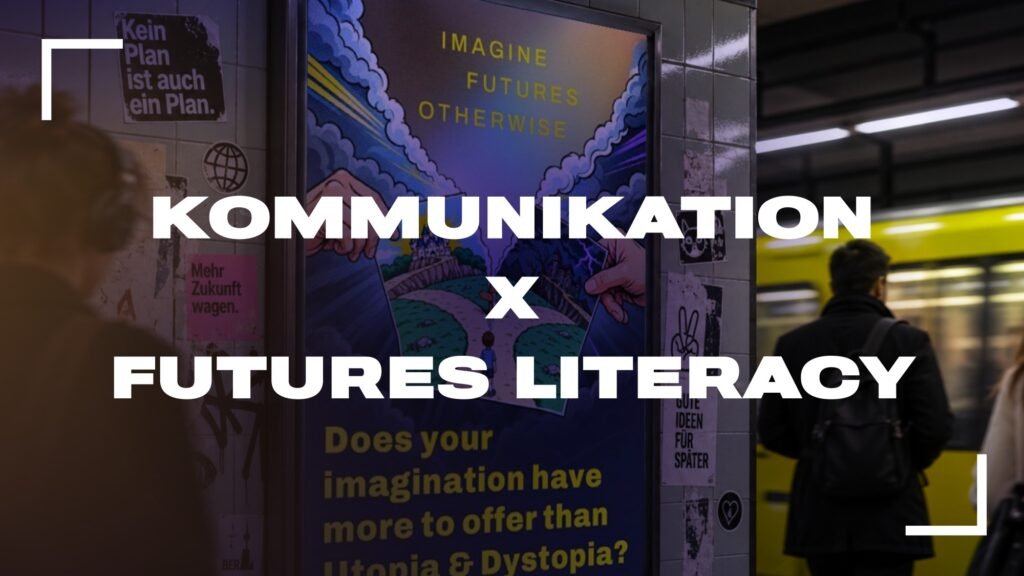
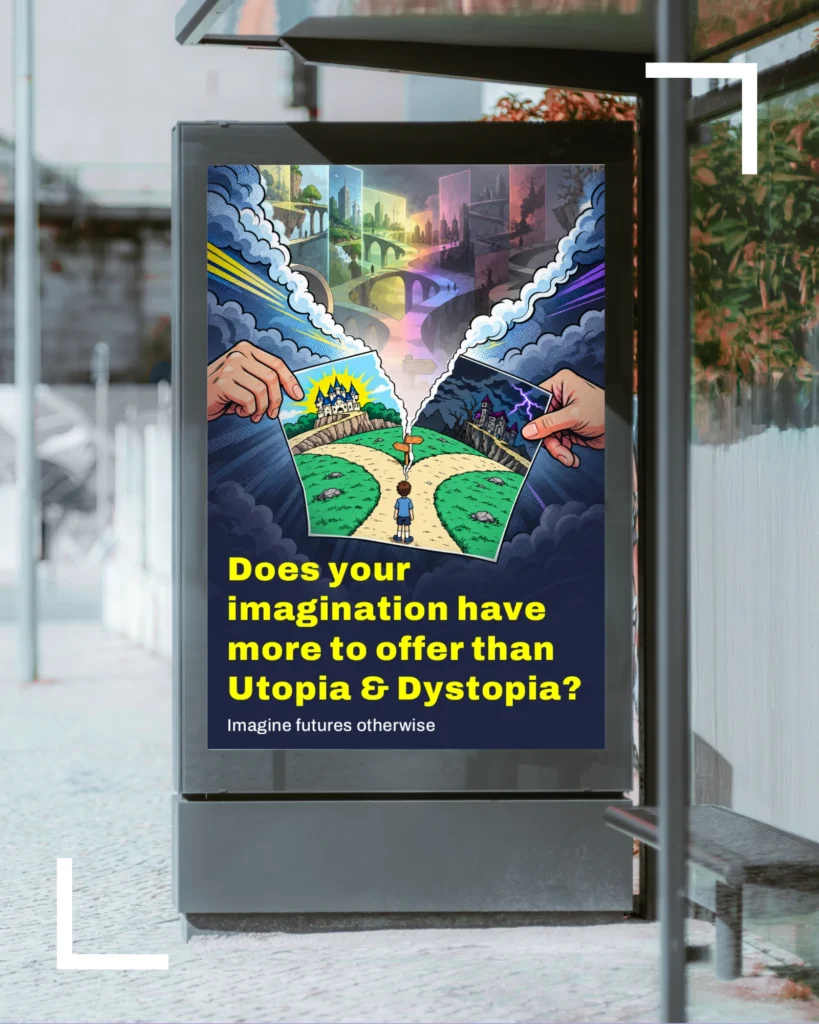
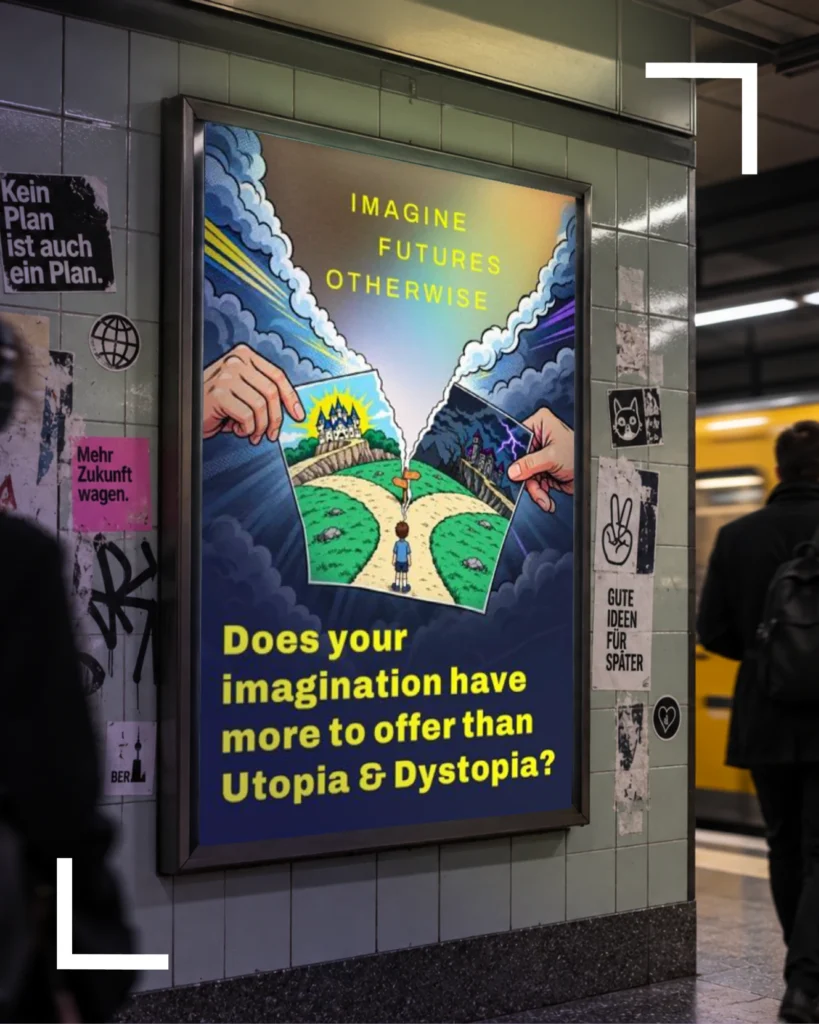
One of the examples takes up the meme “Dramatic Crossroads,” also known as “Two Paths.” It shows a choice between two completely opposite extremes, with nothing in between. Online, it is often used to illustrate sharp contrasts. I labeled the two paths Utopia and Dystopia and drew a tear into the meme. It rips open what lies hidden between the extremes: not nothing, but a broad spectrum of conceivable futures. This symbolically shows a core concern of futures studies.
One drawback of memes, however, is that their meaning can change quickly. They live from being varied, recombined, and placed in other contexts. The best-known example is Pepe the Frog: originally a harmless, humorous comic character, later co-opted by far-right groups and therefore no longer neutral for many. On top of that, anyone who doesn’t know a meme may read it quite differently or not understand it at all.
The idea behind it
- One image instead of an explanation: The meme tells its message on its own. We don’t have to explain that sharp contrasts are problematic; we simply show what they conceal.
- The language of the target groups: Memes speak the language of social media. This may make it easier for them to reach people who spend a lot of time there.
Which questions matter to me in practice
How can I create attention for questions about the future without covering up complexity with simple answers? I prefer to start with open questions that spark thought. For every communication format, it is worth weighing:
- Do people start thinking for themselves instead of just consuming “ready-made” images of the future?
- Can they disagree and contribute their own perspectives?
- Does it become visible from which perspective the images of the future were created?
On a more fundamental level, I also see a democratic mission in this. Democracy is essentially the idea that it is worth debating different visions of the future as a society in order to then agree together on ways to shape the future. Anyone who doesn’t believe the future can be shaped has little reason to stand up for democracy.
After all, it takes more than criticism of the present: It takes images of the future that make it imaginable how things could be better, and the conviction that these images of the future (and the interests behind them) can and should be criticized.
Frequently asked questions
What is Futures Literacy?
Futures literacy is the ability to imagine multiple futures, reflect on your own assumptions about the future, and use this to shape your actions in the present more consciously. The term was largely coined by UNESCO.
What role do humor and emotions play in futures communication?
Humor attracts attention and opens doors. But it is no sure-fire success: It has to suit the target audience and invite reflection rather than ridicule the topic. Emotions such as fear or hope shape how we think about the future, what room for maneuver we see, and whether we take action. It is hardly possible to talk about futures in purely rational terms.
Why does an absurd oracle work?
Because the reaction “That’s nonsense!” raises a question at the heart of futures studies: How do we judge whether a statement about the future is plausible? Futurist Jim Dator even claimed that any useful idea about the futures should appear to be ridiculous at first.
What does Schaltzeit do in foresight and Futures Literacy?
Schaltzeit combines classic futures studies with playful approaches, learning formats, and AI. This is how we strengthen the futures resilience of companies, NGOs, and political institutions. From a broad range of methods, we choose the approach that fits the futures question, the context, and the strategic goals.