
Innovation competitions are an engine for bundling and discussing outside-in innovation impulses and for getting a healthy mix of projects on the road. Big players like Deutsche Telekom are always on board, too, making their resources available for collaborations, research and seed support and thinking together about how the network of tomorrow will evolve.
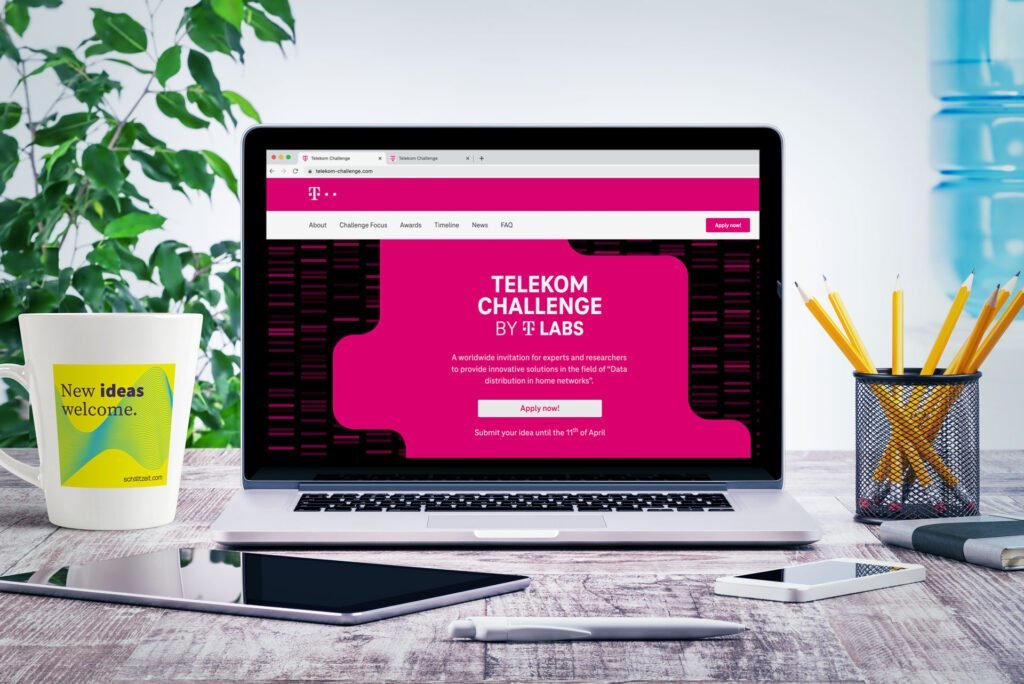
With the “Telekom Challenge,” T-Labs, the research and development unit of Deutsche Telekom, is launching an international science competition on home networks and data distribution. The Telekom Challenge is divided into two competition areas — the Development Stream and the Research Stream — so research doesn’t get short shrift either. The Development Stream explores the question of “how data distribution in home networks can be secured.” “What comes after Wi-Fi and beyond to ensure data distribution in home networks?” is the key question of the Research Stream, and one well worth focusing on.
How will the growing number of IoT and smart home devices change the requirements for home networks?
But why do we need to innovate in data processing and distribution in the home?
Ask the forecasters and one thing seems clear: the number of connected objects in home networks is rising rapidly. Where there used to be just a notebook and a smartphone per person and household, today a huge range of fully connected consumer electronics, from reading robots to ambient light control, has moved into our homes. We expect up to 300 connected objects or more per person.
What’s more, besides voice assistants and connected air purifiers, the “smart home residents” of tomorrow will be using other newer technologies: holotainment, for example, makes it possible to play information and design onto surfaces, to project designs and 3D mapping onto different surfaces, and to integrate touch interfaces. In the kitchen, the cooking robot becomes the maître, while cleaning robots for floors and windows keep the house in shape at all times. Data and data generation ensure constant optimization.
The network effect is omnipresent
Every additional connected object increases the value of the overall system. Residents themselves can easily fulfill newly awakened needs through individualized and personalized technology and even share these benefits, as is already the case with smart access systems.
Even though, fortunately, not everyone has this appetite for electronics, networking and targeted smart home automation can increase energy efficiency in the home network. Biochemical networking as in nature – in the forest, via symbiotic fungal networks (mycelia) – does not yet exist in home networks. So it’s time to research it. How should home networks be designed to distribute data energy-efficiently? How can they combine data and process it energy-efficiently?
Smart home revenue is growing by around 12% a year, according to Statista figures. It follows, however, that the amount of data generated will also rise rapidly. On top of the existing coronavirus effect due to working from home and homeschooling, this means the data needs to be distributed as “gently” as possible.
Innovative approaches for future, secure data distribution in home networks
So it seems plausible that the “Telekom Challenge” is looking for new answers here to optimize data distribution in home networks effectively and energy-efficiently, including over the air.
So if you have crazy ideas, remember: “Opportunity does not knock, it presents itself when you beat down the door.” (Kyle Chandler)
With nearly €700,000 in real prize money, the chances look good for pushing your own ideas forward. You can submit your application via the Telekom Challenge website at https://telekom-challenge.com. Alexander Lautz, head of T-Labs, together with Claudia Nemat, Prof. Dr. Claudia Eckert and other prominent jurors, will review the ideas and hopefully identify promising future potential for home networks.
Applications are open until March 15, 2021.
For those of you who are curious about what’s “under the hood,” we can reveal that PEACOQ, our software for innovation competitions, works in the background to make sure all the ideas in this competition safely find their way to the jury. We at Schaltzeit GmbH are especially proud, as one of the first T-Labs spin-offs (2006), to support this competition with our software. The goals were ambitious: 6 weeks to launch — right in the middle of the year-end rush. Our biggest thanks go to our lead developer Thomas from CisLogic – thanks for the coding! A big thank-you also to Varvara for tireless testing and to Johanna for focused project management and configuration.
We’re happy to tell you more about our adaptive platform PEACOQ and its possible applications – just send a short email to berlin@schaltzeit.com.
And since cooperation is sadly not an everyday thing, we would like to expressly thank Agorize for promoting this competition together with us on their contest portal.
Links:
– Telekom Innovation Laboratories
– Telekom Challenge: neuer Wissenschafts-Wettbewerb, Deutsche Telekom
– website of the Telekom Challenge