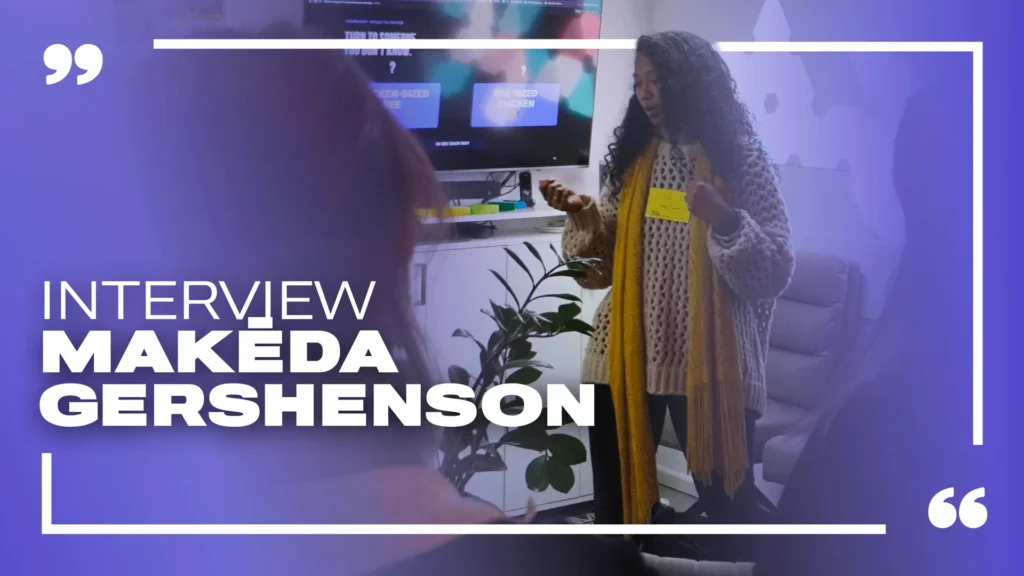

Futures Games II – Interview with Makēda Gershenson, Quest Labs
Five Black creatures, one deck, a launch on Black Friday. Makēda Gershenson talks about rest as resistance, joy as an anticipatory technology, and why her Black Jellyfish senses with its body instead of thinking with a brain.
Interview: André Winzer, developer of the Foresight Zoo and CEO at Schaltzeit
Key takeaways
- The Black Menagerie is a conversation deck by Makēda Gershenson of Quest Labs in Berlin: five Black animals, Dator's four worlds, 36 scenarios, and a few Write Your Own cards.
- It builds on the “menagerie of postnormal potentialities” by Ziauddin Sardar and John A. Sweeney (2016): Black Swan, Black Elephant and Black Jellyfish. Makēda adds the Black Marsh Turtle for rest and the Black Sheep for playful disruption.
- The pre-sale starts on Black Friday, 27 November 2026. A game version is in beta, and editions for educators and children as well as expansion packs are planned.
- You can play it solo, 2-5 players, or teams; larger groups share animals. Three rounds take about 45 minutes.
- The scenarios draw on signals from the African and Asian diasporas as well, not only from a Western lens.
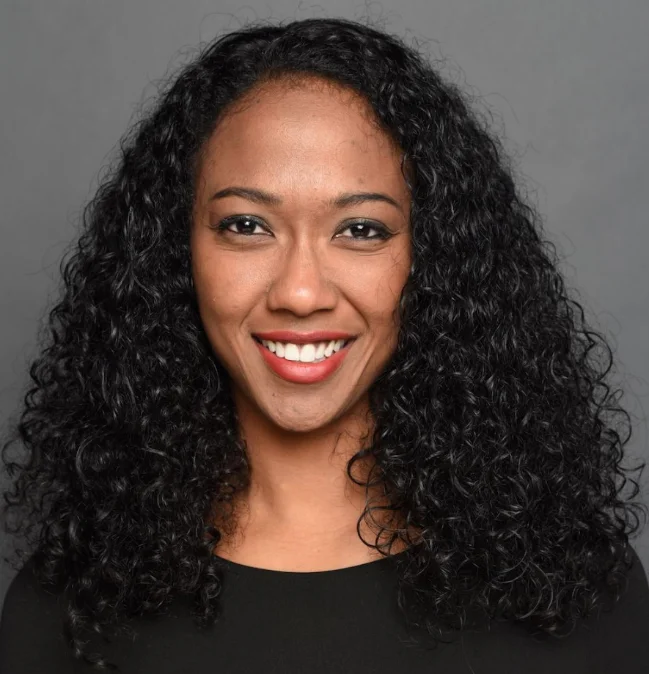
Makēda Gershenson, founder of Quest Labs
On 12 November 2026, Futures Games II took place at Schaltzeit in Berlin. 26 participants, three games, one evening under the motto “Stop predicting, start playing”: no matter how much data we gather, the future stays opaque. So let’s play with it.
Three very different approaches were on the tables. Sylvia Veenhoff of the German Environment Agency (UBA) presented a foresight toolkit that helps municipalities rethink their city centres. Nora Marleen of Playful Business sent her group off with “Moonshot – The Innovation Game” in search of bold ideas beyond well-worn patterns of thinking. And Makēda Gershenson of Quest Labs brought her Black Menagerie: a deck of five Black animals that stand for very different ways of meeting an uncertain future.
Each of the three games gets its own interview in its own format. This one moves through three time layers: Then, Now and Futures. We spoke with Makēda by video call a few days after the evening.
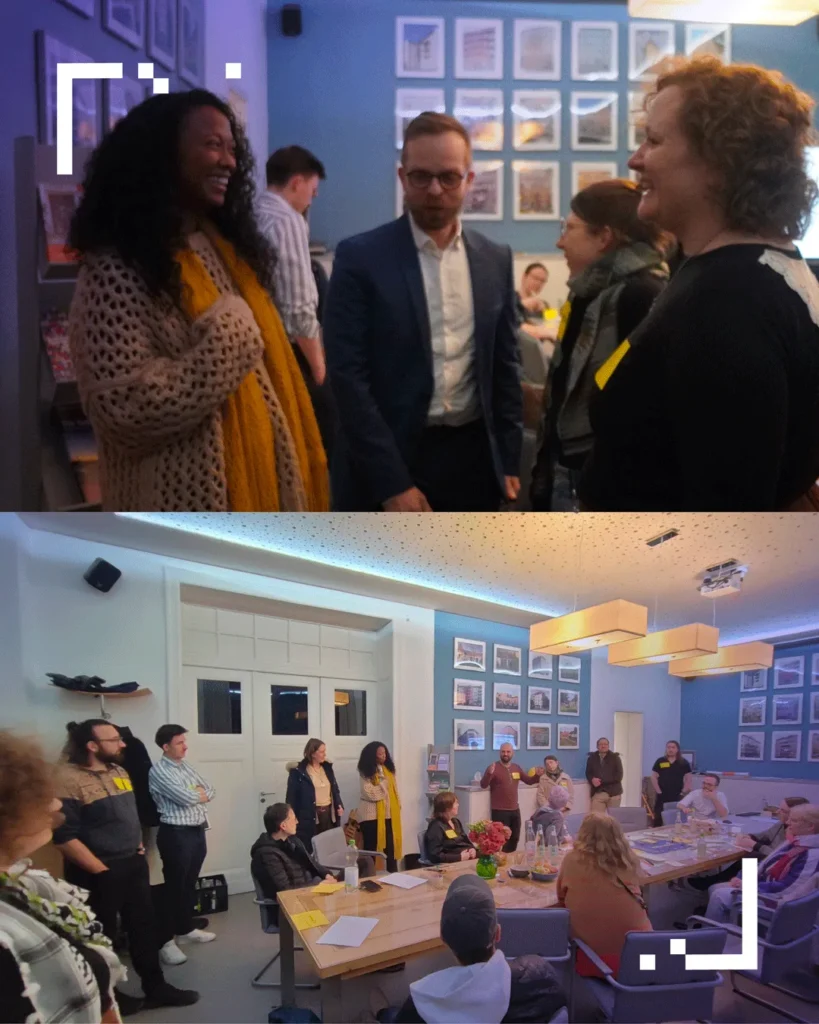
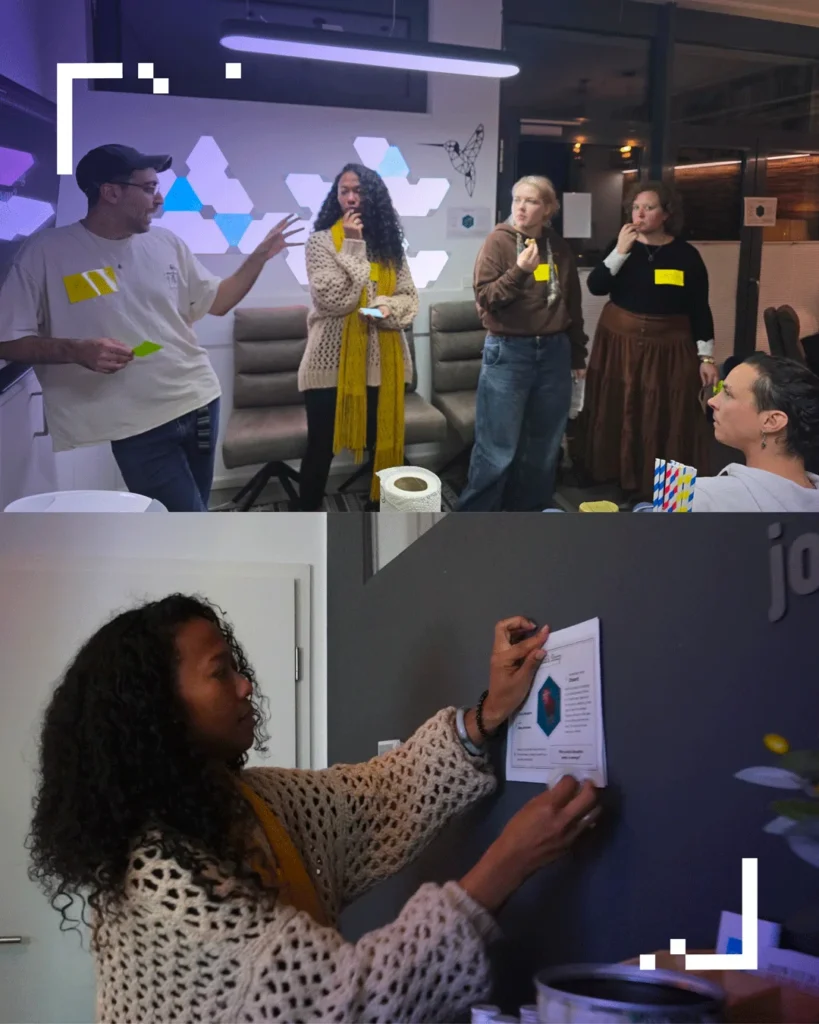
Makēda Gershenson at Futures Games II on 12 November 2026 at Schaltzeit in Berlin. Photos: Schaltzeit
Then: Candles, mirror neurons and Berlin
Makēda, who are you?
I am an educator, a futurist and an artist. I bring futures to different communities, and I love researching how we are going to move into a future.
Before we go into the future, let’s go back. What did you play as a child?
A teacher once asked me what I wanted to be when I grew up. I said: left-handed, have an accent, and be a guitar. Not play a guitar. But to be one. I was already trying on new ways of being. I also created businesses, but it was never about selling. Building a business was how I got to do things I enjoyed, like making candles. My mirror neurons were always on: if I saw somebody climb, I would climb. If I saw someone play an instrument, I would try that instrument. I spent a lot of time observing and tinkering to see what was possible, what brought me joy, what stretched my own capacities. I still do. Now I call it my J.O.B.: my joy of being.
You have held quite different positions in your life. What shaped you?
I'm an educator and a perpetual learner. I've been an elementary school teacher, an international performing artist, a tax professional, a cross-cultural trainer and an executive coach. Sometimes I feel like a time traveler.
What shaped me most are my two roots, which are also where the Black Menagerie comes from. I am African-American and Chinese-American. Afrofuturism taught me how to dream wild and world-bending things. I can expect the future to be weird and wondrous, and still rest in a deep knowing that everything needed for change is already here.
My Asian heritage adds something else. I come from a high-context culture, where the collective is key: we are always traveling together. We don't arrive alone. A high-context culture also leaves a lot unsaid, and that's where the Black Elephant comes in. It speaks the unspoken. All parts are needed in order to be whole.
These two roots have always been in conversation. My mom immigrated to New York from Kowloon, Hong Kong, and I'm part of a women's group that grew out of Asian Women United, which turned 50 this year. I think of Yuri Kochiyama, a Japanese American activist in Harlem who stood with Malcolm X, and Grace Lee Boggs, a Chinese American activist who organized with Black movements in Detroit for decades.
- What are Afrofuturism, Asian futurisms and Afro-Asian futures?
The word. The cultural critic Mark Dery coined “Afrofuturism” in 1993 in his essay “Black to the Future”. His founding question is already one for futures studies: can a community whose past has been deliberately erased imagine possible futures? The sociologist Alondra Nelson carried the term into academia, first through a mailing list from 1998, then in 2002 with a special issue of Social Text. The movement itself is older than the word, and it lives in music, novels, comics and film.
Read moreShow less
The argument. For futures work, the writer Kodwo Eshun made the sharpest point in 2003. He describes a “futures industry” of technoscience, media and market forecasting, in which power works predictively as well as retrospectively: the powerful employ futurists and draw power from the futures they endorse, while Africa increasingly appears only as the object of projections, in forecasts of decline. His conclusion is not an aesthetic but a claim on the means of prediction itself.
From the continent. In 2019 the Nigerian-American author Nnedi Okorafor coined “Africanfuturism”: science fiction rooted in African culture, history and mythology, written from the continent and not centred on the West. The question behind the split matters for every foresight practice: whose vocabulary describes whose future?
In practice. The Institute for Security Studies runs an annual African Futures Conference with its African Futures & Innovation programme, in 2026 in Pretoria under the title “From Data to Decisions”. In the games world, “AfroRithms from the Future” by Lonny Avi Brooks and Eli Kosminsky, with Ahmed Best since 2019, is a cooperative storytelling game that centres Black and Indigenous perspectives.
Afro-Asian futures. In 1955, 29 newly independent Asian and African countries met in Bandung, Indonesia, against colonialism, agreeing on "the equality of all races and all nations, large and small." Meanwhile, the West continued to imagine Asia as a high-tech future with no people in it, which Roh, Huang and Niu call "techno-Orientalism." Asian futurisms answer by writing people, ancestry and community back into the future. In the US, activists like Yuri Kochiyama and Grace Lee Boggs carried Afro-Asian solidarity into Black movements, and Boggs called this "visionary organizing" (2011).
Decolonial and feminist. As early as 1993, Ziauddin Sardar warned in Futures against a “colonizing” of the future by the images and interests of a few. Recent work ties the decolonial strand to the feminist one, because a return to tradition does not free everyone; Nassiri-Ansari and colleagues call patriarchy “only one of many colonizing forces” (2025). Makēda calls her lens decolonial feminist.
How did you end up in Berlin, and in futures research?
I have always been fascinated by Berlin. At Stanford, I studied German Studies and Psychology, with a minor in Judaism. It's wild to me that in my lifetime, there were two different countries here. Being here, I keep pausing to acknowledge the history of the land I'm on and the future I'm living in.
I call myself a world weaver. Not so long ago, someone in my body, on this land, doing what I do, would not have been imagined; it would not have been allowed. When I walk the halls of Humboldt, where W.E.B. Du Bois studied, I pause and let time collapse.
Berlin shows how much change is possible in one generation. That is the Black Swan: the world we live in now was unimaginable to many people then.
I learned that lesson in 2020. In February, I was training teachers in New York and collaborating on Resilience 2032, a social media theatre piece to get people to the polls, when professional futurists told us a global pandemic was too dystopian and a woman of color in the White House was too far-fetched. Within weeks, COVID was everywhere. Within a year, Kamala Harris was in the White House as Vice President, and I knew education needed futures thinking.
I love German wordplay: put words together and POOF, a new thing exists. Germany has Erinnerungskultur, a culture of remembrance. I once asked about Vergessenskultur, a culture of forgetting, and was told it's not a thing. But what if it is? What a society forgets shapes which futures it can imagine.
Berlin has a history of human zoos. Given my lived experience and the world we're living in, the Black Menagerie had to be the opposite: no cages, nothing on display. It's a tool for liberating the imagination, and it travels with you.

A note from André Winzer
Makēda’s pause stayed with me. Our Foresight Zoo is a collection of metaphors, and every metaphor carries history, including the word “zoo” itself. Her menagerie answers that differently: it does not collect and cage, it travels with you. We will keep thinking about what our own image carries.
Now: The Black Menagerie
You are launching on Black Friday. What exactly is coming?
A pre-sale for the Black Menagerie Conversation Deck. Launching a card deck with rest and joy at its heart on the biggest shopping day of the year is intentional. At Futures Games, people mentioned it plays more like a conversation than a game, and I love the idea of playing with alternative futures. You pick an animal, draw a scenario, and lean toward one of four possible worlds (Dator's four futures). Then the table visits the world the fewest people choose. The least-picked future is the one we need to practice imagining. It's just a short visit to look around, try on other perspectives and move through uncertainty together.
It's for anyone willing to step into a little bit of discomfort or confusion. The invitation is to make that playful. The game version is in beta.
How did you come up with the name?
The core trio of the menagerie (Black Swan, Black Jellyfish, Black Elephant) comes from Sardar and Sweeney's postnormal times. I kept them black, and made sure the two I added were black, too: the Black Marsh Turtle, and the Black Sheep. They're the superstars that make this menagerie unique. I wanted to see myself in futures work, and I wanted others to see themselves there too.
For me, the name is a reclamation: Black rest, Black joy, Black as something that's not negative. No fear of a black box, just a belief that both seeds and stars begin in the dark.
- What is the menagerie of postnormal potentialities?
Postnormal times. The futurist Ziauddin Sardar uses this name for the present as an in-between time: the old normal no longer holds, a new normal has not yet emerged, and complexity, chaos and contradictions, his “three c’s”, drive the situation on. He first presented the idea in a lecture at City University London in October 2009; it appeared in print in Futures in 2010 as “Welcome to postnormal times”.
Read moreShow less
The three animals. In 2016, Sardar and John A. Sweeney published “The Three Tomorrows of Postnormal Times” in Futures and gave postnormal times a menagerie. The Black Swan, made popular by Nassim Nicholas Taleb in 2007, stands for what is “not perceptible or articulated, even by experts”. The Black Elephant is the opposite: predicted and probable, but nobody wants to talk about it, and when it finally happens, people try to pass it off as a black swan. Vinay Gupta defined it in 2009; Thomas L. Friedman spread it in the New York Times in 2014. The Black Jellyfish is Sardar and Sweeney’s own addition: something familiar whose complexity we underestimate, harmless on its own and devastating in a bloom. Jellyfish blooms have shut down power plants and, in 2006, disabled the aircraft carrier USS Ronald Reagan in Brisbane.
The three tomorrows. The animals belong to a method, and each one lives in its own tomorrow. The extended present covers roughly the next five to ten years, filled with trends and weak signals that can no longer be averted; this is where the Black Elephants stand. The familiar futures reach ten to twenty years ahead and feel familiar because they are shaped by images and imaginings of the future; this is the home of the Black Swans. The unthought futures can only be reached by questioning one’s own axioms and worldview; Sardar and Sweeney represent them with the Black Jellyfish, “normal” phenomena driven toward postnormalcy by positive feedback.
Makēda’s twist. The Black Menagerie keeps the three animals and adds two: the Black Marsh Turtle and the Black Sheep. And it reads the jellyfish differently, as an embodied register rather than a systems bloom.
Sardar and Sweeney’s menagerie had three creatures, and you added two: the Black Marsh Turtle and the Black Sheep. Why those two?
They live within the negative space. The turtle and the sheep symbolize rest and playful disruption. In a world that wants me to hustle and grind to keep up with capitalism, I want to dance and I want to sleep.
The Black Marsh Turtle comes partly from my Asian heritage; my family has roots in Chinese Buddhism, and that tradition shapes my own spiritual and contemplative practice. I've heard Black Marsh Turtles are kept as pets in parts of Southeast Asia. Can you imagine a classic first pet as a turtle, not a puppy? It teaches a different pace.
Slowness often gets read as laziness. Depending on who you are, rest can be seen as self-care and important leisure, or as something unearned. After playing with Causal Layered Analysis with many groups, I've seen how that's baked into ideologies, policies, our systems in place. Understanding systems at play isn't always enough to interrupt the grind. I need to embody slowness as resistance, as Tricia Hersey speaks of. Futures often talks about Beschleunigung, acceleration. I'd offer Entschleunigung, deceleration, as one dose of medicine for our times: slowing us down enough to notice what is happening around, to and for us.
And the Black Sheep?
Joy is justice, for me and in the body I am in. If I am already pushed to the margins, already underestimated, and my thinking already sits outside what's considered possible, why not be as preposterous as I want?
Think of a Black sheep. Often it carries a negative connotation: a misfit. Black sheep and enlightenment tend to live within the same metaphor: light is good and desirable, dark is bad and to be avoided. Yet, we're moving quite quickly into an opaque, uncertain world. What if our obsession with enlightened knowledge, with a single way of knowing, is part of what makes hospicing modernity as we know it so painful?
In German we have “schwarzer Humor”, black humour. In English that would be dark humour, right?
Right. That's one reason I enjoy living and working internationally. Words and metaphors carry different connotations in different places. I know some origins of these phrases, and my question is: what if dark doesn't mean negative or bad? What if we turned our metaphors inside out? That's Sohail Inayatullah’s idea of changing the myth. What if? What if?
- What is Causal Layered Analysis?
The layers. The futurist Sohail Inayatullah looks at an issue on four levels at once: the litany, the headline version; the systemic causes; the worldview or discourse; and at the very bottom, myth and metaphor. The deeper the layer, the slower it changes. According to Inayatullah, a system changes within one or two election periods, a worldview within decades, a metaphor within generations.
Read moreShow less
The origin. The idea took shape in the early 1990s at courses and conferences of the World Futures Studies Federation, among them in Bangkok. It was first described in Futures in 1995; Inayatullah’s own programmatic article followed there in 1998.
Why it matters here. Makēda trained with Inayatullah. In 2026 she co-authored an article in the Journal of Futures Studies with Ozioma Egwuonwu and Marimar López about a CLA masterclass in Lisbon. Its premise: “changing the story can change the system”. The Black Sheep and the Black Marsh Turtle are exactly such moves on the deepest layer.
The limits. Practitioners name them themselves: the analysis is demanding and takes more time than other methods, the worldview layer is the hardest, and the layers cannot always be separated, as Ivana Milojević summarizes in her introduction to the volume “CLA 2.0” (2015).
Who drew the creatures?
A really dear childhood friend from Anchorage, Alaska, named Sam Buchanan, who is also an amazing multimedia artist. We both grew up with the idea of the Yeti and of creatures that move through the darkness. He is an artist in many ways; I've enjoyed dancing on stage to his blends. We've been close for many years, and the images come from his style and interests.
Give us a short pitch. What do I need to play the Black Menagerie?
Just the deck: 54 cards with five animals, four worlds, 36 scenarios, three Write Your Own cards, reference cards and a closing card. Play solo, with up to five folks, or more in teams, in about 45 minutes. A scenario might read: "Your doctor wrote you a prescription for a community garden, two afternoons a week. The garden has a waiting list. The pills were quicker." Scenarios are built from real signals: in England, doctors referred about 1.3 million people to "social prescribing" in 2023. Everyone leans toward a world. Then the table visits the world the fewest people picked, and answers as their animal.
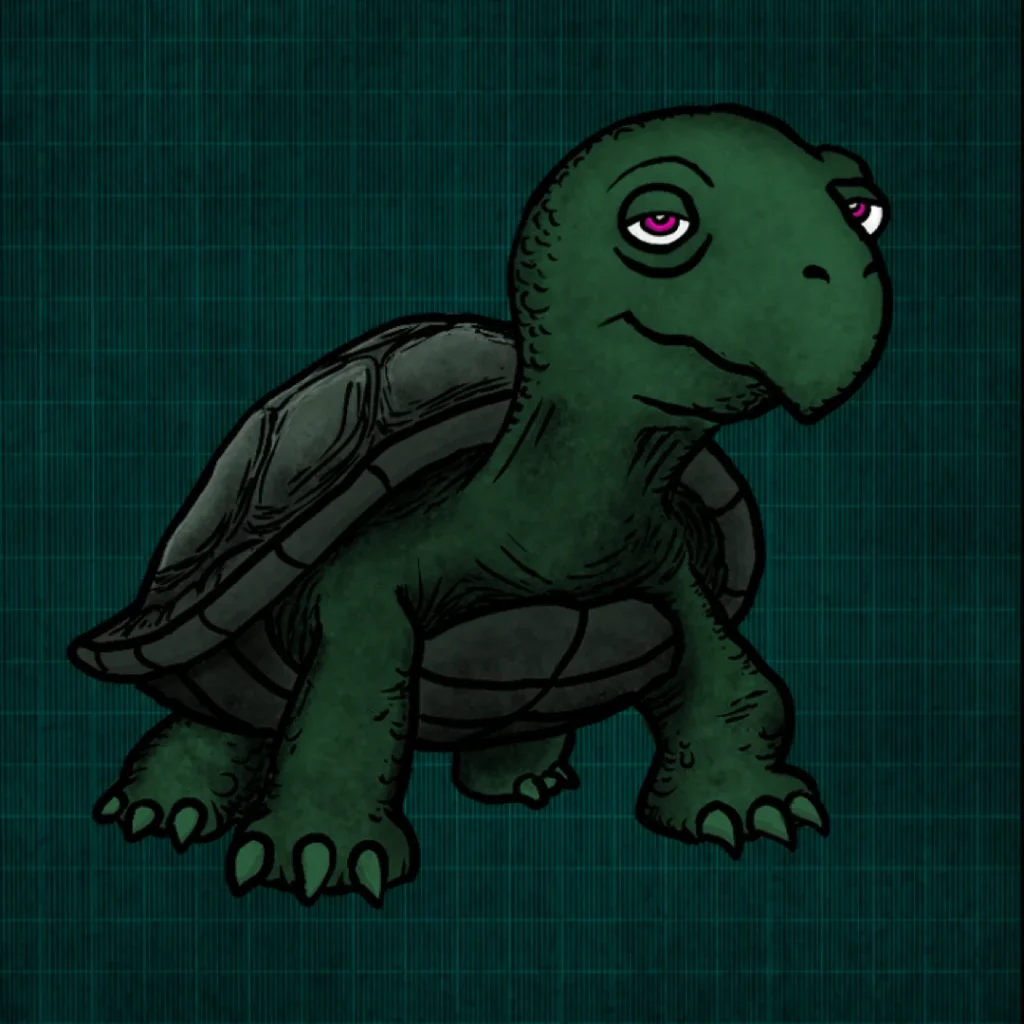
The Black Marsh Turtle, one of the five creatures of the Black Menagerie. Illustration: Sam Buchanan

Scenario card from the Black Menagerie Conversation Deck
Do you plan on more animals? When I research for the Foresight Zoo, I keep finding animals, plants and phenomena.
These are companions. A zoo collects and cages. This menagerie travels with you.
People can hold a handful of things; that is how our brains work, we think in chunks. Right now, these are the five I can carry in my body. I love the idea of the Black Menagerie being in communication with all the flora and fauna in the Foresight Zoo. The deck will grow, people will write their own scenarios; the Foresight Zoo animals can visit as friends and cousins.
For now, I want to focus on the skills that, based on my research, would be most helpful: that people can slow down and that they can tap into joy. Given the world I live in and the people I work with, that is the focus. It is an introduction to futures that invites people to identify with the archetypes and build community around them. In a number of workshops, there has been a contingent shouting: “The Black Sheep are in the house!”
“These are companions. A zoo collects and cages. This menagerie travels with you.”
Makēda Gershenson
- Cousins from the Foresight Zoo
Makēda invites the animals of our Foresight Zoo to visit as friends and cousins. Five of them might feel at home in her menagerie, from African and Asian traditions and beyond.
Read moreShow less
- Anansi, the spider of the Akan in Ghana: a trickster who bought all stories from the sky god. With the slave trade, the stories travelled to the Caribbean and the Americas, where Anansi lives on. Cultural memory survived what little else survived.
- Sankofa, also from the Akan: “go back and get it”. The bird flies forward while turning its head back, fetching on the way what it needs. In 2021 the futurist Lilith Boettcher used it as an image of reflective nostalgia. The historian Erik Seeman adds a caveat: the oldest record of the sign dates from 1927, so it is probably younger than many believe.
- The Pale Fox of the Dogon in Mali: a diviner draws a grid in the sand in the evening, the fox runs across it at night, and the answer is read from its tracks in the morning. Nobody can tamper with it in between. A built-in delay, a close relative of the Black Marsh Turtle.
- Yarrow: 50 dried yarrow stalks are the classic tool of the I Ching. The slowness is intentional. A coin toss gives the same hexagrams in seconds, but with a different value for insight.
- The Giant Tortoise: Jonathan, a Seychelles giant tortoise on St Helena, was at least 194 years old in 2026, the oldest known living land animal. Patience as strength.
You see the deck as a toolkit that can be expanded?
Absolutely. Iteration is one of my love languages, and I don’t think it will ever stop. The scenarios are based on signals, and in alignment with my decolonial feminist lens, many come from the African and Asian diaspora. So much is happening beyond a Western or European lens. The more people play, the more they can bring in signals of change from their own worlds. That's why there will be expansion packs: our scenarios keep changing.
I am really excited about the game version. It draws on P.R. Sarkar's idea of the sadvipra, someone who holds every archetype at once. In the game, every voice is needed for integration to happen and for us to move forward together.
At Futures Games, you led us through the deck and told us when to flip. Does it need a facilitator?
No. A play guide card walks through the rounds. I often wear my facilitator hat, but the deck is made for people to play on their own. The researcher in me just loves hearing what comes out of the conversations.
The game, in beta mode, will play out of the box with conditions, rounds, and signature moves for each animal. The flip moved into the game version.
Who is it for?
People in liminal spaces, navigating uncertainty. Mostly educators and organizational leaders, and the college students in my cohorts are finding it really helpful too. Educators swim in the in-between, and many organizations and entrepreneurs are figuring out what to do next. This is a chance to try on a different approach.
Futures: Joy, masks and the quest to question
Why is play important, even for adults?
I am laughing, because just today I had a dyad practice with someone in my latest FLIP cohort. When I work with my Futures Alphabet, which offers different registers for navigating the future, the quote I hear most is: Fun? What is fun? Where is fun? We are so disconnected from joy.
Joy can lower the stakes. We are in such tumultuous times, the world is at stake, and play gives people permission. In a game you can try on a future, you can try on a voice. You can pull the Black Elephant card and say the thing you would never risk saying. The animal offers a mask.
You asked at the beginning what I enjoyed as a kid. Play is how we learned growing up, and on an internal level, I don’t think we forgot that. There is a power that comes from being able to play. Rosi Braidotti talks about joy as a motor of political change. I see joy as a technology, an anticipatory technology.
Play can also be restful. With systems wobbling everywhere, rest and play are the opposite of hustle and grind. They make space. We never stopped needing play, but society stopped giving us permission to express it. That is where generativity and creativity live: in the weird and the wild.
“I see joy as a technology, an anticipatory technology.”
Makēda Gershenson
There are many dystopian stories in which the whole world is a game, or survival is. If you could give the world new game rules, what would they be?
I am always fascinated by people's fascination with Cards Against Humanity. It has cool mechanics, everybody seems to enjoy it, and there are a bunch of expansion packs. And yet, it transforms elements of our most dystopic futures into entertainment. My vision for a future is Cards for Humanity, with endless expansion packs. This deck is a nod towards that.
We are very committed to winning, even to survival. The world moves in extractive, transactional, military ways. A game without winners asks for humility instead.
So my rule would be: the quest is to always question. When I feel I have found my footing, I remember the only constant is change. I want to be nimble enough to dance with whatever comes next.
Is there anything we haven’t touched on?
The water we're swimming in: the Black Jellyfish. Sardar and Sweeney read the jellyfish as a systems phenomenon, with the bloom as its key element. This summer, I got to sit with John Sweeney and share about my embodied twist.
When humans play a futures game, they play it in their bodies, yet our bodies are undervalued. My body will say: No! Don’t move towards that future. I don't want that. My chest tightens, my palms get clammy, a pit forms in my stomach. The body acts as a vessel, both a prototype and an archive of possibilities. We can rehearse new behaviors, alone and together, before we move toward the future we want.
Also, jellyfish don’t have a brain. They aren't led by thinking. They ask: what am I sensing, here, now? My felt sense is a signal, a form of futures intelligence we've barely begun to value. We try to make sense of the unknown with our heads. The jellyfish invite us to make sense of it with our whole bodies.
- What is embodied foresight?
The stance. Joshua Floyd, Alex Burns and Jose Ramos introduced the term in 2008 in the Journal of Futures Studies. It does not describe a tool but a stance: the practitioner embodies the principles of futures work in everyday life, so that it grows out of their way of living instead of running alongside it. Its core is the ability to hold uncertainty and not-knowing.
Read moreShow less
The foundation. In 2012, Floyd grounded the idea in Futures with Francisco Varela’s enactive approach: knowing does not consist of representations but of embodied action. How we know our world and think ourselves into the future depends on our bodily presence.
At Quest Labs. Makēda describes her twelve-week cohort FLIP as an embodied futures literacies programme: six “travelers” move through twelve “worlds” along the arc of a hero’s journey and end with a futures affirmation or a job description for the year 2032. The Black Menagerie is part of it as archetype practice. The masterclass behind her CLA article also used breath, interoception and an embodied CLA game. Her Black Jellyfish brings that register into a card deck.
We trust a smartwatch to tell us whether we are about to have a heart attack, more than our own awareness of the body. In a game, you are allowed to say that you are angry or sad.
That is part of why the two additions are about slowing down and playing. We pause so we can feel into the body. We play so that we can move beyond the margins of the myths we live by: that we need to be productive, that we have to be useful. I don’t even like the word “use”. I'd rather plant or tend to the future than use it. We are earth seed. We are star seed.
People ask all the time what makes a game "serious". Our conditions are serious. That's precisely why we need to play. This season, you're invited to take more restful and joyous futures more seriously.
- Who are Ziauddin Sardar and John A. Sweeney?
Ziauddin Sardar was born in 1951 in Dipalpur in the Pakistani Punjab and grew up in Britain. He studied physics and information science at City University London and worked as a science journalist, television writer and academic, from 2001 to 2013 as a professor at Middlesex University. In 1999 he took over the journal Futures, and he later became director of the Centre for Postnormal Policy and Futures Studies, a network that promotes futures literacy with a particular focus on marginalised people. His core question: who owns the future? In 1993, he argued that futures studies had defined itself at every stage through the dominant relationship between Western and non-Western cultures, and was thereby colonizing the future. In 2010, he gave the present its name: postnormal times.
Read moreShow less
John A. Sweeney trained in Hawaiʻi. From 2009 to 2014 he was a researcher at the Hawaii Research Center for Futures Studies, and in 2018 he completed his PhD under Jim Dator. From 2014 to 2018 he was deputy director of Sardar’s centre in London; later he taught in Almaty and held a UNESCO Chair in Futures Studies in Tashkent (2023). In a 2013 editorial, he read jellyfish blooms that clogged power plants and warships as a sign of postnormal times, the seed of the Black Jellyfish. Games run through his work: a foresight gaming system for the UN Development Programme, and the Scenario Exploration System of the European Commission’s Joint Research Centre, which he co-authored. By his own account, he has run foresight workshops and gaming systems in more than 45 countries.
Together they published “The Three Tomorrows of Postnormal Times” in 2016: a method, a menagerie and the polylog, a form of conversation in which many logics stand side by side instead of being resolved. It fits a deck that needs “every voice” at the table.
A link to our first evening: the sentence “within the context of games, uncertainty is an asset”, which we quoted in our recap of Futures Games I, comes from “A Game for All Seasons” (2020), the lessons learned from the Scenario Exploration System by Laurent Bontoux and colleagues, with Sweeney as second author.
Frequently asked questions
What is the Black Menagerie?
The Black Menagerie is a conversation deck for futures literacy by Makēda Gershenson of Quest Labs. Five Black animals stand for different ways of meeting an uncertain future, combined with 36 scenarios based on signals of change.
Which animals are in the Black Menagerie?
The Black Swan, the Black Elephant and the Black Jellyfish come from Ziauddin Sardar and John A. Sweeney’s menagerie of postnormal potentialities. Makēda Gershenson added the Black Marsh Turtle for rest and the Black Sheep for playful disruption.
What are postnormal times?
Postnormal times is Ziauddin Sardar’s name for the present as an in-between period: the old normal no longer holds and a new one has not yet emerged. Complexity, chaos and contradictions drive the situation.
How long does a round take, and how many people can play?
The deck can be played solo, with 2-5 players, or in teams. Three rounds take about 45 minutes.
Do I need a facilitator?
No. The deck is designed to be played without a facilitator. Makēda Gershenson also uses it in her own workshops and cohorts.
Where can I get the Black Menagerie?
The pre-sale starts on Black Friday, 27 November 2026, via questlabs.world. A game version, an edition for educators, a version for children and expansion packs are planned.
About Makēda Gershenson
Makēda Gershenson is an educator, futurist and artist, and the founder of Quest Labs, a Berlin-based “living lab for futures literacies” (since 2022), and of Mosaics in the Making (since 2012). She holds two bachelor’s degrees and an MEd from Stanford University and an Executive MBA from Quantic School of Business, and is completing her MA in Futures Research at Freie Universität Berlin. She trained with Sohail Inayatullah, Ivana Milojević, Riel Miller, and Jake Dunagan and has worked in 37 countries. Her work weaves together futures methods, behavioural design and art-based practices into playful futures engagements. She developed the Black Menagerie and the Futures Alphabet, and co-authored “Metaphors for Reimagined Futures” in the Journal of Futures Studies (2026).
- The Black Menagerie at a glance
- Name: The Black Menagerie, questlabs.world/black-menagerie
- Developed by: Makēda Gershenson, Quest Labs, Berlin
- Illustrations: Sam Buchanan
- Builds on: Ziauddin Sardar and John A. Sweeney (2016), the menagerie of postnormal potentialities, with a decolonial feminist lens and two added creatures
- The five creatures: Black Swan, Black Elephant, Black Jellyfish, Black Marsh Turtle, Black Sheep
- Type: conversation deck; a game version (Spring 2027)
- Cards: 54 cards, 5 animals, 4 worlds, 36 scenarios, 3 Write Your Own cards, reference cards and a closing card, plus a play guide.
- Players: solo, 2-5 players, or teams. Larger groups share animals.
- Duration: about 45 minutes for three rounds
- Facilitation: not required; designed to play out of the box
- Target group: educators, organizational leaders, students, people in liminal spaces
- Editions: Black Menagerie Conversation Deck (pre-sale now); planned: game version (Spring 2027), Educator Activity Deck, a children's version and expansion packs
- Also used in: Quest Labs’ twelve-week FLIP cohorts, as archetype practice
- Debut: 2025 at the International Healing-Centered Education Conference
- Availability: pre-sale from Black Friday, 27 November 2026, via questlabs.world
- Price: Digital Version $28.88, Starter $38.88, Deluxe $68.88, Full Menagerie (Deluxe and pre-ordered game) $98.88
Sources and links
About the game and Quest Labs
- The Black Menagerie: https://questlabs.world/black-menagerie/
- Quest Labs, About: https://questlabs.world/about/
- Quest Labs, Program (FLIP, Sandbox Sessions): https://questlabs.world/program/
- Egwuonwu, Ozioma; López, Marimar; Gershenson, Makēda (2026): Metaphors for Reimagined Futures: Insights from Causal Layered Analysis in Practice. Journal of Futures Studies, Perspectives, 7 May 2026. https://jfsdigital.org/2026/05/07/25501/
- Resilience 2032 (social media theatre): https://www.noproscenium.com/resilience/
- UCL / Lancet Public Health (2025), social prescribing in England: https://www.ucl.ac.uk/news/2025/sep/social-prescribing-rises-sharply-among-englands-gps
On postnormal times and the menagerie
- Sardar, Ziauddin (1993): Colonizing the Future. The ‘Other’ Dimension of Futures Studies. Futures. https://doi.org/10.1016/0016-3287(93)90163-N
- Sardar, Ziauddin (2010): Welcome to postnormal times. Futures 42. https://doi.org/10.1016/j.futures.2009.11.028
- Sardar, Ziauddin; Sweeney, John A. (2016): The Three Tomorrows of Postnormal Times. Futures 75, pp. 1–13. https://doi.org/10.1016/j.futures.2015.10.004
- Sweeney, John A. (2013): Sign of Postnormal Times. Editorial. East-West Affairs 1(3/4), pp. 5–12.
- Dator, Jim (2009): Alternative Futures at the Manoa School. Journal of Futures Studies 14 (2), pp. 1-18.
- Bontoux, Laurent; Bengtsson, Daniel; Rosa, Aaron; Sweeney, John A. (2016): The JRC Scenario Exploration System – From Study to Serious Game. Journal of Futures Studies 20(3), pp. 93–108. https://doi.org/10.6531/JFS.2016.20(3).R93
- Bontoux, Laurent; Sweeney, John A.; Rosa, Aaron B. et al. (2020): A Game for All Seasons: Lessons and Learnings from the JRC’s Scenario Exploration System. World Futures Review 12(1), pp. 81–103. https://doi.org/10.1177/1946756719890524
- Taleb, Nassim Nicholas (2007): The Black Swan. The Impact of the Highly Improbable. New York: Random House.
- Friedman, Thomas L. (2014): Stampeding Black Elephants. The New York Times.
On Afrofuturism, Asian Futurisms and Afro-Asian futures
- Dery, Mark (1993): Black to the Future. Interviews with Samuel R. Delany, Greg Tate, and Tricia Rose. South Atlantic Quarterly 92(4). https://doi.org/10.1215/00382876-92-4-735
- Eshun, Kodwo (2003): Further Considerations on Afrofuturism. CR: The New Centennial Review. https://doi.org/10.1353/ncr.2003.0021
- Okorafor, Nnedi (2019): Africanfuturism Defined. Blog post; reprinted in: Talabi, Wole (ed.) (2020): AFRICANFUTURISM: An Anthology. Brittle Paper.
- Nassiri-Ansari; Riha; Sivi; Rhule (2025): Decolonial Feminism as a Future Direction for Liberatory Feminist Futures. Journal of Futures Studies 29(3). https://doi.org/10.6531/JFS.202503_29(3).0005
- Boggs, Grace Lee; Kurashige, Scott (2011): The Next American Revolution. University of California Press.
- Kochiyama, Yuri (2004): Passing It On: A Memoir. UCLA Asian American Studies Center Press.
- African Futures Conference 2026, Institute for Security Studies: https://futures.issafrica.org/events/2026/African-Futures-Conference-2026
- AfroRithms from the Future: https://www.afrorithms.com/
- Roh, David S.; Huang, Betsy; Niu, Greta A. (2015): Techno-Orientalism: Imagining Asia in Speculative Fiction, History, and Media. Rutgers University Press.
- Wright, Richard (1956): The Color Curtain: A Report on the Bandung Conference.
- Final Communiqué of the Asian-African Conference of Bandung (24 April 1955). CVCE, University of Luxembourg. https://www.cvce.eu/en/obj/final_communique_of_the_asian_african_conference_of_bandung_24_april_1955-en-676237bd-72f7-471f-949a-88b6ae513585.html
On rest, joy, and slowness
- Hersey, Tricia (2022): Rest Is Resistance: A Manifesto. Little, Brown Spark.
- Braidotti, Rosi (2018): Ethics of joy. In: Braidotti, R.; Hlavajova, M. Posthuman Glossary, pp. 221-224. Bloomsbury Academic. https://doi.org/10.5040/9781350030275.0016
- Rosa, Hartmut (2005): Beschleunigung. Die Veränderung der Zeitstrukturen in der Moderne. Frankfurt am Main: Suhrkamp.
- Machado de Oliveira, Vanessa (2021): Hospicing Modernity: Facing Humanity’s Wrongs and the Implications for Social Activism. Berkeley: North Atlantic Books.
- Inayatullah, Sohail (2002): Understanding Sarkar: The Indian Episteme, Macrohistory and Transformative Knowledge. Leiden: Brill.
- Butler, Octavia E. (1993): Parable of the Sower. New York: Four Walls Eight Windows.
On Causal Layered Analysis and embodied foresight
- Inayatullah, Sohail (1998): Causal layered analysis: Poststructuralism as method. Futures 30(8), S. 815–829. https://doi.org/10.1016/S0016-3287(98)00086-X
- Milojević, Ivana (2015): Introduction. In: Inayatullah, Sohail; Milojević, Ivana (eds.): CLA 2.0. Transformative Research in Theory and Practice. Tamkang University Press, pp. 1–12.
- Floyd, Joshua; Burns, Alex; Ramos, Jose (2008): A challenging conversation on integral futures: embodied foresight & trialogues. Journal of Futures Studies.
- Floyd, Joshua (2012): Action research and integral futures studies: A path to embodied foresight. Futures. https://doi.org/10.1016/j.futures.2012.09.001
On the cousins from the Foresight Zoo
- Boettcher, Lilith (2021): Plädoyer für die Nostalgie. Zu den Potentialen der Nostalgie für die Zukunftsforschung. Freie Universität Berlin. https://doi.org/10.17169/refubium-30690
- Seeman, Erik R. (2010): Reassessing the “Sankofa Symbol” in New York’s African Burial Ground. The William and Mary Quarterly 67(1). https://doi.org/10.5309/willmaryquar.67.1.101
- Griaule, Marcel; Dieterlen, Germaine (1965): Le renard pâle. Tome 1: Le mythe cosmogonique.