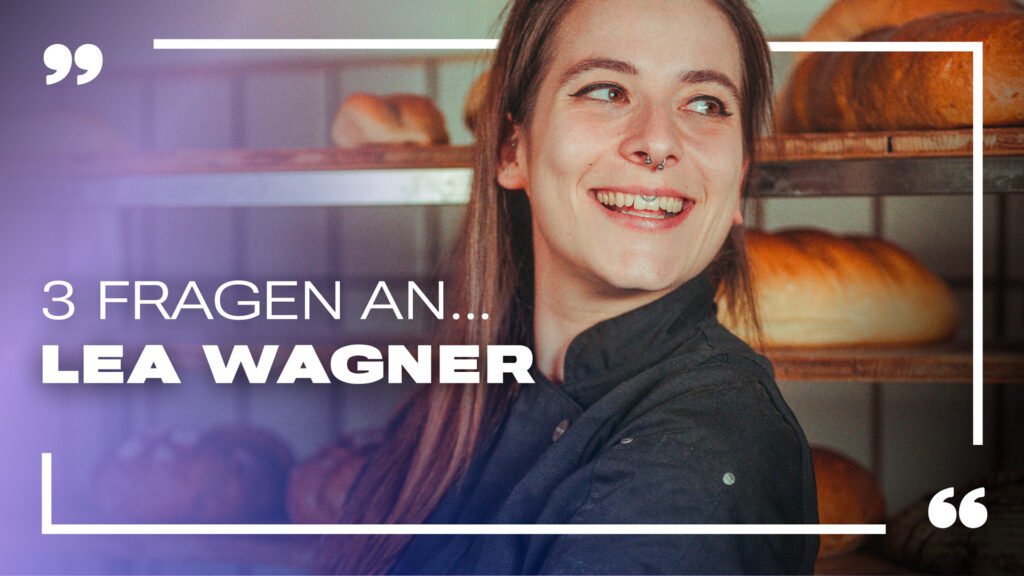

In our “3 questions for…” section, we regularly interview experts on topics that will have a lasting impact on the future of organizations and society. From software development and artificial intelligence to strategic foresight and attitudes toward the future, sustainability, and dealing with fears about the future — we shed light on the trends and developments that help us think and act in a future-oriented way.
Confidence to shape the future in the baking trade: AI, meaningful work & room for change
How do you see the future of your industry?
“A lot is changing in the bakery sector right now”, Lea says right at the start. AI, the big topic? She does not see it as something to fear, but primarily as a tool. Large bakery chains already use software that factors in things few people would think to consider when planning orders: Which holidays are coming up in the Islamic calendar? When are periods of fasting? What will the weather be like? “That kind of thing can be a real help in this industry,” says Lea. She is far less convinced that AI will replace skilled bakers – not least because the industry is already facing a severe shortage of skilled workers.
The media often paint a gloomy picture of the industry’s future, with talk of “the death of the local bakery” and rising insolvency figures. One recurring argument centers on competition between the small local bakery and large-scale industrial producers. What bothers Lea about so much of the negative coverage is not that it names real problems, but that it tells only one side of the story: “The death of the local bakery” simply makes a good headline. She sees the tension between industrial-scale production and local craft bakeries too, but she rejects the idea of casting industry as the villain in a simple good-versus-bad story: “I think there is room for both.” Industrial producers serve a different market, and someone who can only afford a 17-cent bread roll from the supermarket – say, a single mother – deserves understanding, not judgment. At the same time, those are prices a small sustainable bakery neither can nor should try to match.
In Lea’s vision of the industry’s future, there will be a number of large-scale bakeries with branch networks and supermarket supply contracts, and there will still be small bakeries offering a manageable but carefully chosen range, built around quality and local sourcing, and making that value visible to customers. “If you're really good at what you do, people will come to you.” Those who can neither compete with industrial prices nor communicate what makes them different will find it increasingly difficult to win customers. And in Lea’s view, some bakeries have contributed to their own decline: “Some small bakeries have basically run themselves into the ground,” for example by offering huge ranges packed with bought-in frozen baked goods or by treating apprentices and staff poorly.
One thing working in favour of craft bakeries is the growing focus on health and sustainability. Lea’s bakery has switched entirely to long fermentation, allowing doughs to rest for extended periods before baking. This develops more flavour, keeps products fresh for longer and breaks down compounds that can cause health issues for many people. Many customers who can no longer digest supermarket products come to her for exactly that reason. Then there are the short supply chains: the spelt flour comes from an organic farmer just around the corner, making it easy to agree which variety of grain to grow the following year. That reduces exposure to supply-chain disruptions and cuts the bakery’s carbon footprint. Lea is candid about the trade-offs too: long fermentation means more work and noticeably higher energy costs. “But I think our customers appreciate it.”
How do you see the future of the skilled crafts and trades?
Does the baking trade – and skilled work more broadly – have an image problem? Will these careers become more attractive in the future, or will the skills shortage continue? And what about the question of purpose, which is playing an increasingly important role in debates about the future of work? For a baker, the working day starts in the middle of the night. Who really enjoys getting up that early? Yet Lea, of all people, has a compelling answer to the question, "What am I actually getting up for every morning?" Perhaps that is one of the trade's greatest strengths – and one we talk about far too little:
Lea points to a Forsa survey commissioned by IKK classic (November 2025): 91% of people working in the skilled trades find their work meaningful, 84% are proud of their profession, 77% say their work even makes them happy, and only 6% are dissatisfied with their job. Those whose work is largely physical also value the fitness benefits: 71% say their work keeps them physically fit and 80% say it keeps them mentally fit. The act of making something with your own hands is seen as a distinctive strength of the trades – one that neither machines nor AI can replace. For Lea, the reason is obvious: “There is a real sense of purpose. At the end of the day, you have something tangible that you can look at and feel proud of.” In her experience, people who can see what they have created at the end of the day – a loaf of bread, a window, a piece of furniture – are more satisfied. Of course, people in the skilled trades are not immune to mental health problems in demanding working lives. Even so, the sector compares relatively well on mental well-being: the IKK classic study “How Healthy Are the Skilled Trades? 2024/25”, conducted with the German Sport University Cologne, found that well-being among people in the skilled trades is above the population average.
That makes the gap between how tradespeople see themselves and how others see them all the more painful. Many feel their work receives less recognition than other professions. According to the Forsa survey, 99% of respondents consider the skilled trades important to society, yet only 61% feel genuinely appreciated for their work by those around them, and 51% believe the skilled trades do not receive enough recognition in society. Lea knows this from personal experience – and sometimes almost turns it into a game. If she tells strangers simply that she is a baker, she gets a weary “Oh, okay.” If she says she is a master baker, master confectioner, World Championship runner-up and German champion, the reaction suddenly becomes: “Wow, that’s amazing!” For her, the image problem starts early, with parents pushing their children towards the academic track from primary school onwards, as though vocational training were merely a second-rate Plan B to university. “I personally think that’s a bit of a shame,” says Lea, although she also believes things will change. Ironically, AI may help drive that shift: many academic professions may be easier to automate than the skilled work performed by human hands in a bakery.
Lea still sees plenty of need for reform, especially in vocational training. In her view, vocational schools often bring together two very different worlds. On one side are highly motivated young people from family businesses and career changers, some of whom already have university degrees. On the other are apprentices who simply sit through lessons because the material does not really challenge them. The system serves neither group particularly well. Curricula lag behind real-world practice in many areas: modern techniques such as long fermentation barely feature, while anyone who shows creativity in an exam risks losing marks to examiners with an “old-school mindset”. There has been some incremental progress, though: from 2027, the unpopular intermediate exam – which until now carried little incentive because nobody could fail it – will count towards the final qualification nationwide.
Another development has caught Lea’s attention in a positive way: the industry is becoming more female. When she was training for her master baker qualification, around three-quarters of her classmates were men – an unfamiliar sight for Lea, because her family’s bakery had always employed “mostly women”. Even so, that ratio already represented progress. Ten or twenty years ago, vocational school classes might have included only one or two women training as bakers; today, women account for around a quarter on average. The old clichés – this is not a job for women, it is too heavy, too physically demanding – are losing ground, partly because the work itself has changed. The 50-kilogram sacks of the past have largely disappeared. Some are already saying, “The future of baking is female.” A look at Germany’s national baking team, where the share of women is far higher than in the industry overall, suggests they may have a point.
Lea’s conclusion on the future of the skilled trades: they need young people who are eager to change things. Lea herself created bread painting as an art form – something that simply did not exist before and is now taught in workshops in many places. “There is still so much room to explore in this industry,” she says. If that message is communicated more clearly, if social recognition grows, and if more people confidently choose an apprenticeship as their Plan A, Lea sees a strong future for the skilled trades.
What role do you see yourself playing in the future of the baking trade?
Beyond bread painting, Lea is helping shape the future of baking in very practical ways and on several fronts. Through social media and a podcast, she works to build a more positive public image of the skilled trades. She sees these channels as a “voice” that can show people the many sides of the sector and build understanding – whether that means explaining how the price of a loaf reflects energy costs, taxes and fair wages; putting a public face to her local suppliers; or experimenting with recipes and baking techniques to showcase the creative side of her craft.
At the business level, Lea is about to take over the family bakery. She has been actively shaping the business for some time rather than simply preserving the status quo. One example is opening hours: the shop used to be open six days a week; now it opens five, with two of those only half days. The aim is to give employees a proper weekend and more time with their families – far from a given in a profession where work begins at night. Lea says her parents’ generation often knew the baker’s life only as a life of complete sacrifice: no family, no partner, or both only at a very high cost. That is exactly what she wants to change: “There is always a way.” Her experience so far backs her up: “I’ve changed so many things my parents said couldn’t be done. And every single one of them worked.” Her local customers have supported every change so far. She also talks about this – and about how to preserve tradition without standing still – in an episode of her podcast, “Courage to Change – Why ‘Oof’ Is Often Where It Starts.”
She does not romanticize her working life, though: “There are days when you think, ‘Ugh, I really don’t feel like getting up tomorrow.’ But that’s true in any job.” Overall, however, the satisfaction – and the sense of purpose she finds in her work – wins out.
Conclusion: shaping the future instead of fearing it
To us, Lea is a powerful example of what #Zukunftsmut looks like in practice: the courage and confidence to shape the future. The industry faces real challenges: insolvencies, the shortage of skilled workers, bureaucracy and fierce competition. But Lea does not respond to that uncertainty by retreating. She pushes back against it and shows people that local skilled craft businesses can thrive – and that the work can be both deeply rewarding and full of purpose. Instead of merely talking about the future, Lea gets to work shaping it. We wish her every success as she takes over the family business!
More from Lea Wagner:
Social media
@meisterbaeckerin_lea
Panel at ZUKUNFT HANDWERK in Munich
Haltung für ein gesundes Handwerk – Das war die ZUKUNFT HANDWERK 2026
Podcast
Für Laib und Leben
Family-owned bakery
Der Bäckerladen Aschfeld
At Schaltzeit, we know the debates around meaning and agency in the workplace from our own foresight projects, including work for Germany’s Federal Ministry of Labour and Social Affairs. All the better when the answers are found not only in strategy papers, but in a bakery.
Would you like to build greater confidence in the future within your business or industry? Get in touch. Together, we’ll find a format that helps you engage constructively with the questions and uncertainties shaping your future: https://schaltzeit.com/en/futures-experience/