Sign up now to receive regular updates directly to your inbox. All at an appropriate delivery interval that respects your time and attention.
Subscribe nowClose form
André Winzer
ILA 2018 – a look back
The Advanced Foresight Group, represented by Dr. Bernhard Albert (Foresight Solutions) and André Winzer (Schaltzeit), was invited to spend 3 days at ILA hosting LEGO® SERIOUS PLAY® “taster workshops” at the booth of AWB Aviation GmbH – our aim was to explain the basic ideas behind SERIOUS PLAY to participants and to make clear that this methodology helps support strategy processes in companies and business networks.
Play is not wasted time. It activates the creative hemisphere of the brain. The idea behind LEGO® SERIOUS PLAY® is to create a dynamic group process in which people “think with their hands.”
Dr. Bernhard Albert explains Lego Serious Play
We start with a challenge that, building on each individual’s creativity, creates a group process resulting in a “shared design.” The group goes through this spiral of a “challenge,” a “build run,” and sharing several times, allowing the question to be explored in greater depth.
Models become landscapes,
landscapes become an ecosystem in which mutual relationships can be mapped,
in order to finally simulate decisions.
The following “challenges” were played:
The first challenge was to build the “airport tower of the future.” What does it look like? What functions does it have, and which functions will we no longer need in 2040?
The second challenge looked at the trend field of urban air mobility. Which elements will be necessary or desirable in this trend landscape? New aircraft, new services, other parts of the air mobility ecosystem? More on this in our ILA follow-up report, available on request.
What impressed us most was the diversity of participants’ ideas. In our follow-up, we will explain the individual models on the Advanced Foresight Group blog.
As futurists, we are of course particularly interested in new impulses. At the award ceremony for the Innovationspreis der Deutschen Luftfahrt (German Aviation Innovation Award), ILA itself presented many new ideas. At first glance, aviation is a very long-lived business. Because of regulation, innovation intervals are long, and new airframes are rarely developed. Nevertheless, new and partly cross-cutting topics such as digitalization, urban air mobility, customer journey, emission reduction, electric flight, drones, autonomous airspace control, etc. have become an integral part of ILA. You can find the winners here
Emission Reduction category: Airbus Operations GmbH, CCP Technology GmbH, German Aerospace Center (DLR)
Cross Innovation category: Daimler AG, Rolls-Royce Deutschland Ltd & Co KG, Premium AEROTEC GmbH
Industry 4.0 category: Fraunhofer Institute for Structural Durability and System Reliability (LBF)/ MT Aerospace Holding GmbH, NeuronSW Ltd,
Premium AEROTEC GmbH
We’re happy to share our personal feedback on the winners on request.
What impressed me personally:
That appointments are made mainly through business matchmaking – empathy, not the logical level of cooperation, is what decides. Preparation time for trade shows is being drastically shortened. Instead: meeting marathons in 30-minute slots. That means less stress before the event, but all the more stress during it.
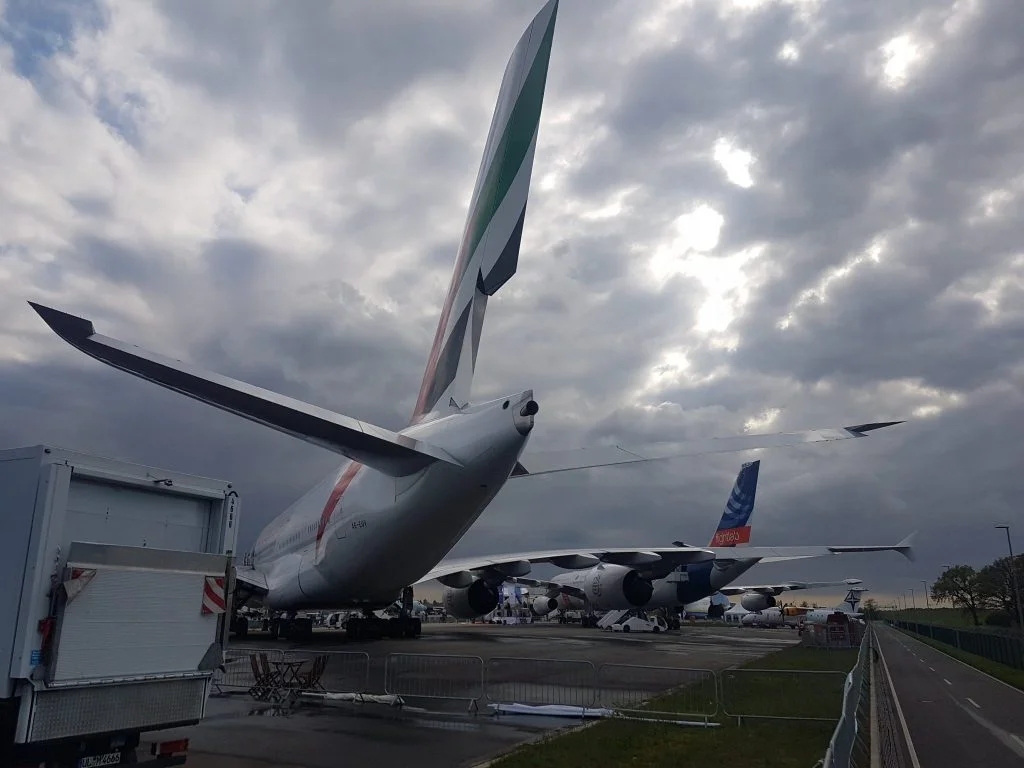
AN 225 (Source: André Winzer)
A guest aboard an Antonov AN225. While the trade show talks about predictive maintenance, this aircraft flies around the clock with 22 mechanics on board. Each mechanic is a specialist for one subsystem and always ready for action. Spare parts for 1–2 months always fly along.
The discussion about foresight in an AWACS aircraft made clear to me how slowly digitalization is reachingAndré Winzer in an AWACS aircraft (Source: Foresight Solutions)
NATO. It’s easier to design new satellites than a new generation of AWACS. The current one will probably keep flying with this technical equipment until 2035. Since satellites are much cheaper to maintain and in some cases deliver higher data resolutions, the AWACS are gradually being decommissioned until a new generation is developed.
The ILA music playlist, stuck in the ’70s, with “Eye of the Tiger” or AC/DC’s “Thunder” – which still got the crowd going.
The gyroplane from Autogyro, a German company founded only in 1999 that is considered the world market leader. I simply didn’t know this concept at all and was impressed that it was developed as early as 1932 by Juan de la Cierva . In a gyroplane, the rotor is not actively driven but kept spinning by the airflow – and that is impressive. On display was the Cavalon, which also won a Red Dot Design Award. A gyroplane can hover and fly on its own, is inexpensive to maintain, and can easily cope with stalls. But see for yourself.The Cavalon gyroplane
Video source: Creator: Polygoon-Profilti (producer) / Netherlands Institute for Sound and Vision (managing director)
Publication date: May 28, 1932 Length: 00:37 www.openbeelden.nl/media/669157 License: Public Domain Mark 1.0
Conclusion: ILA was great. Unfortunately, I only visited Hall 3 on the last day, and many highlights were still hidden there – whether the police’s “crime scene” drone, which quickly takes a laser scan from the air and surveys accident sites, or new electric drives. Of course, the historians were also well represented. There was a book recommendation at the booth of the Gesellschaft zur Bewahrung von Stätten deutscher Luftfahrtgeschichte ( GBSL ) e.V. At its core, it was about how innovation cycles were drastically shortened during World War II – unfortunately, also to the detriment of the pilots.
If you’d like to learn more about LEGO® SERIOUS PLAY®, please contact Aveniture GmbH – our partner in the Advanced Foresight Group. We ourselves are always happy to take part in learning and simulation games – and to design them. Our own formats include the Experience Tower, SpinTheNet, the Agility Game, and – brand new – our Smart Factory game on digitalization.