
There is war in Ukraine. A war that seems unpredictable – and yet was foreseeable. Despite our foresight skills, we closed our eyes. No one knows the deeper intentions of the lying aggressor Vladimir Vladimirovich Putin.
Instead of thinking in scenarios and exploring our room for maneuver, we relied on the “principle of hope”: “it won’t escalate.” Our dilemma: on the one hand, we want to de-escalate the situation, but any help we offer Ukraine will just as surely be interpreted by Putin as a provocation.
Even we in Germany have been confronted with the fact that we are not prepared for war. Our equipment is outdated, compulsory military service has been abolished, and most people only take a first aid course for their driving test. There is no known clear crisis and emergency plan.
The crux of the matter is our energy dependence – on top of that, we have sold off parts of our emergency infrastructure. A third of our gas storage facilities belong to the GAZPROM subsidiary Astora. An article by Deutsche Welle shows that gas storage facilities were systematically emptied to drive up gas prices. Through high gas bills, we are currently providing Russia with substantial financial support. Strictly speaking: Germany is financing this war! So the uncomfortable truth is also that we need greater resilience. At the same time, we must do much more to make megalomaniac aggressors such as Russia’s Putin back down.
That also means finally addressing the uncomfortable issues. While in Russia Alexei Navalny, in 12 tweets, calls for a protest for peace, we too should discuss our options for action and act decisively.
We must be aware that taking a clear position, with all its consequences, will cost us our own comfort zone. What does Europe have to offer? What do we stand for? What are we prepared to accept?
“Everything has a price, and now, in the spring of 2022, we must pay this price. There’s no one to do it for us. Let’s not ‘be against the war.’ Let’s fight against the war.” – Alexei Navalny
And the aggressor Putin must be called by name. It is Putin’s war. Many Russians have recognized that Putin is trying to distract from the country’s real problems, creating a common enemy to bring about a deceptive unity — as a remedy for internal difficulties, disagreements, conflicts and unfinished business — the old and primitive tactic of using an external threat to numb the country’s own internal difficulties, problems, crises and threats.
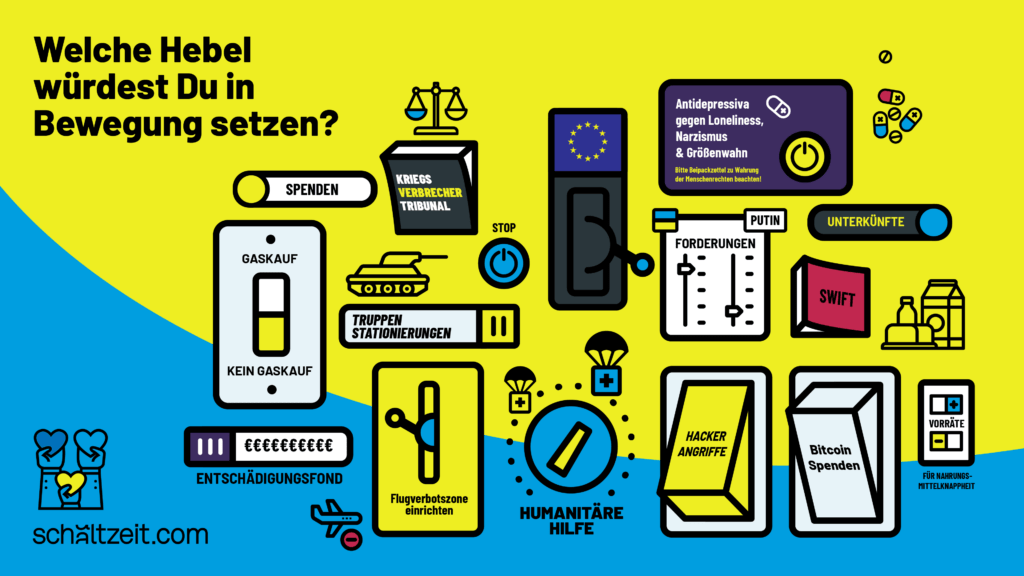
Do we want to feed this image of the enemy? Do we want to play into Putin’s hands and turn aggressively against Russia? What can we do to support the people of Ukraine and Russia? What has to happen to weaken Putin’s support? What means do we have to end this war? What can we do so that the senselessness of this invasion is recognized and the killing of innocent people stops?
What steps are we willing to take in society, business and politics – and on the small scale of our own daily comfort zones?
Will we become hosts who share, take people in and offer support? Will we make sure to celebrate and promote Russian culture as well as Ukrainian culture? Will we reflect on how we are economically and politically entangled in Putin’s position?
Will we make sure our infrastructure becomes more robust so that we are prepared for humanitarian disasters in other countries? Will we be willing to make sacrifices of our own for peace? Will we do more to strengthen the defense capabilities of Germany and Europe? Will we decouple ourselves from gas and diversify our energy production? Will we make sure that we always keep our eyes on the aggressors, not on Russians as a people?
If we look at Kant’s work “Perpetual Peace” (“Zum ewigen Frieden”), he names the following points as the foundation for peace:
1. “No treaty of peace shall be regarded as valid, if made with the secret reservation of material for a future war.”
2. “No state having an independent existence – whether it be great or small – shall be acquired by another through inheritance, exchange, purchase or donation.”
3. “Standing armies (miles perpetuus) shall be abolished in course of time.”
4. “No national debts shall be contracted in connection with the external affairs of the state.”
5. “No state shall violently interfere with the constitution and administration of another.”
6. “No state at war with another shall countenance such modes of hostility as would make mutual confidence impossible in a subsequent state of peace: such are the employment of assassins (percussores) or of poisoners (venefici), breaches of capitulation, the instigation and making use of treachery (perduellio) in the hostile state, etc.”
If we apply “Perpetual Peace” to ourselves, we could interpret it like this: we cannot accept a peace that does not remove the cause of war and is based on blackmail. We Europeans should not create or foster dependencies. That also means weapons and defense equipment should be donated rather than pre-financed. Interfering in Russia itself by trying to overthrow Putin by underhanded means is not a sustainable solution. Let us trust in the internal momentum of the Russian population speaking out against the war (and Putin), in the power of diplomacy and in the values we stand for — it takes time, but its effect lasts longer!
So what does this mean in practice for Germany and its citizens?
You can:
1. Find out where donations in kind are being collected and which goods are accepted – and contribute them (sorted!)
2. Use platforms to offer private accommodation, if possible
3. Develop your own position on different political and economic options for action (no-fly zone, arms deliveries, energy policy, …)
4. Demonstrate, discuss and share (reliable) information
5. Prepare yourself better for emergencies (but please don’t go panic buying!)
6. Not lose hope, look after your own resilience and keep celebrating life
We/society can:
1. Be a host and a safe haven for all the people who have been forced to flee
2. Never give up on diplomacy
3. Seek to prevent violence and terror at all costs
4. Turn off the money tap — even if it means radically restructuring our energy system
5. Bear the costs of keeping the peace
6. Not give up on Russia and Ukraine and their citizens
7. Provide Russians with neutral information, promote independent journalism, show perspectives
Let us not become a nation of frightened neighbors who are horrified by the misery but do nothing to prevent it.
As a team, we discussed how we can get involved.
It was clear that we wanted to support both the people who have fled Ukraine and humanitarian organizations in their work with cash donations and donations in kind. The causes closest to our hearts that we chose were:
Doctors Without Borders: Supporting hospitals to provide training in emergency medicine and emergency surgical care; delivering medical supplies; ensuring medical care for the people — https://www.aerzte-ohne-grenzen.de/unsere-arbeit/einsatzlaender/ukraine
Save the Children: Helping in refugee camps in the border region and supporting arriving families as best they can; for example, children and their mothers receive toys, hygiene kits, diapers and face masks from them — https://www.savethechildren.de/unterstuetzen/nothilfe/spenden-ukraine/?gclid=Cj0KCQiA64GRBhCZARIsAHOLriI7iPcaRw2ZOSZG4uDxDj-K9MuCDgjUhXFQcq7lNK643cEjU0Ph8wAaApHWEALw_wcB
Welthungerhilfe: Emergency aid for East Africa — since the war could have dramatic consequences for some countries in East Africa and the Middle East, whose grain supply is almost entirely dependent on imports from Russia and Ukraine –https://www.welthungerhilfe.de/spenden/
Reporters Without Borders: Defending the human right to freedom of expression — https://www.reporter-ohne-grenzen.de/russland
Our employees are also helping to provide private emergency accommodation. Join in and register at Unterkunft Ukraine (unterkunft-ukraine.de).
We encourage everyone to do something for peace. Whether through time, energy or resources — get involved and help preserve peace for all of us.