
What's behind this year's focus areas?
The challenge centers on four focus areas that are considered key levers for fundamentally rethinking networks:
Autonomous Networks
Networks should not just be automated but become adaptive and self-deciding. This is about closed-loop systems, bandwidth-adaptive 5G slices, real-time edge decisions, and tool-augmented AI agents that can understand operator intentions and implement them technically – reliably, scalably, and without manual intervention.
Energy Efficiency & Zero-Bit Zero-Watt
More data traffic must not automatically mean more energy consumption. The goal: networks that only consume energy when data is actually flowing. AI helps not only in operations (load forecasting, sleep states, RAN optimization) but already in the design and planning of efficient architectures.
Supply Resilience
Telecommunications is globally interconnected. Supply chains must be robust, transparent, and responsive. AI can make risks visible earlier, suggest alternatives, or optimize repair and refurbishment paths – so that critical infrastructure stays resilient.
Security
Modern networks are highly software-defined – which makes them dynamic but also more vulnerable. What's needed are AI-based methods that can anticipate attacks, detect anomalies in context, and automate responses, all the way to autonomously restoring compromised systems.
These four areas are not isolated innovation spaces – they are structurally connected. An AI-native telco needs autonomy, efficiency, resilience, and security as mutually reinforcing pillars.
Our contribution: PEACOQ as the engine behind the scenes
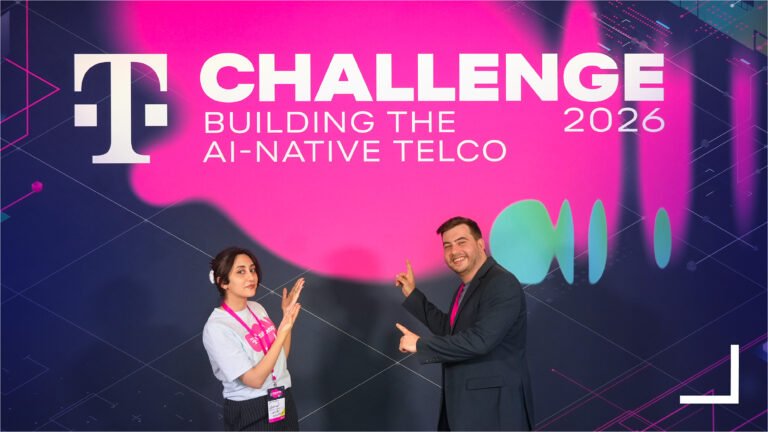
We have supported T Challenge as an implementation partner for several years – and with it, not just a competition but an ongoing space for learning and development. Our work with T Labs has evolved over time: from classic ideas competitions to more precisely orchestrated innovation processes that focus on technical maturity, integration potential, and relevance for the future.
With PEACOQ, our white-label platform for collaborative innovation and evaluation processes, we lay the foundation for this:
- Structured submission processes that allow teams to present their ideas clearly and comparably.
- Evaluation systems that support experts, the jury, and technical evaluation in an integrated way.
- A shared decision-making environment where relevant information comes together in one place.
T Labs are true pioneers. Together, we develop features that help identify the right ideas and teams.
Lucas Buchauer
The platform grows out of practice: out of real competition challenges, the experience of interdisciplinary juries, and the feedback of teams developing their solutions further.
What we've learned from past years:
In recent years, the award winners have included projects that showed how AI and new network technologies can make a direct impact on operations. Examples include:
- AI-supported network optimization that predicts load peaks and automatically shifts resources to make connections more stable.
- Energy-efficient radio network architectures that adapt dynamically to usage patterns, reducing consumption without sacrificing performance.
- High-capacity optical links (e.g., laser link systems) that open up new ways to transmit bandwidth wirelessly and with high robustness.
- Robotics and drone solutions that automate the inspection and maintenance of infrastructure, increasing safety and reducing downtime.
Examples like these show what really matters in T Challenge: not just visionary ideas — but how concepts become workable solutions that tangibly improve network operations, energy consumption, reliability, and security.
A brief look back: three years of T Challenge, three different questions about the future
2023 was all about what a human-centric internet of the future could look like. The winning teams approached Web3 technologies not as hype but as infrastructure that builds trust and connects people. Several teams were honored. Shoelace Wireless received the award for the most innovative solution of the year. Shoelace takes a new approach to optimizing spectrum and network resources, enabling better connectivity for customers. Instead of “network as usual,” the result was a model in which network quality, resource efficiency, and customer loyalty are considered together.
2024 the focus clearly shifted toward AI in Telecommunications: How can network operators use AI to analyze network and operational data faster, more comprehensibly, and in a way that guides action? The winner was Synthefy – with a GenAI-based analytics platform that prepares time series, logs, and network metrics so they can be explored and interpreted in natural language. The message: complexity becomes manageable when AI works in an understandable way.
2025 took things consistently one step further: AI for Telecom – in other words, how AI makes a direct impact on network architectures and service experiences. First place went to Resemble AI. Their approach: synthetic, customizable, natural-sounding voices that make service interactions more personalized, faster, and more accessible. At a time when users expect systems to “understand” them, voice is becoming the central interface.
Who T Challenge 2026 is relevant for
- For teams working to make networks smarter, more resilient, more sustainable, and more secure.
- Submission deadline: December 5, 2025
- Final in Bonn: April 28–29, 2026
- Prize money: up to €450,000 plus access to experts & pilot networks.
Interested in an exchange or a look at our platform?
We're happy to show you how we use PEACOQ to structure innovation processes, support them, and make them scalable — especially where many strong ideas meet a limited number of decision points.
Just write to us — we're ready.