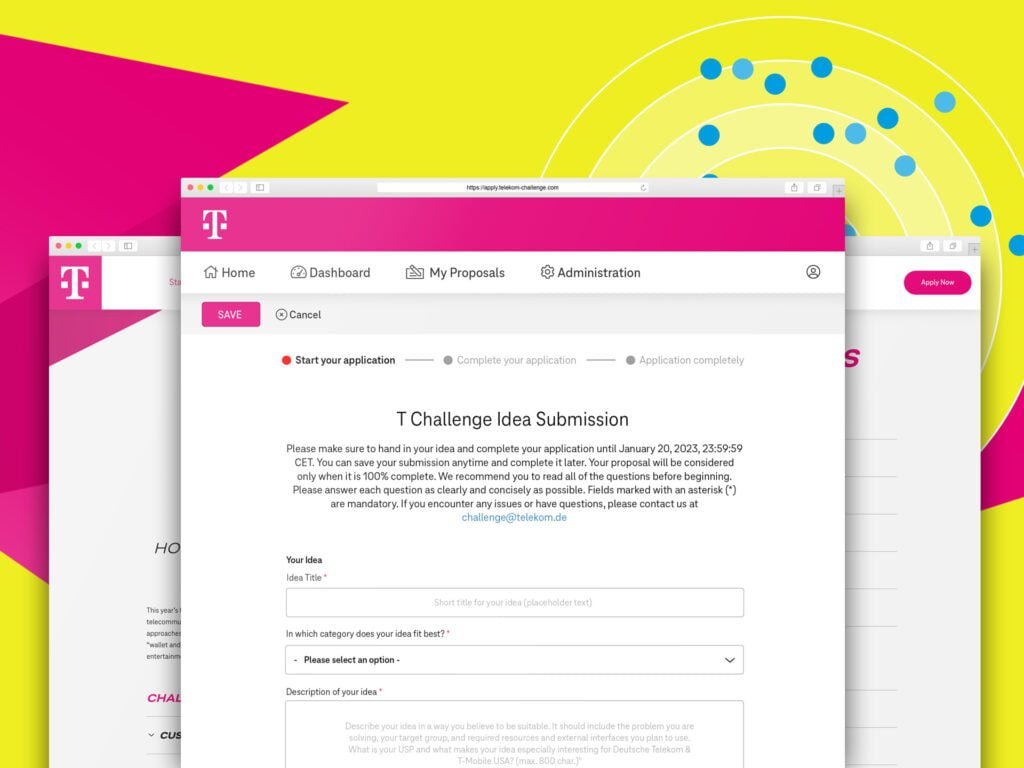

Despite the economic crisis and inflation, Deutsche Telekom AG isn’t shying away from holding the T Challenge again in 2022. For this year’s competition, Deutsche Telekom AG is looking for the best ways to use Web3 technology for telecommunications to create a more human-friendly internet and build closer connections with its customers.
Claudia Nemat, Board Member for Technology & Innovation at Deutsche Telekom AG, recently announced the third T Challenge on her social media channels, once again relying on the proven Technology & Innovation team at T Labs led by Michael Lang and Dr. Miralem Gazibegović, who are tackling the topic of “Web3” together with T-Mobile USA. A single idea can win €250,000, with €600,000 awarded in total. The T Challenge isn’t about handing out money indiscriminately, but about identifying cooperation partners who are interested in jointly advancing the development of Web3, especially in the mobile sector.
About the T Challenge 2022
Launch: November 2, 2022
Motto: “Web3 for telecommunication – creating a human centered internet”
Prize money: €600,000 in total, up to €250,000 in prize money per idea
Target group: Developers, experts, creatives and researchers from universities, R&D institutes, startups, agencies and industry
Link to the website
Web3 – the vision of a new, better internet
The central theme of this year’s T Challenge is Web3. The term Web3 refers to a decentralized internet ecosystem of the future. The 3 doesn’t stand for 3D and immersion, let alone the metaverse; it’s about the web’s underlying technologies changing and evolving. Many of them date back to the 1990s. Last year, I already wrote about the importance of innovation in times of crisis. I think the war in Ukraine in particular has shown us how important it is that infrastructure can and should also work in a decentralized way.
A Web3 that is fairer, more equitable, more democratic and driven by P2P communities. The core innovations make for a web that is user-centered rather than application-centered, less polarized and, thanks to new technologies such as blockchain, less vulnerable to manipulation. Data protection and data security are taken seriously, and the interoperability of services reduces network effects and leads to more security and scalability for users. Users regain control over their data.
Web3 thus focuses on efficiency and intelligence by allowing data to be reused and linked across other services.
Conclusion
If we were to develop a trend radar for Web3, it would be packed with technologies. We know from experience that behind all these trends lie countless individual topics and signals.
Here are the most important terms related to Web3:
Decentralized money, Blockchain, Token-Economy, AI, AR, VR, Digital Wallets, quantum computing, NFTs, Self-sovereign identity (SSI), Mobile Experience, Single Page Application, self-reinforcing contracts, smart contracts, micropayments, security, simple authentication, Cryptocurrency, decentralized Apps, Web3 marketplaces, Network on networks, crowdsourcing skills & technologies, participatory infrastructure, Decentralized ID, Digital assets, DAO, Tokenized ID, decentralized apps, human centered internet, DeFi, Stablecoins, DAC, dapps