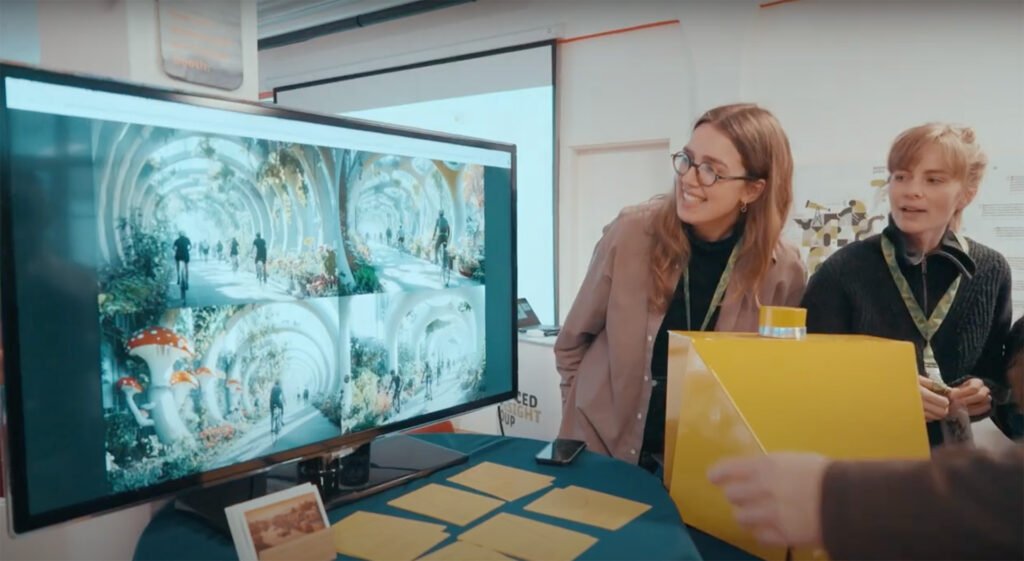
At a joint networking event, we had the opportunity to talk with Dodo Vögler, co-founder of Ellery Studio. In the interview, she explains how the Future Booth came about. It is an interactive, strategic tool for change management, innovation processes and strategic foresight that makes future scenarios visible and tangible. With the Future Booth, the future is not just imagined but communicated – for strategically smart, transparent and effective change.
Dear Dodo, at the evening full of future – as impressively documented in the Advanced Foresight Group’s recap – your Future Booth was used in the group work. While the teams worked on their missions, their visions of the future came to life in impressive images. Whether life in underwater worlds or survival in mountain landscapes.
Can you tell us how the interdisciplinary connection of design, technology and futures research led to the development of the Future Booth?
Dodo Vögler: Gladly! The idea for the Future Booth came about when we at Ellery Studio noticed that people find it hard to express their visions of the future concretely and visually. We wanted to develop a tool that translates abstract ideas into vivid, emotional images. The visualization was meant to emerge jointly through a process of interaction. So the Future Booth is an instrument.
What sets the Future Booth apart from conventional visualization tools – especially in terms of creative interactivity and the use of augmented reality?
Dodo: The Future Booth goes far beyond mere visualization. Depending on the chosen format, the interaction can be guided so that initial visual mood boards are generated. The interactive approach makes it possible to capture ideas in real time and turn them into dynamic, visual concepts. These images of the future serve as strategic orientation aids that take trends and market changes into account and make scenarios tangible.
What concrete applications do you see for the Future Booth in workshops and creative processes?
Dodo: The Future Booth serves as a visual catalyst in a wide variety of settings. We at Ellery Studio guide these interaction processes ourselves.
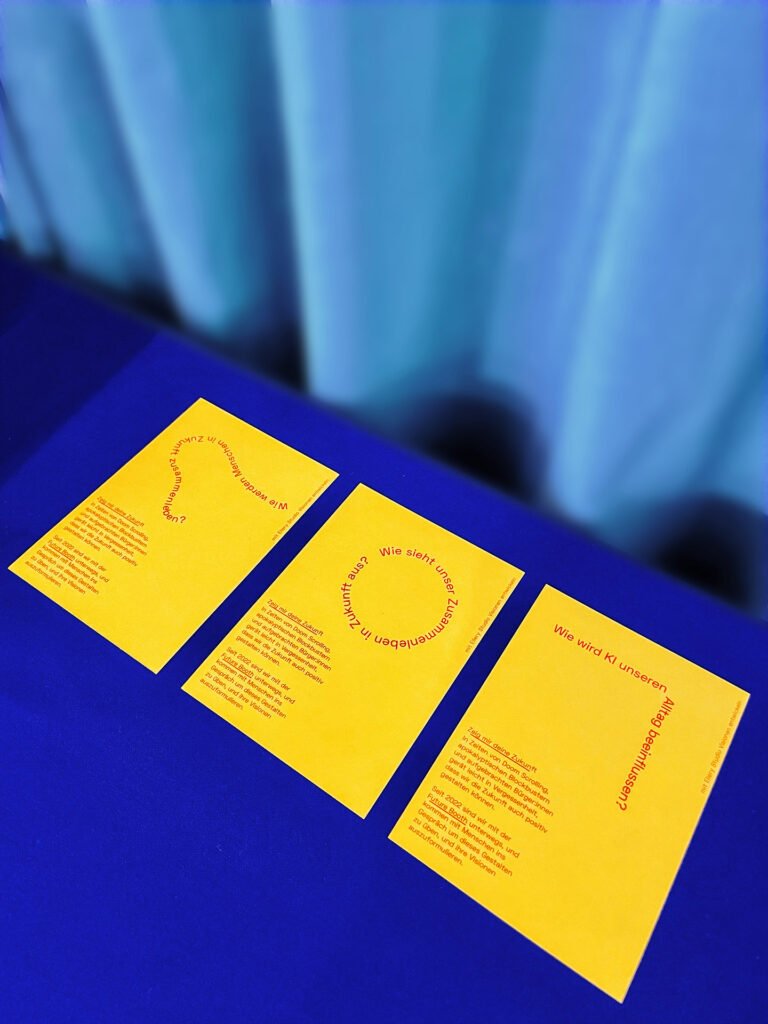
At events such as conferences and company celebrations, for example, we visualize one-on-one conversations live, so participants take their personal image of the future home as a lasting impulse. In workshops such as “Foresight 101,” we use the Future Booth and worldbuilding techniques to help teams develop clear and inspiring target visions.
Reflection is very important. By comparing “before/after” states and fleshing out scenarios, organizational visions become tangible.
To what extent does the use of futures research methods help the Future Booth not only convince technically but also make a cultural and strategic statement?
Dodo: Futures research methods are central to our work. Depending on the format, we use the process of guided interaction to support processes such as scenario planning and the visualization of futures through tangible trend landscapes.
These methods allow us to ground future developments so that uncertainties are also mapped and discussed in the process. We want to create friction.
Finally: how long did the development take, from the first prototype to the final product?
Dodo: Development spanned several years, during which both technical and design aspects were perfected through intensive testing and iterative improvements. The starting point was our participation in the Fridays for Future demonstrations in 2019, where analog graphic recordings were still created instead of AI visualizations. With the onset of the COVID-19 pandemic, the project moved into the digital space. AI visualizations have been used since 2023. The offering has since been expanded to include extended workshop formats – it is now Future Booth 4.0. There were setbacks along the way, but they were used as learning opportunities. At Ellery Studio, the focus is always on pooling the experience we’ve gained and putting it to effective use.
What further developments are you planning for the future?
Dodo: In the future, we plan to make greater use of moving images. Moving images make it possible to convey complex content in a vivid and emotionally engaging way, which increases the effectiveness of our communication strategies.
In addition, Ellery Studio aims to expand workshop formats that allow participants to engage more deeply with future developments. By applying Futures Literacy methods, executives and employees can strengthen their ability to anticipate future challenges and develop innovative solutions. Such workshops foster collective intelligence and increase the adaptability of organizations in a constantly changing environment.
More about Dodo Vögler and the Future Booth
Dodo Vögler is co-founder of Ellery Studio and head of its Foresight and Participation division, as well as co-initiator of the platform “zukunftsforscherin.de” and the “Speculative Futures: Berlin” forum. As an interim professor at HfG Schwäbisch Gmünd (2021–2024), she worked at the intersection of futures studies and shaping the future.
She has received several national and international awards for her work and initiatives, including the Young Scientist Award for Futures Studies, the Malofiej International Infographics Award, the dpa-infographic award, the European Design Award and the ADC Award.