
Method: what is the goal of CLA?
- Critical futures studies
Read moreCollapse


- Litany level: widespread (media) debates on future topics
The top, visible level of CLA is called the litany. In everyday language, the term “litany” is also used pejoratively for an endless list or monotonous chatter – so it refers to widespread, undifferentiated statements about the future (which not infrequently have a fear-mongering, dystopian character). - Systemic level: structural analyses of future topics
The second level, just below the water’s surface, deals with the systemic-structural level and sheds light on the social, economic, cultural and political causes. For anyone with a nuanced interest in a future topic, this level is easily accessible – through specialist literature and scientific findings. - Worldview level: the underlying worldviews of discourses
For the third level, you have to dive much deeper; it is about the deeply ingrained thought patterns and paradigms that shape our understanding of the world: “At this stage, one can explore how different discourses (the economic, the religious, the cultural, for example) do more than cause or mediate the issue but constitute it, how the discourse we use to understand is complicit in our framing of the issue”(Inayatullah, 1998, p. 820). - Myth and metaphor level: culturally anchored stories and images
Worldviews are reflected in myths and metaphors, which convey collective archetypes, unconscious stories and emotional images that shape our (gut) feelings about a given topic.


Application: Mars mission, de-extinction & appropriate technology – which images and myths did we deconstruct, and what were the critical thoughts?
As an introductory example for the CLA evening, we looked at the role of Musk’s tech visions and the idea that future humanity will spread to Mars.
- The litany here would be, for example, headlines about SpaceX rocket launches, plans for future Mars missions or statements by Musk himself about a “multiplanetary” humanity, but also the fear of our current planet being destroyed and the related threat to the foundations of our existence.
- On the structural level, one can look at the concentration on individual tech giants as central players in the tech industry and emerging tech oligopolies, as well as at government funding or influence in politics and business.
- At the worldview level, by contrast, we discussed the extent to which tech utopianism leads people to cling to the belief that technological progress will solve the pressing global problems – with technologies driven mainly by a few central actors rather than shaped collectively.
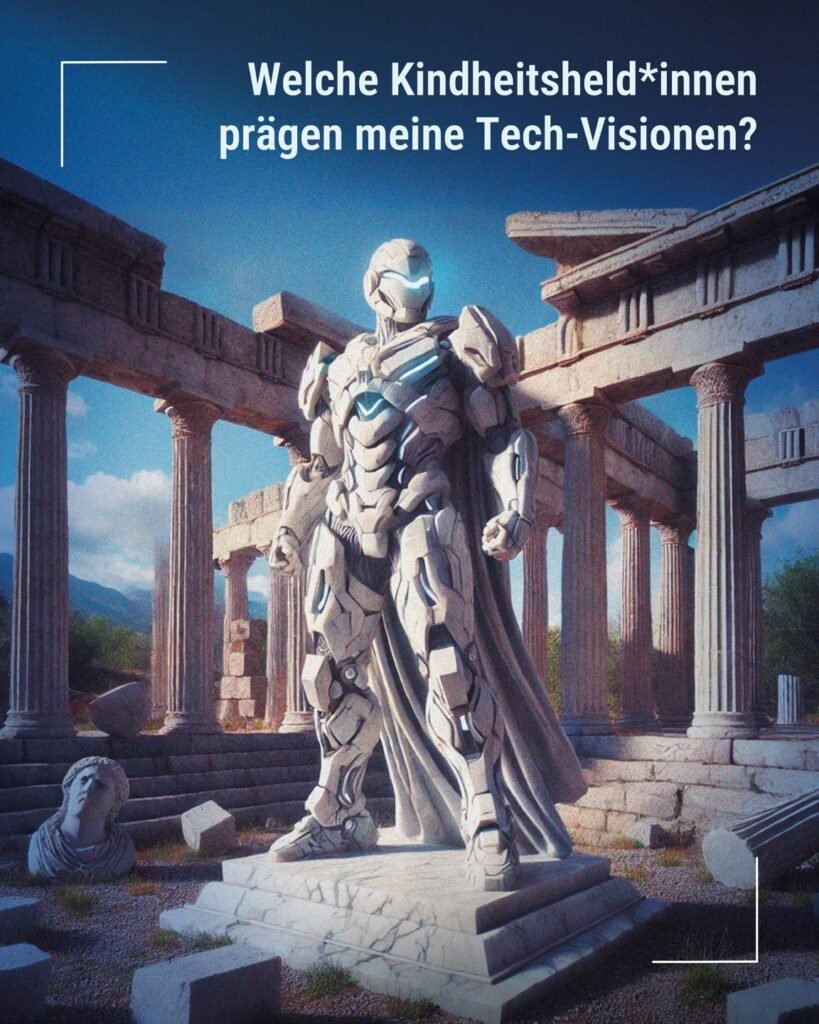
- Underlying this is the idea of the archetypal inventor genius, a heroic tech pioneer who saves humanity with brilliant innovations thanks to his willingness to take risks, his courage and his strong sense of mission – someone like the charismatic and brilliant Marvel hero Iron Man. Musk is sometimes compared to Tony Stark, not only because of his technological entrepreneurship but also because of his public image as an eccentric visionary.


CLA “De-extinction”
- Colossal’s core goal is not mere revival, but the restoration and strengthening of ecosystems. The litany would therefore include the threat to ecosystems and fear of the resulting consequences for humans. De-extinction is meant to save ecosystems with the help of genetic engineering.
- On the systemic level, scientific findings on ecosystems and keystone species were addressed, as well as the destructive effects of climate change on them.
- The worldview we identified is that science is able not only to understand ecosystems but also to repair them. Elements of transhumanism were also identified, and there was speculation about a possible hidden agenda.
- As underlying stories, we saw, among others, the Christian image of humans interfering with creation and playing God, but also the Matrix metaphor.
An exciting consideration during reconstruction was whether and to what extent tech visions change if the underlying story is instead based on the Gaia hypothesis, understanding the Earth (Gaia) as a self-regulating system. If you change the metaphor to “Mother Earth” who “has a fever,” it becomes questionable whether artificially reviving individual animal species can heal the system. The role of science shifted away from intervening in the self-regulating system toward better understanding, protecting and respecting our natural system.
CLA “Appropriate technology”
- One example we used was the open-source operating system Linux. Its litany is the demand that all users should have the freedom to use the system and to view, modify and share the source code.
- On the systemic level, we named the competitive struggles and market logic of big tech players as well as the principle of open-source licensing.
- The worldview thus seems to be strongly based on user sovereignty and collective ownership of knowledge/code – combined with a critical view of the power of large capitalist software vendors.
- We associated this with stories of dominant powers and rebellious countermovements (Empire vs. underground fighters). As a metaphorical image for open-source code as a decentralized, self-evolving construct of knowledge, the network of a fungal mycelium came up: a structure that branches out widely, takes on a life of its own and absorbs nutrients – or new knowledge – in many different places. As a pop-culture counterpart, the plant world of Avatar came to mind, where plants are connected by fine networks of fibers and function like a large decentralized neural network that holds knowledge everyone can share in.
In the reconstruction, we found it hard to come up with new images; interestingly, we could hardly think of a story without a power struggle as its central element. Nevertheless, an exciting debate emerged about modularity and the possibilities of systems existing in parallel.
Food for thought: the ocean around the iceberg as a fifth level?

The question of whether CLA could be expanded by another level, the ocean, sparked an exciting discussion: are there constant elements that run through everything? Like the ocean currents that carry and change the entire iceberg? Could there be – as on our globe – different interconnected oceans with their own dynamics, depending on the cultural sphere, for example?
Another exciting question was whether the iceberg metaphor itself imposes a certain logic of thinking that causes other questions to be overlooked.
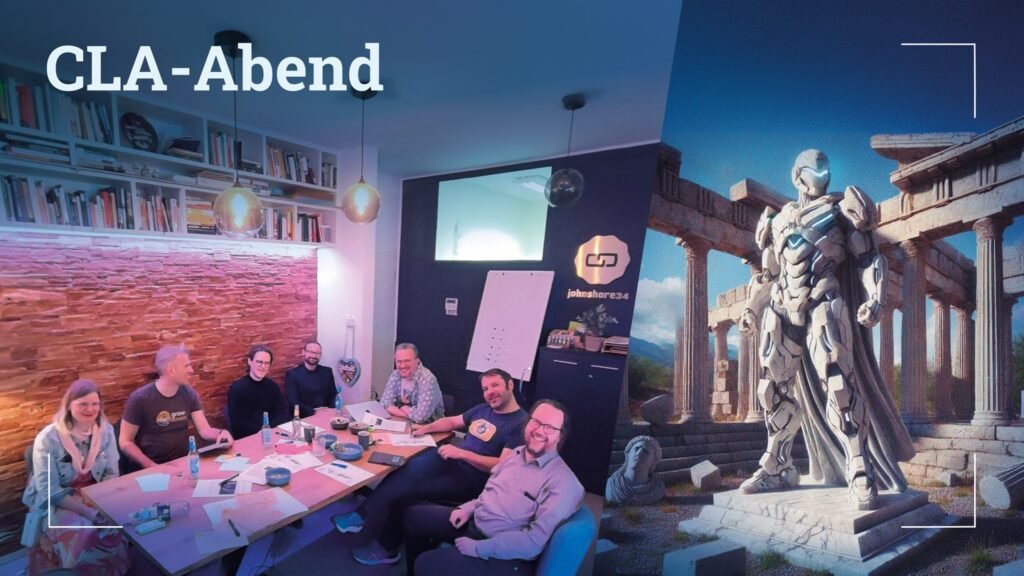
We would like to thank all participants of the CLA evening for the very stimulating exchange and the many critical ideas! In the end, the CLA evening impressively showed us how valuable it is to recognize hidden assumptions in our images of the future, thereby gaining completely new perspectives or uncovering blind spots in the form of perspectives that had not been considered.
This is where we at Schaltzeit come in: With a broad repertoire of approaches and methods, we support you in dealing with the uncertainties of the future and in developing innovative paths. Together with you, we find out which approaches and tools best fit your goals – just get in touch.
The accompanying CLA worksheet is available here for you to download free of charge.
And if you’d like to dive into more methods interactively, we look forward to welcoming you at one of our upcoming events: View events
Media report on the Mars mission:
- Inayatullah, S. (1990). Deconstructing and reconstructing the future: Predictive, cultural and critical epistemologies. Futures, 22(2), 115-141.