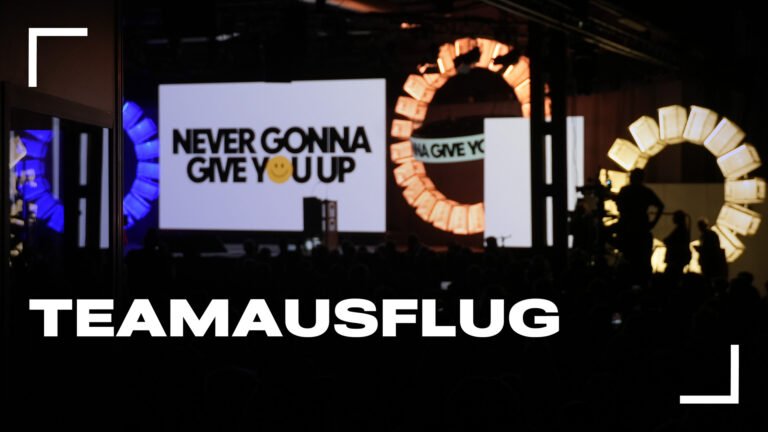

Schaltzeit spent the past three days in Nuremberg, where the innovation association Querkraft had called its members to its annual conference. The cross-cutting theme – a so-called “Querboot” – was digitalization. Nine working groups discussed within their fields how digitalization is having an impact, what changes can be expected in the future, and above all which steps each of us needs to take.
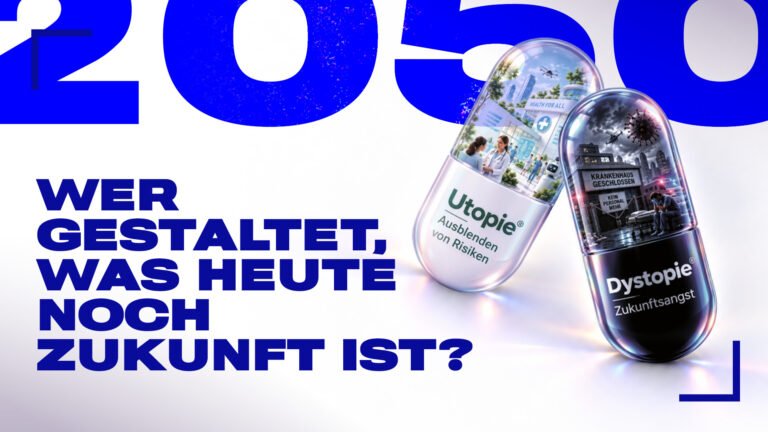
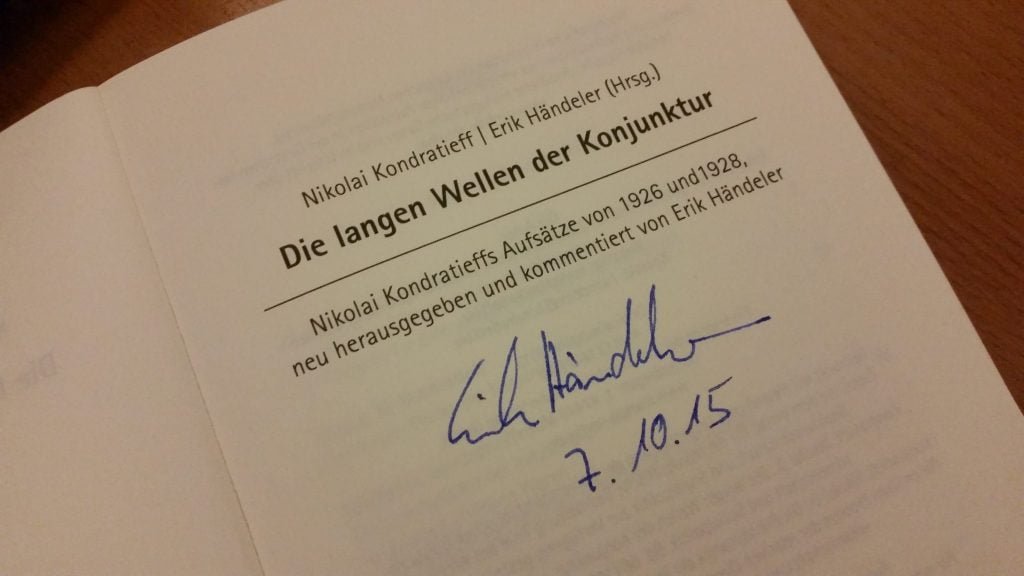
A particular highlight was the talk by Erik Händler. Born in Wuppertal, he ended up in the south of Germany as a futurist. His topic was the Kondratiev cycle and its so-called long waves. Fittingly, he calls his current book “Die Geschichte der Zukunft” (The History of the Future).
Here are a few insights from him and his talk:
- We humans only ever change when resources are scarce!
- Machines can take over many tasks, but not the most important ones.
- The era in which computers make us more productive is over!
- Our work will be to solve problems.
- That is why there is no limit to economic growth.
- In the future, much will revolve around intellectual work in conceptual space.
- Knowledge work and idea development will be the new, important fields of work.
- In the future, health will be the scarcest resource and also a limiting factor.
- The problem with mental work is that it isn’t linear in time, i.e., effectiveness does not necessarily correlate with time.
“The 5th Kondratiev,” digitalization, is nearing its end. This means there will once again be both upheaval and a crisis. This time, emerging economies won’t be able to help us through their economic growth as they did for our market in the first destabilization at the beginning of the 21st century. In the future, we can no longer afford “long chains of command” – the rethinking has to start now!
Above all, we need to focus on “knowledge work,” i.e., dealing with unstructured information, as well as on people’s physical and mental health. Let’s not reserve retirement (in the sense of freely allocable, funded time) for the old, but bring it forward in the form of sabbatical months along the way – as a break and a chance to find new energy and interests. In old age, people can keep working at a reduced level as far as their health allows, and important resources such as knowledge and long-built relationships are not abruptly lost upon retirement. This way, we will live more intensely. We will work with more fulfillment, be mentally more productive, and be able to truly savor our time even when we are younger.
Our challenges for the future:
- Invest more in education.
- A new, results-oriented culture of debate!
- Establish knowledge work as a discipline.
- Enable a work culture for knowledge work.
- Eliminate the bottleneck of knowledge classification.
Many heartfelt thanks to Luisa Salewski and the entire team who made this wonderful conference possible. By the way, if you ever take a look beneath Nuremberg, you’ll be amazed by the beer cellars. The tour gave me some astonishing insights. After all, if beer consumption back then exceeded 500 liters per citizen per year, how did anyone manage to collect taxes efficiently and do knowledge work? 😉 Find out for yourself and enjoy the tour. For me, another highlight of Nuremberg. Thank you!