
We want to protect the climate without giving anything up? At first glance, that’s a contradiction. Still, one small step anyone could take might be to make their nutrients available to other organisms. So how about donating your body to nature after your life is over? It’s clear that ethical convictions and beliefs clash here. But first, the facts. For several years now, there has been a trend toward natural burials. These natural burials are mostly characterized by doing without:
- Gravestone
- Treated wood for coffins
- Embalming
- Biodegradable clothing
- Urn or jewelry
- Cremated remains (as these are usually contaminated)
In Europe, these green burials are still largely unknown. Their drawback is that decomposition depends on soil conditions and proceeds very slowly. We’re talking about up to 30 years or more.
Since 2000, so-called burial forests have been established in Germany and Switzerland, where cremated remains are laid to rest. These forests are operated for 99 years but do not allow the body to be buried whole. The drawback of burying ashes is that they often contain heavy metal residues.
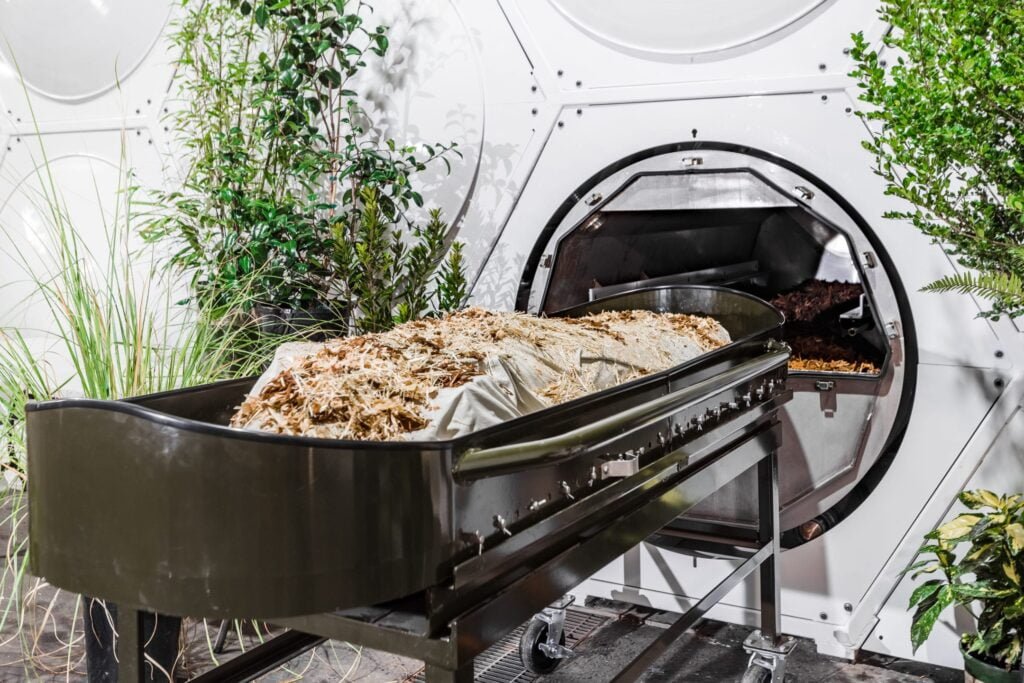
The company recompose.life takes a completely different approach. It wants to “compost” people and hand the soil over to their families. This transformation from corpse to compost is thus accelerated. Instead of a Schaltzeit (literally: “switching time”) of 360 months, 30 days are now enough. Prof. Wescott of Texas State University studies the compostability of human bodies. He says: “As long as you have good bacterial activity, you can decompose in probably a month.”
First, the body is prepared as in a crematorium. The company relies on vessels in which the body is broken down into soil within 30 days. In the process, the body is placed on a cradle and surrounded by alfalfa, straw and wood chips. Inside the vessel, decomposition is then stimulated by thermophilic, heat-loving bacteria. Pathogens are destroyed as well, since the bacteria operate at 55 °C (131 °F).
The founders themselves want to act according to the cradle-to-cradle principle. Why should we burn organic material when it could allow other organisms to feed on it? This saves between 0.84 and 1.4 metric tons of CO₂. In Germany alone, around 985,000 people die each year. That adds up to an enormous potential for CO₂ savings.
What’s more, the result is compost that can be returned to nature. That’s why the first location in Kent, Washington, was called a greenhouse. Anyone who wishes can take the soil home. With up to 1 m³ of compost per person, it may be wise to donate the soil and keep a small memento.
Of course, the shift to cradle-to-cradle principles runs up against not only our personal opinions but also our religious denominations. The Catholic Church, for example, stresses that it rejects participation in burials of Catholics in burial forests, because a nature-religion creed contradicts the Christian belief in resurrection and eternal life. In other words, people cannot be part of a cycle after death. Still, accompaniment by a member of the clergy is already permitted.
What would you choose? Pro environment? Or pro tradition?
—–
Further links on the topic:
Recompose — Ecological Death Care
Human Composting Could Soon Be Legal in Colorado – The New York Times (nytimes.com)
Klimafreundliche Bestattung: Körper zu Kompost | heise online
How do you compost a human body – and why would you? – BBC News
Katrina Spade (@KatrinaSpade) / Twitter
Human Composting Could Soon Be Legal in Colorado – The New York Times (nytimes.com)