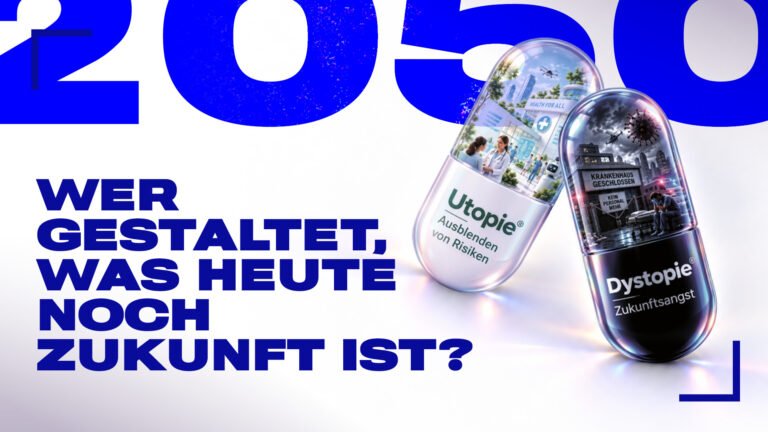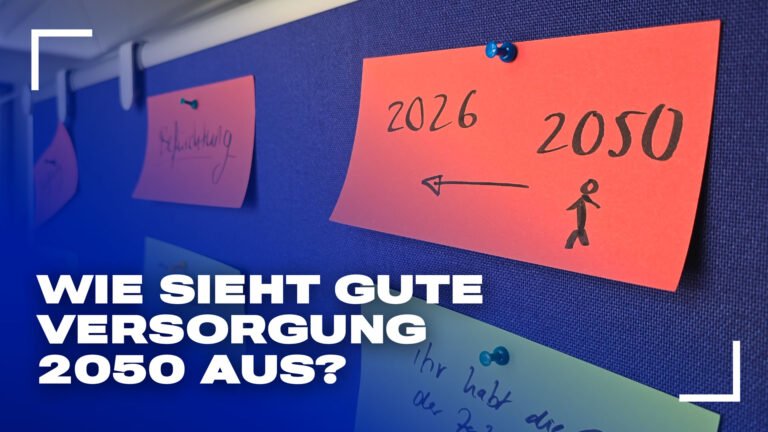

At the 2nd Futures Studies Symposium, I had the opportunity to design and facilitate a workshop on artificial intuition on behalf of Schaltzeit. One question that mattered most to me was what role our natural intuition plays in decision-making. When do we rely on analytical solutions, when can intuitive decisions be the better option – and which of these processes would we like to hand over to an AI?
Part of the challenge with these questions is that we neither know which influences interact in our heads when we make decisions, nor can we trace in detail which mechanisms mesh in the engine room of an AI.
The workshop concept is therefore inspired by the principle of a black box, in which the processing remains in the dark and only the input (question & information base) and the output (possible solutions) are known: The actual recipe for intuition is hidden inside the black box. The workshop provides a framework for jointly discussing the presumed components of the black box and, building on that, formulating requirements for AI-based decision-making processes in organizations.


Artificial intelligence and human intuition: How can companies design decision-making processes with these components? Is artificial intuition possible, and if so, what do we require of it? The BLACK BOX workshop concept provides a framework for working through these questions interactively.
In organizational decision-making, AI analyses and intuitive expert decisions are increasingly combined to achieve the best possible results efficiently. This raises the question of the different qualities of human and artificial intelligence and how they interact.
Today, AI takes on many decision-making tasks that used to be assigned to humans. This shifting division of labor between humans and AI, which many organizations are currently going through, is where the BLACK BOX workshop concept comes in: in an interactive reflection, participants explore for their specific decision area what role artificial intelligence and human intuition should play in the decision-making process and which requirements apply.
Discussing these processes consciously also makes it possible to recognize the weaknesses, one-sidedness, and biases that previous decisions based on human intuition were subject to. This creates an opportunity to overcome them instead of unconsciously transferring them to AI models and multiplying them.


When and why is our BLACK BOX workshop useful?
Intuitive expert assessments are made above all when problems are ambiguous and poorly defined and the underlying information is heterogeneous and complex. But what happens when these assessments are to be handed over to an AI?
The concept of intuition has fascinated management and psychology scholars for decades. They have defined intuition as a fast, non-logical, and complex decision-making process. Whether experts’ intuitive decisions are relied on depends on the type of task, the available data, and the nature of the problem area:

- For problems that lend themselves to analytical solutions, analytical decision-making may work best.

- However, when problems are ambiguous and poorly defined, intuitive decision-making may well be the better option
AI has long since surpassed humans at analysis in terms of efficiency, speed, and accuracy: not only can it analyze huge amounts of data, but (with more data) AI systems can also learn and improve decision-making. So far, however, this applies mainly when the AI can draw on an environment in which sufficient historical data is available.
But how often is that the case in everyday reality? What happens when the data is ambiguous? When tasks are left open? When there are no precedents to rely on? In these situations, the results of an AI are uncertain, too. Incomplete definitions distort the result so that decisions look like random products of confusingly assembled scraps of information.
The results of AI analyses and predictive decision-making behave much like human intuition:

- In environments with enough historical data to predict future outcomes, AI is well suited to predictive decisions

- In uncertain environments (especially when there is no precedent to rely on), AI results are uncertain as well and unfavorably distorted by random overlaps in the data
The more decisions in organizations are made on the basis of AI, the more often the question arises as to which key parameters must become conditions in order to reach good decisions even when tasks are uncertain and incomplete. To decide which parameters an artificial intuition has to process, we first need to reflect on which values matter in intuitive decisions when we humans make them. How does intuition arise from our perception, our memory, and our emotional perspective? And which of these could or should be parameterized and transferred to an artificial intelligence?


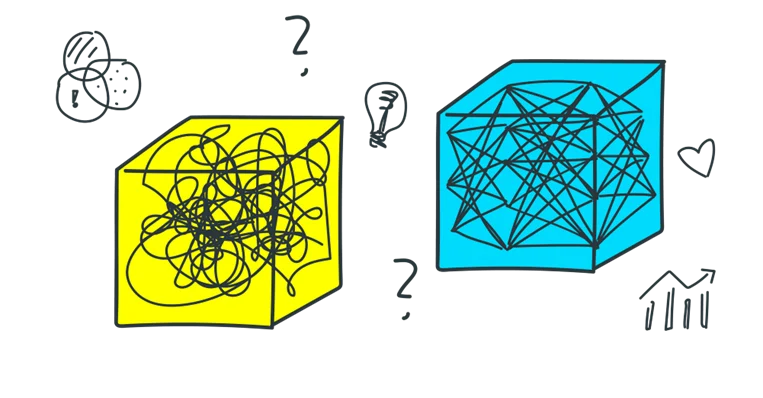
Figuratively speaking, we can therefore imagine the human, intuition-driven decision-making process as a not fully known tangle of information and interlocking processes. For our assessments, we can observe influences and results. We can draw conclusions. But how the processing of information interlocks remains in the dark.
Within this tangle, we in turn try to identify aspects that seem particularly striking and relevant to us. I designed the BLACK BOX workshop concept so that an organization can unravel this tangle together.


The principle of a black box describes processes with input and output in which the processing remains in the dark.
In the workshop, a decision-making process is divided into three different processes:

INPUT: What information do I have available, and what can I factor into the decision-making process? In what context am I working on the question, and under what circumstances was it brought to me?
PROCESSING: What personal perspective, emotions, and personal connections do I have to the topic? How do they interact with the input information?
OUTPUT: How does this come together into a result? Which considerations and perspectives may need to be added? Which (unconscious) influence should I reflect on and remove as far as possible?
Since the workshop concept focuses on transferring intuitive human decisions to the remit of an AI, there are two black boxes whose input, process, and output are discussed: the human mind and the engine room of the AI.
In the workshop, participants look, on the one hand, at the information, guidelines, and methods that have shaped previous human decisions and assessments. On the other hand, they examine the parameters the AI evaluates and its mechanisms. This makes it possible to identify characteristic parameters of the different decision-making processes in order to jointly:
- reflect on how decision-making processes change as soon as they are handed over to an AI, and
- define which requirements an AI must meet when it is entrusted with the corresponding tasks.
In the BLACK BOX workshop at the 2nd Futures Studies Symposium, the example topic was developing a new concept for a sustainable and fair reform of the pension system.
The workshop participants were divided into two groups. In a short time, Group A spontaneously – and therefore necessarily intuitively – developed a proposed solution for reforming the pension system. Group B took on the role of an AI for this task and was therefore bound to measurable quantitative factors and data when developing solutions. The resulting approaches were collected on a three-dimensional black box in the workshop room and clustered on its back under “OUTPUT.”

One half of the black box represented the AI, the other the brain and human intuition. On the front of the box, the information needed for each way of working on the topic was noted under INPUT.
The next step addressed the question of what is inside the BLACK BOX. Group A collected emotional connections, experiences, their own knowledge of the topic, and other personal influencing factors as well as methods they used.

Group B, by contrast, collected parameters and mechanisms that show how they would approach the topic as an AI – for example, which distortions arise from translation errors in training data, how parameters are generated from data sets, and how satisfaction in old age could even be expressed in numbers as a yardstick for a good pension system.

The results were then presented. Participants assessed which aspects are important and meaningful for a decision-making process. Building on this, they discussed
- which parameters the AI must take into account in its analyses,
- which things cannot be expressed quantitatively and should continue to be handled by humans
- and which other decisions would be better handed over to an AI
Finally, each participant was asked to picture their own fictional artificial intuition and to formulate their requirements for an “intuitive” AI in a statement.

RESULTS
The workshop sparked many interesting discussions, from hidden biases and the balance of analytical and intuitive elements in decision-making to the philosophy of free will.
My personal highlights from our discussion:
- An AI looks for patterns in the data available to it and uses them as the basis for its decision-making – so isn’t what we understand by AI today much more an artificial “intuition” than a so-called artificial “intelligence” anyway?
After all, AI can only decide on the basis of the data it has already received. Its decisions are a remix of its input – but is that any different for us humans? - An AI improves its decision-making iteratively, while humans have the self-confidence to be convinced by their very first decision – isn’t that rather arrogant and untenable?
- Exhaustiveness: Do we have to come to terms with the idea that we can no longer transparently trace the countless components of an AI’s decision-making in their entirety – just as with human intuition?
- Is artificial intuition the better intuition because it can base its decisions on an unimaginable number of experiences and diverse perspectives? – compared to human intuition, with its limited horizon of experience and knowledge.
Thanks to all participants for the exciting exchange.
Special thanks go to Sebastian Denef for bringing an AI developer’s perspective to our discussion and to Nilofar for her support as workshop assistant.
References/sources
Bassett, D. S., Sporns, O. ( Network neuroscience. Nature neuroscience, 20(3), 353 364.
Weh, L., & Soetebeer, M. (2021). KI-Ethik und Neuroethik fördern relationalen KI-Diskurs. In Arbeitswelt und KI 2030 (pp. 51-59). Springer Gabler, Wiesbaden.
Sloman, A. (1971). Interactions between philosophy and artificial intelligence: The role of intuition and non-logical reasoning in intelligence. Artificial intelligence, 2(3-4), 209-225.
Vincent, V. U. (2021). Integrating intuition and artificial intelligence in organizational decision-making. Business Horizons, 64(4), 425-438.