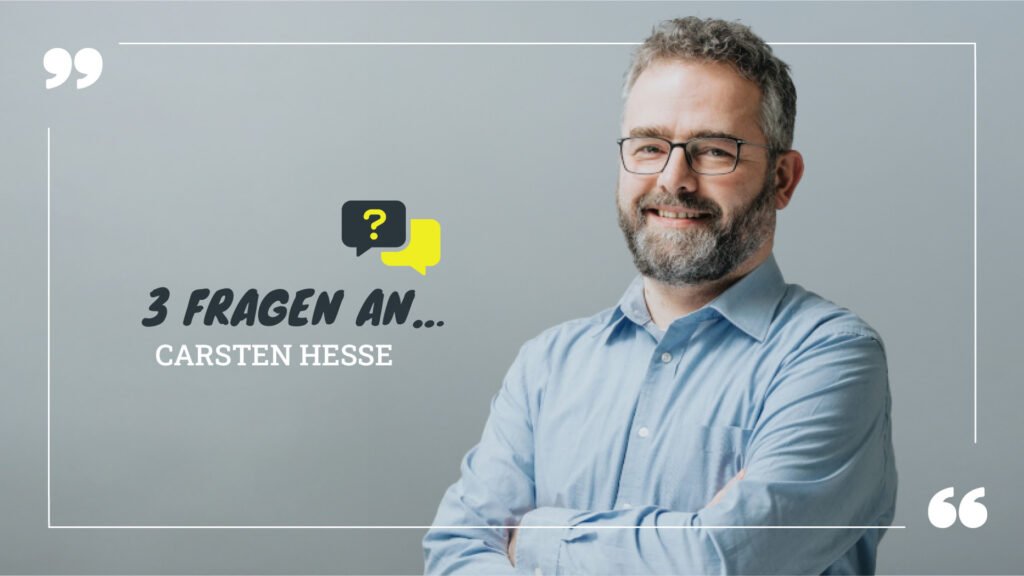

Transformations are usually not a technological question but a cultural one. You can embrace change, or you can reject it. Which path you take depends on the experiences you've had with change in the past, the influences you've inherited from previous generations, and whether you have any idea of where you want to go in the first place. And those ideas alone are the result of many external influences and your own reflections. As a social scientist, Carsten looks at this from a perspective that puts social interactions between people at the center.
Why is change a challenge?
Carsten: Change is a particular challenge because it meets resistance. This is mainly because change is not just a technical question but above all a cultural one. Technologically, we often already have the solutions, but accepting and implementing them requires a profound shift in mindsets and habits.
Many people aren't willing to go along with change. This also has to do with the experiences they have had with change in the past. People often feel comfortable in the world they have built over the course of their lives and don't want to give up this familiar environment. Change means uncertainty and can threaten their sense of security and stability.
That's why change is usually only accepted when something “pinches” – in other words, when there is noticeable pressure. It doesn't matter whether this pressure comes from outside, for instance from external circumstances, or from within, from one's own experience. People tend to choose the easiest path for them, the one that requires the least cognitive effort. Change, however, often demands exactly the opposite: effort, rethinking, and leaving familiar paths.
For all these reasons, change often meets resistance, because it demands not only technical adjustments but above all a cultural and personal willingness to transform.
How do you perceive change in your region, Central Germany, which is going through its first transformation in recent decades?
Carsten: In Central Germany, we are currently experiencing a profound transformation that confronts us with immense challenges. Our economy has to change fundamentally for ecological reasons, while demographic trends are having a negative impact on the structure of the region. Demographic data forecast major changes that actually call for adaptation and transformation. Yet the population does not always accept these necessary changes.
Many people in the region are not yet ready to embrace these changes, even though they are indispensable for sustainable, future-proof development. The key is therefore to reach a so-called critical mass, at which change is carried not by a minority but by the majority. The article “The Pareto effect in tipping social networks: from minority to majority” describes this critical mass as being around 25 percent. From that point on, more and more people adopt the new behaviors and attitudes. And this also applies to other forms of organization, such as companies.
To accelerate this change in Central Germany, it is important to connect people in a targeted way and to address each target group directly rather than talking down to them. Only then can this critical mass be reached faster and the transformation be shaped successfully. Overall, it's clear that while we as a region face major challenges, a conscious, strategic approach will allow us to make the necessary changes.
Where does this resistance to change come from?
Carsten: Resistance to change has deep-rooted causes that go far beyond the present. Our norms, values, and behaviors shape us profoundly and are passed down over generations – from our parents and even our ancestors. A fascinating example is the so-called Limes effect: although the Roman Limes existed more than 1,000 years ago, it still influences the psyche of people in the affected areas today. Where people's ancestors lived on the Roman side and Roman structures were established, people are on the whole more satisfied and healthier.
These historical and cultural imprints play an important role when it comes to resistance to change. It's not only about where we want to go, but also about where we come from and how we – like our parents – dealt with past changes. In our region, for example, many people went through adolescence during the period of reunification, a phase of life in which young people normally get guidance from their parents. Yet during reunification, these very parents were often disoriented themselves, absent, or still finding their own footing.
Against this background, it is especially exciting to explore how this generation perceives the changes needed today. It is just as important to find out which structures and measures are needed to make the change a positive and sustainable experience for everyone involved. Only if we understand these deep-rooted influences can we overcome resistance and successfully shape the future.
Many thanks to Carsten for his insightful thoughts!
- More about the work of Carsten and Zukunft [X]: Preparing for tomorrow
- Follow Carsten on LinkedIn: View LinkedIn profile