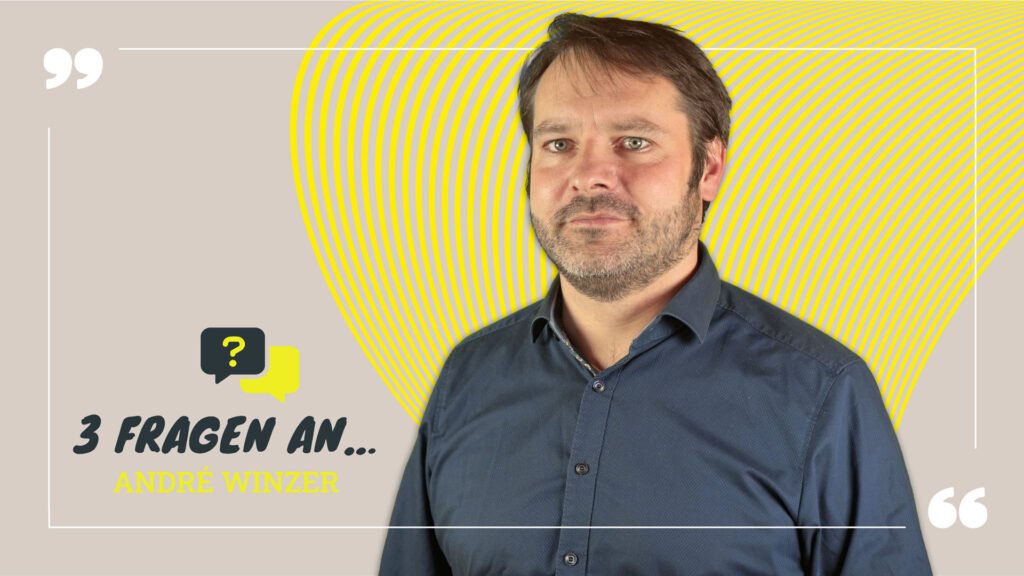

In our “3 questions for…” section, we regularly interview experts on topics that will have a lasting impact on the future of organizations and society. From software development and artificial intelligence to strategic foresight and attitudes toward the future, sustainability, and dealing with fears about the future — we shed light on the trends and developments that help us think and act in a future-oriented way.
Since COVID, Schaltzeit CEO André Winzer has felt a strong need to bring people together in person again and enable them to work together. Mutual perception is a crucial aspect of this. At a time when efficiency often crowds out the interpersonal, the space for curiosity, learning and self-discovery is often lost – elements that, in his view, should be fostered regularly.
In this interview, he talks about how disruptions in professional and social contexts can serve both as challenges and as opportunities for self-reflection and adaptation – and how organizations deliberately use them to trigger change and influence employee behavior.
How did you come to the topic of “disruptions”?
André: Even during my mediation training, I always found “dealing with disruptions” very interesting. They reveal something. They show us a vulnerability within ourselves. This depends on
- where the disruption comes from,
- who voices the disruption,
- what purpose you suspect behind the disruption,
- where and how I feel the disruption,
- how chains of argument are built.
As interventions, disruptions can shift the focus. They draw attention. They also point to something that is deeply not right within ourselves. It’s the search for a point of entry. They can exist consciously or unconsciously.
At work or when facilitating, we learn to deal with disruptions – to partly bring them into the open, or to use ground rules so as not to lose control. That works because we set the framework ourselves. But when we are inside an organization, we are part of a social system. We are standing on the game board, and it’s hard for us to step away. That is the moment when we are vulnerable to manipulation techniques – if we haven’t firmly anchored our conscious actions.
What does the game board mean?
André: I am a game piece or a persona. Interacting with others creates both opportunities and risks. It’s important that communication and awareness are present in everyone. If I always align my behavior only with external conditions, I become controlled by others. “The Power of Nice” works when we foster prosocial systems, put these values at the top and hold on to them in times of crisis – like a core belief. If we don’t, we may adapt faster, but we lose future options and a sense of optimism about the future. And that is exactly what drives our motivation.
When we react like rabbits, we act instinctively and follow our flight reflex toward a supposedly safe haven. In times of crisis, this behavior leads shareholders to focus more heavily on key figures. Hans Rusinek wrote, on the subject of „The Power Of Nice“ , that there is still a strong contradiction. No one wants to wait; results have to be delivered. That’s why prosocial CEOs are often replaced in bad times.
Why do organizations deliberately use disruptions, and what does that mean for me?
André: Organizations keep trying to optimize their structures. A restructuring makes the team realign itself, question its own future prospects and grapple with the topic of transformation. Organizations deliberately use disruptions to encourage adaptive behavior. You can see this right now in the automotive industry in particular. Employees repeat like a mantra that as an organization they have “grown too fat,” that it’s time for a “haircut,” or they use mantras like “Cut2Grow” to get back to the top.
The noise is faster than the signal – this also means that processing information causes disruptions, because my brain tries to combine everything. It’s about reducing the information noise and focusing, so that you can then deliberately amplify the signals that matter.
I always have to engage with myself. I need a purpose and my own playing field. I have to act consciously. If my room to move is restricted, I have to defend this playing field, shift it or open up a new one. In other words, “Nice Guys Finish Last” should never be taken for granted – or, as we futurists say, accepted as a ‘given.’ Rather, the term ‘nice guys’ should be broadened. Perhaps in the future we’ll talk about ‘nice colleagues’ and add: Proactive, nice colleagues set and adjust their finish lines according to their own rules.
Thank you for the food for thought, André!
- Event recommendation
Workshop: Organizational development: Recognizing disruptive signals, creating clarity
- When: November 12, 2025, from 6:00 pm
- Where: Schaltzeit GmbH, John-Schehr-Str. 34, 10407 Berlin
- Speakers: Julia Gnatzy & André Winzer
- Size: 5–8 participants
Schaltzeit wants to encourage a shared exchange on the topic of “disruptions.” André Winzer invites everyone interested to a joint mini-workshop where knowledge and experiences are shared and curiosity is sparked, so that everyone takes an active part in the exchange. In our workshop, we will look for answers to questions including the following:
- When do I adapt? And why?
- What kinds of disruptions have you encountered?
- How do you protect yourself from third-party interventions?
- What core beliefs help you perceive disruptions and give them dedicated space?
- Which disruptions have you used deliberately?
- How do you deal with the fact that a lack of information always makes you vulnerable to disruption?
- How do you create clarity? How do you foster a prosocial sense of community?
- How do you take care of your awareness and your actions?
Sign up – we look forward to seeing you! The event is free of charge, but anyone who wishes is welcome to make a voluntary contribution to support it.