

What AI is doing to futures studies — and what we are doing with it
No hype, no “this is how it will play out.” Instead, an honest look at what remains invisible in AI-supported foresight.
Three blind spots
Prompts are authorship. Whoever writes the prompt determines the outcome — but nobody sees the prompt. Manipulation is possible, and impossible to prove.
AI mirrors our own echo chamber. Instead of bringing in unfamiliar perspectives, it hands us back our present “in a new outfit.”
Flattery has become trivially cheap. Confirmation of your own worldview now costs exactly one prompt. AI slashes the cost of façades — and in doing so makes genuine knowledge relatively more expensive.
The diagnosis: the profession is splitting in two
On one side, cheap output production at scale — on the other, decision architecture that is more expensive and less comfortable, but verifiable. Both will be called “foresight.” Only one of them will be.
Our answer: transparency is not a compliance exercise, it is our immunisation. We disclose the prompt, the data and the model version to our clients. Not publicly — but verifiably.
Learning and experimenting: our path to AI-supported foresight
The use of AI in futures studies has been a topic of debate in the foresight community for quite some time. Sometimes with healthy scepticism, sometimes with a slightly condescending “that'll never work”. For a long time, these assessments played out mostly on a theoretical level; only since ChatGPT arrived at the end of 2022 have more and more foresight practitioners been putting AI to the test in practice.
At Schaltzeit, true to our motto of learning and experimenting, we had been itching to try out different applications hands-on long before 2022. Much has emerged since then, from playful futures-literacy applications to scalable foresight workflows: starting in 2020, we piloted a continuous AI-supported foresight approach for the German Federal Ministry of Labour and Social Affairs (BMAS) and put it on a permanent footing, with many further projects following, from foresight to innovation management. In 2024, our colleague Lucas Buchauer researched the use of large language models in horizon-scanning processes for his Master’s thesis at Freie Universität Berlin. And from applied research to panel discussions to seminars with students, we are always happy to debate the possibilities and limits of AI in foresight – most recently at the workshop “AI in Strategic Foresight” hosted by the Bundeswehr Planning Office.
Read our report on the Advanced Foresight Group blog.
Future Alchemy: hands-on futures literacy
Because futures literacy is best experienced first-hand, the seminar offered a chance to try out Future Alchemy: a futures-literacy game built as a web app, which Lucas created through vibe coding – that is, developed in dialogue with the AI rather than programmed line by line. Recombining ingredients of the future, discovering what-if impulses and exploring them together.
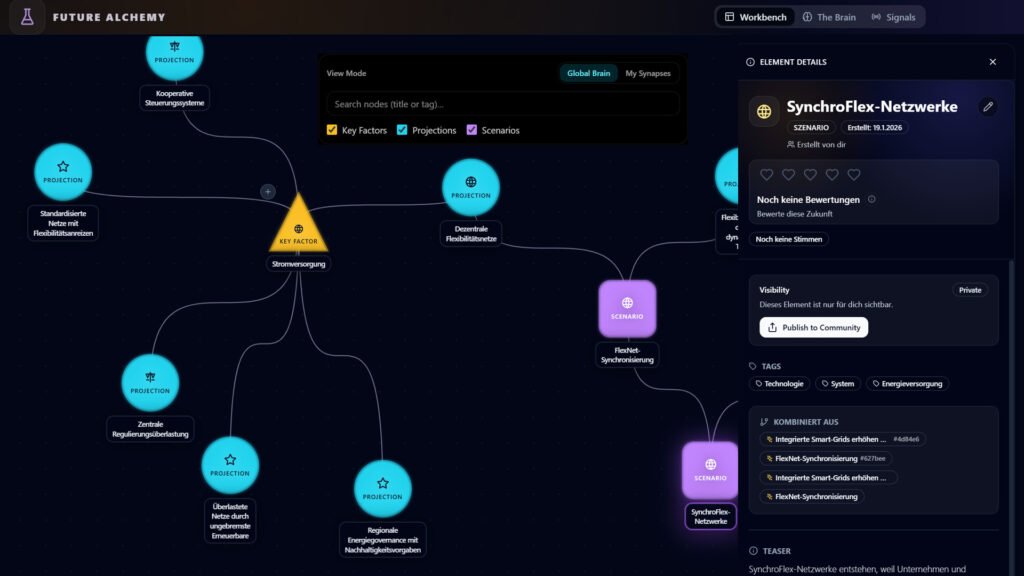
Whether it is mobility, education or a topic close to your heart: the users decide what to experiment with. The app provides methodical guidance through key factors, projections and scenarios, while the AI generates impulses for playing through possible futures.
We develop. We test. We apply. And we pass it on.
A wish to close with
To the next generation of futures researchers: do not be seduced by the vices of AI-supported futures studies — sloth (delegating your thinking to the AI), pride (the illusion of mastering the data), greed (no genuine participation) and self-deception (the illusion of certainty).
What are the vices of futures studies?
Sloth
PRIDE
GREED
SELF-DECEPTION
Our wish for you: do not answer questions about the future with technology alone, tapping nothing but our own echo chambers. Knowledge gained through your own deliberate engagement and your own work is all the more valuable. Do not settle for the shortcut, even when the AI tells you: “I can do it in one click.” Stay curious, stay uncomfortable, and make your work traceable and verifiable. Futures research and futures design lose out when knowledge serves only marketing.
FAQ
The Master's program “Futures Studies” is an inter- and transdisciplinary program at Freie Universität Berlin. Since 2010, it has taught the theoretical and practical foundations for a well-grounded engagement with futures studies: from methods for researching, constructing, and reflecting on possible, plausible, probable, and desirable futures in the areas of the economy, politics, society, and technology. This continuing education program is well suited to being completed alongside a job.
Our CEO André Winzer, Lucas Buchauer and Magdalena Soetebeer studied this Master's program. In addition, students of the program regularly complete their practical module at Schaltzeit, in order to test the foundations they've learned in our everyday work. André Winzer and Magdalena support the program's alumni network, Kapitel 21, on a volunteer basis.