
PEACOQ addresses exactly that: data capture, data structuring, and the targeted consolidation of information — so that teams can…
- Cleanly capture and organize content (e.g. ideas, contributions, signals, profiles, resources),
- Understand and explore connections within data (e.g. patterns, clusters, developments),
- and actively consolidate data (e.g. from submissions, research, feedback, and external sources).
Depending on the project, the emphasis differs: sometimes more on governance and workflow (innovation, community), sometimes more on exploring and understanding (foresight, innovation), sometimes more on curating and merging (all three). More background on PEACOQ can be found at peacoq.net.
A Practical Example: Evaluation Logic in Innovation Competitions
We are currently using PEACOQ to support an innovation competition (T-Challenge), among other things. This clearly demonstrates what structured data spaces can achieve: during the evaluation phase, PEACOQ helps make contributions quickly visible, comparably classifiable, and decisions transparently prepared – especially when many experts, criteria, and perspectives are involved.
Important: This is just one use case. PEACOQ is not “the evaluation platform” but a toolkit for data-driven collaboration across different process logics.
Why Our Focus Has Shifted Strongly Toward AI
Over the past year, our PEACOQ focus has noticeably shifted toward AI — for two reasons:
- AI in development: We now use AI as a matter of course to iterate faster on development and conceptual work (e.g. in prototyping, writing, and structuring requirements).
- AI in the platform: At the same time, demand is growing to use AI directly within platform work — not as a “gimmick,” but as concrete support in data-rich processes.
PEACOQ is an ideal place for this: many projects fail at the point where data exists, but no one can find, contextualize, and connect it quickly enough.
Which AI Features We Have Already Implemented
In PEACOQ, we have already developed and implemented several AI-adjacent features, including:
- Content generation: Support for creating content (text, and in some cases images)
- Pre-screening: Initial sorting/evaluation of content to streamline reviews
- utomated capture & completion: Enriching data, closing gaps, making fields consistent
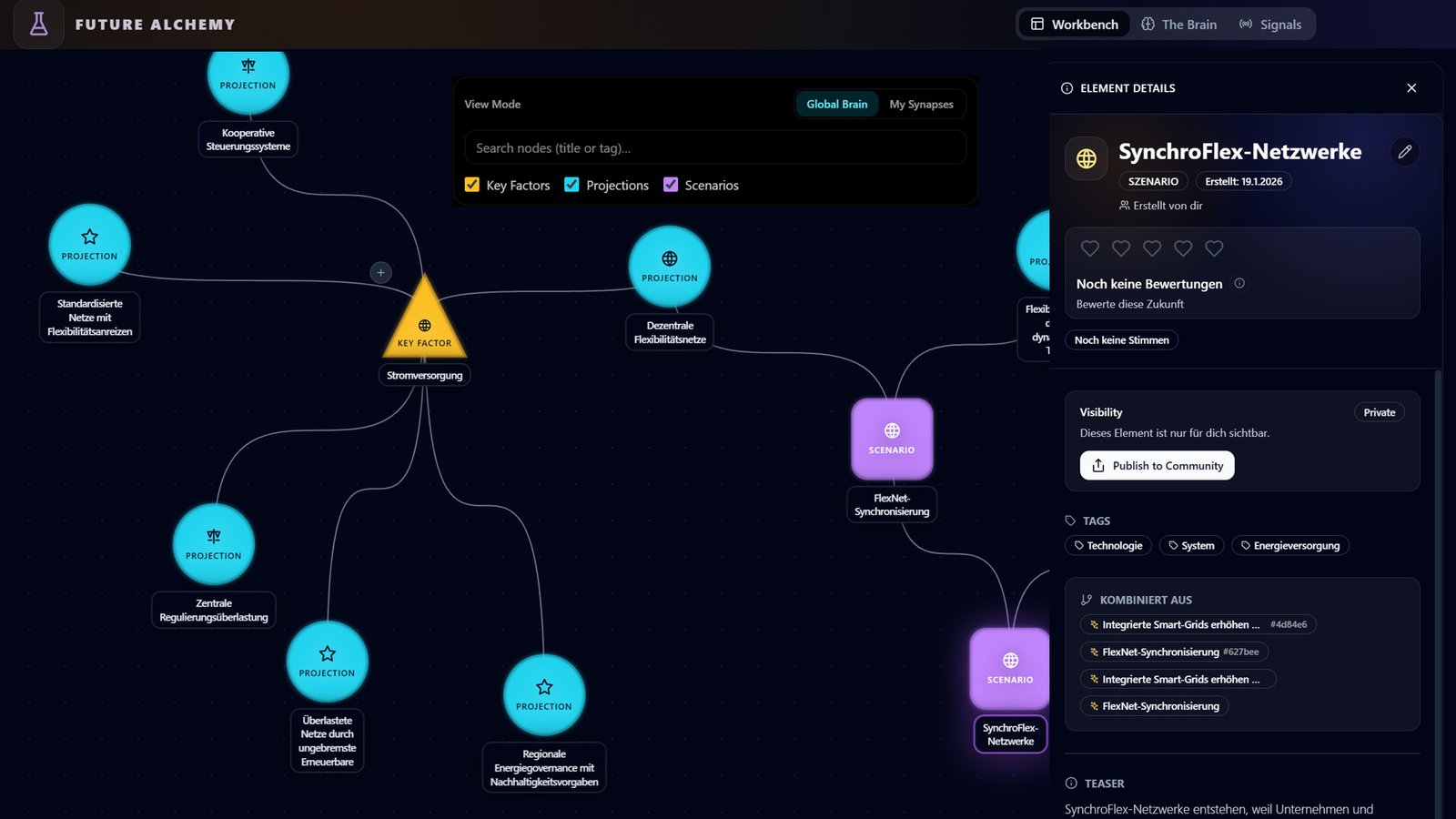
- Network graphs & connection suggestions: AI proposes relevant relationships between datasets (e.g. thematic proximity, similar actors, shared references) and makes them visible in network visualizations
The underlying goal is always the same: less friction in the workflow — more focus on content and decision-making.
The Next Big Step: AI Features Step by Step
We are currently integrating additional AI features step by step and expanding existing ones. A central new element is an AI chatbot being developed within an ongoing project.
More important to us than the chat as a feature is what it changes about how the platform is used: it shifts the interaction with data from “searching and clicking” to “asking, understanding, connecting.”
Instead of working through lists, filters, and individual datasets, users can enter into a direct dialogue with the data space — for example:
- What are the most important topics in this dataset right now?
- Which entries are connected — and around what?
- What has changed since the last update?
- Show me everything relevant to X and sort it by Y.
In short: data becomes addressable – and thus more accessible, especially in large, complex data spaces. At the same time, the structure is preserved: answers can be traced back to specific datasets, verified, and further processed as a team.
Second Development Track: PEACOQ as a Self-Configurable White-Label Solution
In parallel, we are advancing a development that could significantly transform our offering in the long run:
Until now, PEACOQ has been built primarily on a per-client basis: we develop setups tailored to the process, data logic, and user groups of each project. That remains important — but long-term, we want to develop PEACOQ as a configurable white-label solution.
The vision: clients can assemble their own system — depending on their needs, as an…
- Innovation management tool,
- Foresight suite,
- or community platform,
…without launching a full custom development each time.
This is a significant step — technically, conceptually, and in terms of how we collaborate with clients: it shifts from “we build something for you” to “you configure your suite — and we support you strategically, methodologically, and technically.”
What This Means for the Coming Months
This year, PEACOQ will be fundamentally rebuilt in several areas: modularization, AI integration, clear configuration logic.
We are right in the middle of the rebuild – and hope to share more concrete insights soon.
👩🏻💻 If you want to learn more about PEACOQ
Visit the PEACOQ website: peacoq.net
🖇️ If you want to find out where and how your organization can use AI
We support you in identifying meaningful use cases, clarifying risks and framework conditions, and setting up concrete next steps.