
30 Years of Global Futures Research – and a Call to Action
Strategic foresight thrives on collaboration across borders. At Schaltzeit we work in exchange with other think tanks and organize collaboration – regionally, nationally, at the European level, and internationally. Together with Cornelia Daheim, the founder of the German Node, we worked for the think tank of the Federal Ministry of Labour and Social Affairs (BMAS), alongside Foresight Solutions, Sudeco, and the IIT, under the leadership of Marc Bovenschulte.
The Millennium Project – A Global Think Tank for the Future
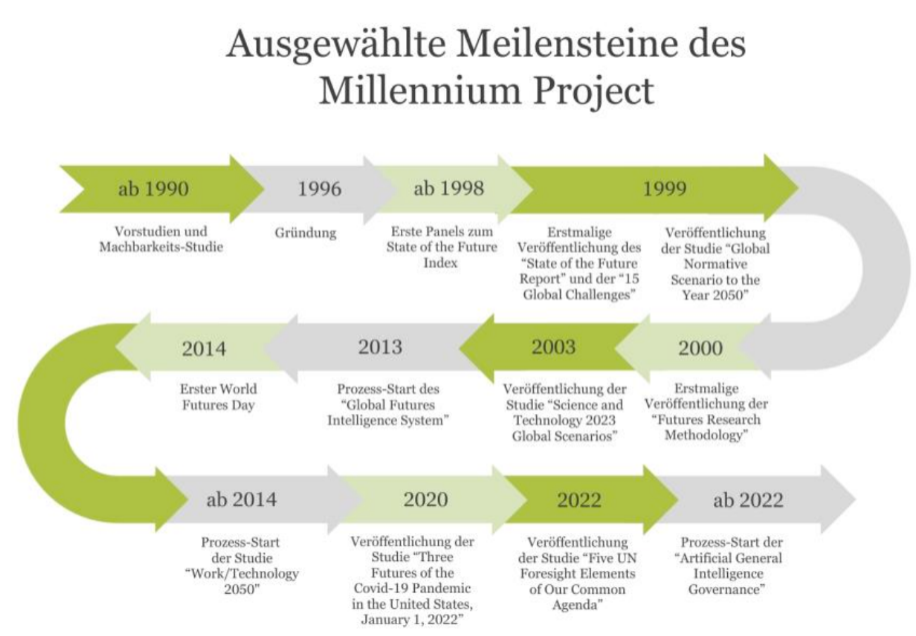
The Millennium Project is an international, participatory think tank founded in 1996 – following a feasibility study from 1992. It describes itself as a “trans-institution” that transcends traditional boundaries between academic, political, and private-sector structures: a platform where diverse perspectives are brought together.
The goal of the project is to gain well-founded insights into global trends and challenges through interdisciplinary exchange among futures experts from academia, politics, business, and civil society, and to offer decision-makers better options for action regarding the future. As a non-profit NGO, the Millennium Project has a worldwide network of so-called Nodes – currently over 70 hubs around the globe.
Since its founding, the Millennium Project has established innovative methods of futures research and published extensive works. Key activities include the annual “State of the Future” Reports and the accompanying State of the Future Index (SOFI). These publications compile international data, results from Real-Time Delphi surveys, and other research approaches to assess the state and future developments in areas such as education, health, environment, economy, and technology.
The 15 Global Challenges
What makes the Millennium Project distinctive is the openness of its network: anyone who wishes can join a Node and collaborate on the 15 Global Challenges. These challenges serve as the framework for analyzing the global condition. First defined in 1999, the 15 Challenges are:
- Sustainable Development and Climate Change: How can sustainable development be achieved for all while simultaneously combating climate change?
- Clean Water Without Conflict: How can it be ensured that all people have sufficient clean water without conflict?
- Balance Between Population Growth and Resources: How can population growth and resource demand be brought into balance?
- Democratization: How can authoritarian regimes be transformed into genuine democracies?
- Improved Global Foresight: How can decision-making processes in a rapidly changing world be improved through integrated foresight?
- Global IT Convergence: How can all people benefit from the global convergence of information and communication technologies?
- Ethical Focus in Market Economies: How can an ethical approach in market economies help narrow the gap between rich and poor?
- Health: How can the threat posed by new and re-emerging diseases and resistant microorganisms be reduced?
- Education and Learning: How can education help humanity become more intelligent and competent in addressing global challenges?
- Peace and Conflict: How can shared values and new security strategies reduce ethnic conflicts, terrorism, and the use of weapons of mass destruction?
- Empowerment of Women: How can the changing status of women contribute to improving living conditions?
- Transnational Organized Crime: How can transnational criminal networks be prevented from becoming powerful global actors?
- Rising Energy Demand: How can growing energy demand be met safely and efficiently?
- Scientific and Technological Innovations: How can breakthroughs be accelerated to improve humanity’s living conditions?
- Global Ethics: How can ethical considerations be routinely integrated into global decision-making?
State of the Future Report 20.0
In September 2024, the 20th edition of the “State of the Future” Report was published – over 500 pages providing a comprehensive overview of the current state and future prospects of the world. The report is based on 29 quantitative variables collected through international Real-Time Delphi surveys. The State of the Future Index (SOFI) 2035 provides a condensed picture of the global condition.
The report shows: despite global progress in many areas, significant risks remain – such as environmental destruction, growing social inequality, and technological challenges – which can only be addressed through international cooperation and forward-looking political decisions. A particular focus currently lies on the governance of Artificial General Intelligence (AGI) and its impact on the world of work.
The German Node of the Millennium Project
In Germany, the Millennium Project is represented by the German Node. Founded in 2003 by Cornelia Daheim (Future Impacts), the Node is now co-led with Clara Jöster-Morisse. It serves as a central link within the global network and represents the German perspective in international futures research.
“The need for international collaboration in Strategic Foresight remains undiminished due to multi-level or perma- and poly-crises. The Millennium Project therefore provides a roof under which members can advance projects and initiatives both globally and locally. It is up to all of us to find answers to the Global Challenges.”
Cornelia Daheim, Founder of the German Node
The German Node has made significant contributions to international futures research through numerous projects and promotes knowledge transfer between regional and global actors. The range spans from workshops and Delphi studies to publications and interdisciplinary collaborations.
Historical Milestones of the German Node
- 2003: Founding of the German Node (cooperation since 2001)
- 2004: Launch of the “Weak Signals Wiki” in collaboration with all MP Nodes
- 2005: Support of the European Foresight Conference
- 2007: Conducting the Impact of Technologies Survey
- 2009: Publication of the MP Nodes Survey & “Underrated Future Topics”
- 2011/2012: Creation of MP Nodes Profiles for all Nodes
- 2015/2016: Delphi project with students at FU Berlin on Future of Work & Cities
- 2016/2017: Publication of “Future of Work 2050” in German, English, and Korean
- 2017: Workshop “Future of Work 2050” at FU Berlin (Huddle Conference)
- 2018: Cooperation with FEN, the German Node, and FU Berlin: “Gaming in Foresight”
- 2019: Publication of scenarios on the Future of Work 2050
- 2020: Publication “COVID and the Future of Work” (in German)
- 2023/2024: Publication of “History of the MP” – a historical review of the Millennium Project’s development
Shaping the Future Together – A Call to Action
As a personal highlight, I would like to draw attention to the publication “History of the MP” as a historical retrospective, as well as the publication “COVID and the Future of Work,” which demonstrates how work can evolve with the support of digitalization. I see particular strengths of the German Node in the field of the future of work, which it can also contribute to shaping AGI governance.
However, 30 years of the Millennium Project are not only a reason to celebrate – they are also a mandate for all of us to not merely analyze the 15 Global Challenges but to actively address them: climate change, social inequality, technological disruptions through AI, conflicts, and resource scarcity – all of this demands that we do not just analyze, but act.
My appeal: Let us take the global challenges seriously – and address them in our daily actions. Whether as a company, an organization, or an individual: everyone can contribute to shaping the future. It helps to measure successes, to jointly develop scenarios and action steps, and to spread enthusiasm for shaping the future – without falling into dystopias. verfallen.
At Schaltzeit, we embrace this responsibility. We invite you to join us in addressing the global challenges – through exchange, dialogue, and action. Because the future belongs to those who actively shape it.
Let us use the next 30 years together.
Future Challenges for the Millennium Project
The Millennium Project itself faces challenges: it must find a balance between active work on substantive topics and the integration of younger generations. New formats must enable global exchange digitally as well. The Nodes should not only distribute information but more effectively contribute their local expertise to global strategies.
This also requires new tools – whether for global Real-Time Delphi surveys, for calculating the SOFI, or as a replacement for the Global Futures Intelligence System (GFIS), which was shut down in 2023. Participation and institutional anchoring must not decline but must increase.
- What is a Node?
A Node is a regional hub of the Millennium Project. Each Node represents the perspective of its country or region within the global network. Its tasks include:
- Representation and Communication: A Node brings regional perspectives into the global project and communicates findings to the local public.
- Contribution to Surveys and Expert Identification: Nodes participate in international surveys, Delphi processes, and the identification of experts.
- Public Outreach: Nodes inform about the project’s activities and publications, attracting further interested parties.
- Independent Project Implementation: A Node can initiate its own projects that address regional needs and potentials.
A Special Thank You
My special thanks go to Cornelia Daheim, who leads the German Node and, as a futures researcher, consistently advocates internationally for the relevance of Futures Literacy. Cornelia inspires so many young people to face the global challenges with good spirit and determination – that is invaluable for futures research and for all of us.
Related Links
- The Millennium Project: millennium-project.org
- Future Impacts (German Node): future-impacts.de/millenium-project
- German Node at MP: Germany Node
- State of the Future Report: State of the Future 20.0
- GFIS History: Global Futures Intelligence System
Sources